Showing posts with label brand stories. Show all posts

Monday, April 6, 2026

542. Brand Stories: TIKI-TIKI MANUEL ZAMORA, the Medicine Against the Malady of Beri-Beri

TIKI-TIKI MANUEL ZAMORA, Print Ad, 1937

One medicine that has a special place in our medical history is TIKI-TIKI, that was developed in 1909 by chemist-pharmacist MANUEL ZAMORA ,(1870–1929), of  Sta. Cruz, operating out of his laboratory/pharmacy on R. Hidalgo Street. It was formulated to cure infantile beriberi (“taun”, in Pilipino) , a deadly disease that plagued poorly-nourished Filipino children during the American colonial period, caused by Vitamin B1 deficiency.

TIKI-TIKI 'BOUNCING BABY', Print Ad, 1940

Made from rice bran extract, it became a crucial public health solution during the American colonial period. The brand name was derived from “tikitiki” a local term for   the rice bran from which the liquid medicine was extracted. The bran was a rich source of Vitamin B1 or Thiamine and it was Zamora who successfully extracted a stable version of it, producing it commercially, thus saving thousands of Filipino babies’ lives.

TESTIMONIAL AD 'Virginia Dela', Print Ad, 1953

Zamora made known TIKI-TIKI’s life-saving impact on Tiki-Tiku print ads that were circulated in dailies and magazines regularly: The TIKI-TIKI MANUEL ZAMORA extract is a medicine unequalled in quality  for the prevention and cure of Infantile Beri-Beri which is a dangerous disease of children…..Within the years that this famous TIKI-TIKI MANUEL ZAMORA has beEn discovered, countless mothers and children have been saved from early death”.

TIKI-TIKI 'Health Protection', Print Ad, 1958

The success of the ban prompted international pharmaceutical companies like Parke Davis  to make lucrative offers to Zamora to buy him out, but he refused to sell the rights to his formula, ensuring it remained accessible to Filipinos. Zamora eventually helped establish the Philippine Pharmaceutical Association.

UNITED AMERICAN TIKI-TIKI Print Ad, 1964

While originally a specialized medicine, TIKI-TIKI is now manufactured by Unilab as a children's multivitamin brand, originally under the name United American (Tiki-Tiki Drops and Syrup). It became well-known for its memorable jingle that was heard on he raio without fail, every day—“United American, United American, United American TIKI-TIKI ang bilhin!”.

UNITED AMERICAN, 'Bring Up Your Babies', Print Ad, 1964

Today, TIKI-TIKI is a significant product in the history of Philippine medicine, credited with fighting a national health crisis.

SOURCES:

Wikipedia, https://en.wikipedia.org/wiki/Manuel_A._Zamora

Ginats in History: Manuel A. Zamora: https://www.asiaresearchnews.com/content/manuel-zamora

Saturday, February 14, 2026

539. Brand History: QUAKER OATS, Philippine Ads, 1926-1981

QUAKER OATS, one of the early oat meal brands that founds its way in the Philippines during the American period, has a long and hallowed history that. It began as early as 1850 when the first of  several milling companies was formed, that would in time, merged with other millers, leading to the etsbalishment of a successful oatmeal company. 

1877 is recognized as the brand’s founding year when it was registered that year  by Henry Parsons Crowell, making QUAKER OATS the first trademarked breakfast cereal in the U.S., symbolizing honesty and purity. Its brand character is a hatted, white-haired man in a cravat, an iconic Quaker man, though to have been chosen by  former owners, Henry Seymour and William Heston, a symbol of good quality and honest value.

QUAKER OATS "Back from School" Print Ad, 1926, "Lipang Kalabaw"

Merging in 1901 with other mills to form the Quaker Oats Company, it revolutionized breakfast with the first rolled oats, boxed recipes, and later, instant oatmeal. Though QUAKER OATS’ first advertising  began in 1882, its introduction in the Philippines merited advertising only in the 1920s with print ads for the Rolled Oats variety. The product was imported and distributed by Muller & Phipps (Manila) Ltd.,

QUAKER Quick Cooking OATS, 1936

In 1922, the QUAKER Quick-Cooking Oats was introduced, one of the first convenience products that was widely known in the Philippines after the War, In 1966, Quaker Instant Oatmeal was launched. Four years later, in 1970, the first flavored oatmeal –Maple & Brown Sugar--was distributed regionally.The Chewy Granola Bars were introduced to the world in 1981. 

EVERYBODY LOVES QUAKER OATS, 1960 Print Ad

QUAKER "The Best on the Shelf" 1967 Ad

Today, QUAKER  is a subsidiary of PepsiCo, which acquired the company in 2001, and continues its presence in the Philippines, as Quaker Oats Philippines, ensuring the continuity of the brand which is more than 140 years old.

GROW TALL WITH QUAKER, Print Ad, 1968

A HERITAGE OF GOODNESS, Print Ad, 1981

Friday, May 10, 2024

471. Brand Stories: LILY’S PEANUT BUTTER, 1950 to present

LILY'S PEANUT BUTTER Magazine Ad, 1989-90

The beginnings of Lily’s Peanut Butter began in 1950, when the first natural peanut butter was produced in the country. It was not until more than 2 decades later that, in 1972, home-made brand was fully commercialized with the founding of the Newborn Food Products , Inc. to raise the quality of the product.

In 1998, Arch. Ramon T. Pua was name President and CEO of Newborn Food Products, Inc., and under his term, the distribution system was improved, the management and organizational structure of the company was strengthened, and new product line were introduced like Coco Jam and Jelly Gem Ice Pops.

 The company celebrated its 50th year in 2000 by advancing its vitamin A advocacy program and introducing product innovations: the launch of the new 20g. peanut butter sulit pack (2007) and new variant  Chocolate-Peanut Butter in new PET bottle packaging (2008).

 More line extensions followed like the first ever healthy variant—Lily’s Peanut Butter Lite,  made from real peanuts and stevia extract. Another is Lily’s Crunchy Peanut Butter, with cracklin’ real peanut bits. Rounding out the Lily’s line is Lily’s Choco Almond Spread, made with real tablea and roasted almonds.  The brand became more visible when it employed young hearthrob Daniel Padilla as its celebrity endorsers.

After 70 years, Lily’s Peanut Butter has become part of the Filipino snacking tradition, with a trusted quality that continues to grow strong with every passing year.

LILY'S PEANUT BUTTER PRODUCT LINE, Source: Lily's FB Page

SOURCES:

History - Lily's Peanut Butter: Weebly, https://mylilysofficial.weebly.com › history

Lily's Company AVP screen grab, 2019

Lily’s Peanut Butter: From savory dishes to desserts, posted 19 Sep. 2013. https://enjoyingwonderfulworld.blogspot.com/2013/09/lilys-peanut-butter-from-savory-dishes.html

Saturday, December 2, 2023

450. Brand Stories: EVENFLO Nursers, Print Ads 1960s-70s-80s

BOTTLE WITH EXPERIENCE, Print Ad, 1984

The brand of feeding bottles or nursers that Filipinos have trusted for more that 60 years has actually been around for more than a hundred years. EVENFLO was launched in the 1920s as a maker of baby feeding bottles in Ravenna, Ohio.

BEST BUY FOR BABY, Print Ad 1960

Its flagship division, EVENFLO Feeding, Inc. had its start in 1920 as the Pyramid Rubber Company, initially producing breast pumps, pacifiers,  sippy cups—and its most popular products in the Philippines—feeding bottles. As early as 1935, the company secured patent rights for Evenflo's nurser unit featuring the pioneering SURE SEAL ring, which secured the nipple to the bottle. This led to the introduction of the EVENFLO line of feeding equipment.

THE GREATEST NURSERS EVER MADE! Print Ad, 1960

The first EVENFLO bottles were introduced at the start of the 1960s decade in the Philippines, and they were advertised in weekly magazines as “the greatest nursers ever made”.

 In the next decade, EVENFLO Philippines was initiated in 1972 and, for the first time ever, novelty nurser bottles, molded and painted to depict friendly animals and cartoon characters, were marketed.

EVENFLO. Because you love your baby, Print Ad, 1974

In 1987, EVENFLO introduced clear polycarbonate novelty nursers decorated with Disney favorites like Baby Mickey, Minnie Mouse and Baby Donald Duck, among others. Through a series of mergersand acquisitions, EVENFLO positioned itself as a  single source supplier of baby care products and accessories—from nursing kits, safety pins, sterilizers, bottles, nipples, diaper cases, and toys.

SURE-SEAL NIPPLE Evenflo Ad. 1984

In 2014, EVENFLO Co. Inc.  was acquired by Goodbaby International Holdings Ltd. , a juvenile products company that develops, manufactures, markets and sells strollers, children's car seats, cribs, bicycles and tricycles, and furniture--thus expanding the EVENFLO portfolio even more.

 SOURCES:

Evenflo Company Profile, https://jobs.aami.org/profile/evenflo-company-inc/41796/

Evenflo, https://en.wikipedia.org/wiki/Evenflo

Goodbaby International, https://en.wikipedia.org/wiki/Goodbaby_International


Sunday, September 25, 2022

396. America’s Foremost Name in Authentic Footwear: GENUINE CONVERSE CHUCK TAYLOR ALL-STAR, 1967 Ads

CONVERSE CHUCK TAYLOR ALL-STAR 1967

One of the most popular brands of athletic shoes from the 1960s, the Genuine  CONVERSE CHUCK TAYLOR ALL-STAR took Philippines ports by storm, as it carried the heritage as “America’s Foremost Name in Authentic Footwear”. Charles Hollis Taylor (b. 24 Jun 1901/ d. 23 June1969) was an American basketball player and basketball shoe salesman/product marketer who is best known for his association with the Chuck Taylor All-Stars, which he helped to improve and promote.

The design of the iconic Chuck Taylor All Star has remained largely unchanged since its introduction in the early 1920s. Styled for champions, CONVERSE rubber shoes are lightweight for great speed and comfort. 

They are understitched with web tape backstay for extra support. “Peg-top” upper gives support without binding the ankles. 

The shoes are equipped with protective toe guard, permanent set eyelets, and non-marking positive traction outsole.

 The first U.S. Olympic basketball team wore Chucks in 1936. At the height of their popularity,  CONVERSE CHUCK TAYOR ALL-STAR were endorsed by more coaches and worn by more players than any other athletic shoes. 

BRILLIANT MATCH, Converse Chuck Taylor All Star, 1967

As for Chuck Taylor, he was inducted into the Sporting Goods Hall of Fame in 1958, and after his death, was inducted into the Naismith Memorial Basketball Hall of Fame.

 SOURCES:

Wikipedia.com, Chuck Taylor: https://en.wikipedia.org/wiki/Chuck_Taylor_(salesman)

History of Converse Chuck Taylor All-Stars:  https://www.opumo.com/magazine/history-of-converse-chuck-taylor-allp-star/

Chuck Taylor: You May Know His Shoes, But Do You Know His Story? by Chris Flook, Mar. 10, 2021

https://www.visitindiana.com/blog/post/chuck-taylor/


Monday, July 4, 2022

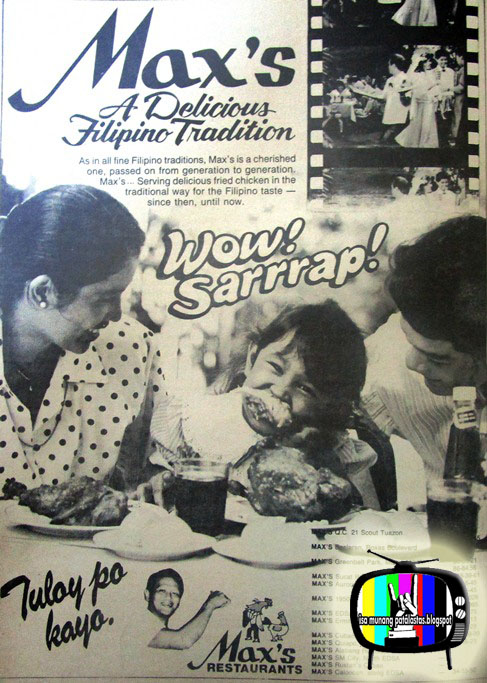
379. Brand Stories: MAX’S FRIED CHICKEN, The House that Fried Chicken Built, 1945

MAX'S RESTAURANT Corporate Print Ad, 1989

The enterprising Mr. Maximo Gimenez  founded the popular fried chicken restaurant way back in 1945, who met American soldiers who  posted in Quezon City. These military men often dropped by his house, where they would be served homecooked meals. This gave rise to the idea of opening a QC  café—MAX’s---which the Stanford-educated quickly put up to answer this need.

Source: MAX's Restaurant website

The first menu offering was fried chicken, that soon became everyone’ favorite, especially when Gimenez’s niece, Ruby, improved on the recipe that gave the chicken an appealing deliciousness—what with its crispy skin, and tender meat that one would dip with sweet Jufran or Mafran catsup. It soon opened a branch along Dewey (Roxas) Boulevard and expanded its menu.

MAX'S FRIED CHICKEN, 1987

MAX's also began actively advertising on TV and print since the 1970s, and one of its most memorable commercial, under the “Sarap to the Bones” campaign  starred Mr. Pure Energy, Gary Valenciano, in 1996.

 WATCH MAX'S RESTAURANT "GARY V." TVC HERE:

Now known as MAX’s Restaurant, the Philippine institution has evolved into a modern restaurant chain, but which continues to be beloved part of the Filipino tradition of fine family dining.

MAX'S KIDDIE PARTY SURPRISE, 1988

SOURCES:

Max’s Restaurant web site: https://www.maxschicken.com

Max’s Restaurant youtube channel: Gary V, https://www.youtube.com/watch?v=68GM3EU3K6o

Tuesday, April 26, 2022

370. Pop from the Past: CLICQUOT CLUB

CLICQUOT CLUB was first produced in 1881 in Massachusetts, as a sparkling cider by LaCroix Fruit Farm. It was named “Clicquot”,after the French champagne “Veuve Clicquot”. After The Clicquot company was formed, the apple cider was dropped, in favor of a new drink—the Clicquot Club Ginger Ale. Other flavors followed: Cream Soda, Strawberry, Orange, Rootbeer, Lemon & Lime, and Grape. Its “Eskimo Boy” mascot, became one of the most recognizable brand characters in the U.S. 

It was distributed internationally in the 1950s, that led to its Philippine launch. Rafael Yabut‘s “Tayo’y Mag-aliw” radio program, aired over DZRH, promoted the product in a segment called “Clicquot’s Tayo’y Uminom Program”. Clicquot Club was gone by the early 1960s;  the company was eventually bought by the Cott Beverage Corporation of Connecticut in 1969.

Monday, January 24, 2022

360. Brand Stories: HENO DE PRAVIA Soap, Print Ads 1960s-80

HENO DE PRAVIA, Print Ad, 1974

One of the more prized soaps in the world are those made in Spain, and some brands like Maja enjoyed worldwide success, like Maja by Myrurgia , a favorite soap brand in 1930s Philippines.

In the late 60s, another Spanish made soap made its appearance in the Philippines and had a long, successful run as a beauty soap with “fragrance that leaves a little bit of you behind”: HENO DE PRAVIA.

The green soap in the familiar yellow and white package was a product of Perfumeria Gal, which produced the soap in 1905. The soap came into existence when one of the company's founders, Salvador Echeandia, traveled to Pravia in 1903, a northern Spanish village, where he went to sell his company's products. He arrived while farmers were busy cutting “heno”, a grass used as fodder for livestock, and its aroma captivated him. 

HENO DE PRAVIA, Print Ad, 1968

Upon his return to Madrid he reproduced the fragrance of the “heno” grass and blended it with geranium, lavender and a hint of sandalwood. He marketed the soap as HENO DE PRAVIA, and in tribute to its derivation, made the bar mossy green, and wrapped it in yellow, the color of “heno” when it dries.  HENO DE PRAVIA became  Spain's best-selling soap, and its name has become a household word there.
HENO DE PRAVIA, Family 1, Print Ad, 1980

In the 1960s, HENO DE PRAVIA made its appearance in the Philippine market, and was promoted on the basis of its fragrance and credentials, having won awards in London, Paris and Madrid. Its first advertising print ad featured Filipina models, butw hen the agency, J.Romero & Associates took over, the ads featured Hispanic beauties and Castilian-type models, in keeping with the soap’s origin.

HENO DE PRAVIA, Print Ad, 1974

HENO DE PRAVIA, which caims to be still the no.1 beauty soap in the world, manufactured by Perfumeria Española Corp., a joint venture of  Perfumeria Gal with CIP. The brand is still available in the Philippines today, distributed by JDH Zuellig Inchcape Inc. It is also sold on online stores like Lazada and Shopee.

HENO DE PRAVIA, Family 2, Print Ad, 1980

SOURCE: Spanish Shop Online: https://www.spanishoponline.com/heno-de-pravia.html

Saturday, January 15, 2022

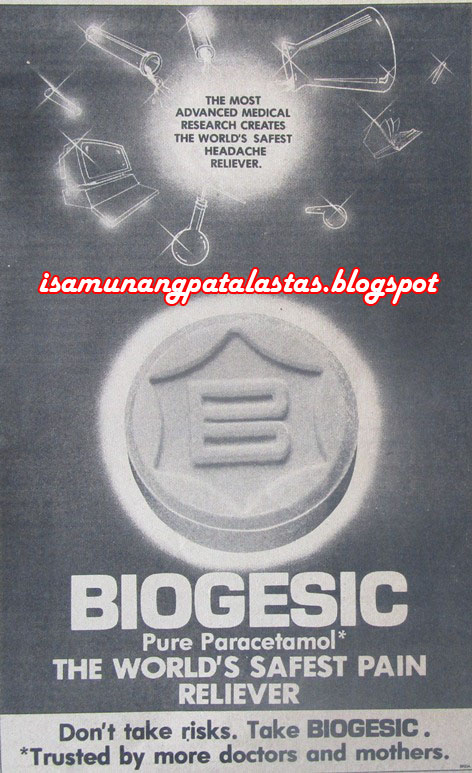
359. Out-of-Stock, but Never Out-of-Mind: BIOGESIC, Print Ads 1987

DON'T TAKE RISKS, TAKE BIOGESIC, Print Ad, 1987 

BIOGESIC  has been in the news lately, as the popular paracetamol brand has suddenly gone out of stock—along with analgesic, anti-pyretic, cold and cough medicine brands-- in the midst of the ongoing covid surge. The supply situation was so bad that even one netizen asked John Lloyd, current BIOGESIC endorser, for the much-needed tablets.   

A Biogesic out-of-stock  meme circulated during the covid surge, CTTO

BIOGESIC has been in the market for over 50 years, a product of the pharmaceutical firm, United Laboratories, Inc. (UNILAB). For decades, anti-fever and pain brands available  locally were paracetamol and aspirin-based, like Cortal, Cortapen, Medicol, Bayer’s Aspirin. The introduction of acetaminophen products expanded the market, and by the late 1970s, Tylenol, the widely-used American brand from McNeilab of Johnson & Johnson, was launched in the Philippines, along with its cold medicine counterpart, CoTylenol.

Tylenol became a huge threat to BIOGESIC and other local brands, as it was sold on the basis of safety—it does not cause stomach upset like aspirin does, which can irritate the stomach lining. Tylenol was also sold on its American leadership (America’s #1 Pain reliever), to capitalize on the so-called colonial mentality of Filipinos. 

CHILDREN'S BIOGESIC SYRUP PARACETAMOL, 1987

All that changed when Tylenol products in the U.S. were laced with cyanide in 1982 by still-unknown criminals, resulting in 7 cyanide deaths in Chicago. The product was pulled out of the Philippine market, and by 1986, BIOGESIC took over the safety theme with the absolute claim: “The World’s Safest Pain Reliever”—in reference to its pure paracetamol ingredient, not the brand. In 1987, a children’s syrup version was even introduced.

BIOGESIC never let go of this safety positioning, and has served the brand well, especially when the “Ingat” campaign, featuring celebrity actor John Lloyd Cruz, was launched in 2007. Marketing pundits believe that the consistent brand messaging of BIOGESIC  paved the way for Filipino consumers to continue trusting the product for aches, fever, and pain, as it continues to be the leading choice for paracetamol in the market—if people can only find it in drugstores today!

SOURCE: John Lloyd and 9 Years of “Ingat”. The Manila Times: https://www.manilatimes.net/2015/05/23/lifestyle-entertainment/show-times/john-lloyd-and-nine-years-of-ingat/185906, 23 May 2015

Monday, December 6, 2021

354. Brand Stories: LA PACITA BISCUITS, 1921

LA PACITA QUALITY BISCUITS, 1964 AD

In the 70s and 80s, people joked that the German term for biscuits was “Ski-Flacks” (from Skyflakes, pronounced with German accent), while the Japanese term was “Hai-Ro” (from M.Y. San’s “Hiro” biscuits).  In Spanish, they say, the word for biscuit was “LA PACITA”.   Indeed, all though the 60s “LA PACITA” brand became a generic term for Pinoy favorite treats like biscocho, mamon tosatado and crackers.

The brand name began in the Fabrica de Biscochos Y Dulces Biscuits Especiales, established in 1921 by Luis Martinez at Progreso St. (now J. Eustaquio) in San Juan. In this bakery were baked assorted biscuits, that were branded “LA PACITA”, named after Don Luis’s  wife Pacita.

TASTY...CRISPY...LA PACITA. 1960 PRINT AD

Luis Martinez & Co. produced 5 kinds of LA PACITA biscuits that included Cream Filled Cookies, Club Crackers, Chees-Et,  Tostados (Prima) and Camachile (baby finger cookies), which became favorite in-between meal snacks, pasalubong treats and baon for schools and offices. L. Martinez and Co. also produced Vitamin Bread.

LA PACITA Biscuits were heavily advertised in the 50s and 60s. In 1970, son Felicisimo took over the management and the company was rechristened F. Martinez and Co., Inc. The product line expanded with the addition of  Paciencia, Butter Cookies, Raisin Cookies, and new product launches for Snax and Supreme Flakes. Its assorted Famous Five—all 5 biscuit varieties contained in one big canister—is consistently a pasalubong favorite.

FAMOUS FIVE, 5-IN-1 Pasalubong Favorite

Luis Martinez & Co. was acquired by San Miguel-Purefoods in 2014. Its factory is based in Antipolo City and continues to operate to this day, churning out classic Pinoy snack goodies with the LA PACITA brand, made flavorful by 100 years of outstanding biscuit-making experience.

 SOURCES & NOTES:

Alex R. Castro, originally written for FilipiKnow, under the title “14 Classic Philippine Brands And Their Surprising Origins”, https://filipiknow.net/classic-filipino-brand-name-origin/

Reposted on spot.ph.

Wednesday, October 20, 2021

347. Brand Stories: TENTAY PATIS, 1949

RUPERTA "Tentay" JAVIER and her famous Tentay Patis, 1960s vintage bottle

Aling “Tentay” was the nickname of Ruperta Javier, the enterprising mother from Navotas who, in 1949, gave us the popular dipping sauce, TENTAY PATIS.  Aling Tentay, who learned patis-making by accident, was looking for a home business to supplement her family income. She came from a fishing family, so she saved the unsold catch, fermented the fish and bottled the fish sauce, which were a hit to friends and neighbors.  

TENTAY PATIS is still being enjoyed on Filipino tables, manufactured by Tentay Food Sauces, Inc. Aling Tentay would be proud to know that the fisch sauce brand that bears her name is sold not only here, but also distributed around the world--from the Middle East, Hong Kong, Japan, Australia to Guam, Hawaii, New Zealand and mainland U.S.A.

 WATCH THE TENTAY PATIS VIDEO
FROM "BUSINESS & LEISURE", uploaded 9 Mar. 2016

SOURCES:

The Beginnings of a a Mother’s Legacy, http://www.tentaysauces.com/2011/03/tentay-patis-a-mother%E2%80%99s-legacy/

Video credits: Proud Pinoy-Tentay Patis. by Business and Leisure, uploaded 9 March 2016. 

Wednesday, September 29, 2021

344. Brand Stories: DANGWA TRANSPORTATION COMPANY, 1928

BADO DANGWA, Gounder of Dangwa Tranco

DANGWA has become synonymous with blooms and flowers, so that when one needs them for special occasions, one is directed not to Dimasalang St. but to—“Dangwa”, where the buses that drop these flowers all the way from Baguio have their terminal. The bus line owes its name to Igorot maverick Bado Dangwa, a La Trinidad Agricultural School graduate.

DANGWA, 1960, screengrab from igorotna youtube post

DANGWA BUS, 1970. from the blog 'Home Court'

His ambition to be a teacher was put on hold when his school principal James Wright, convinced him that there was a better future in the transportation business. To get him started, Wright provided the cash-strapped Dangwa 5 Chevrolet cars discarded by the North Garage transport service. Dangwa was suddenly in business, using these cars to ply the La Trinidad-Baguio route.  Thus the DANGWA TRANSPORTATION COMPANY was born.

DANGWA TRANCO, Fleet no: 578,Bus Manufacturer:Santarosa
Motor Works Inc., Model: SR SDX,Taken: East Ave., Quezon City,
 posted by markstopover on flickr.com

Eventually, he would grow his fleet from just 3 cars in 1928 to 173 vehicles at the onset of World War II. After the war where he served as a guerrilla leader, he put the Dangwa Transportation back on its feet, and which continues in business today with its modern fleet of  air-conditioned buses. Dangwa would later become the governor of the Mountain  Province.

 WATCH "DANGWA TRANSCO"
The Beginning and Early Years,  uploaded by igorotna
20 Sep. 2020

SOURCES: Dangwa Tranco, The Beginning and Early Years, youtube, uploaded by igorotna, 20 Sep. 2020, https://www.youtube.com/watch?v=Ofy4l4lW2pA

Home Court, https://rusa4.wordpress.com/tag/dangwa-tranco-bus-1970/

Dangwa Terminal FB Page

Flickr.net: Posted by markstopover, DANGWA TRANCO, Fleet no: 578, Bus Manufacturer: Santarosa Motor Works Inc. (Philippines), Model: SR SDX, Shot Taken: East Ave., Quezon City

Gutierrez, Lazaro, Memoirs of Baguio 1901-1960, Summer Capital Publishing House, p. 215.

Fry, Howard T., A History of the Mountain Province, New Day Publishers, Quezon City, Philippines, © 1983

Wednesday, September 22, 2021

343. Brand Stories: ALEMAR'S "The Biggest and Most Modern Book Store in the Far East", 1945

THE SIBALS, Founders of ALEMAR'S, 1945

When couple Dr. Ernesto and Alegria Sibal started selling American books from a one-table store in 1945, little did they know that their business would grow into  “the biggest and most modern bookstore in the Far East” in the 50s and 60s. Their bookshop—ALEMAR’S  was derived from Mrs. Sibal’s name—ALEgria, and the first given name of the Sibal daughters, MARia. 

VISIT ALEMAR'S, 1975 AD

ALEMAR'S, in its heyday, had its main store on Rizal Avenue and branches in Ermita, Recto, Quezon City and Makati. It ventured into printing and publishing in 1950, through its Phoenix Press and Phoenix Publishing House.

DOVER & SUNSET BOOKS, 1978 AD

BY 1975, ALEMAR'S WAS EVEN SELLING KIDDIE CLOTHES!

 ALEMAR’S  carried more than just books—local, imported, textbooks, used books-- it also sold  school and office supplies, toys, men’s, ladies’ and children’s wear, home accessories, magazines and more. Central Book Supply, a division specializing in law books, was also put up. With more aggressive competition from National Bookstore and with heirs leaving for the U.S., ALEMAR'S started closing its shops in the 1980s.


SOURCE: “The Alemar’s Story”, 1961 Philippine Business Progress Report, pp. 24-25.