Showing posts with label Procter and Gamble. Show all posts

Wednesday, November 26, 2025

532. Brand Stories: VICKS INHALER, Richardson-Vicks, 1941

Movie idol JAIME DELA ROSA for VICKS INHALER, 1959

Pharmacist Lunsford Richard founded  Richardson-Vicks out of a family emergency. His young son, Smith Richardson suffered from a serious case of croup. Lunsford combined unique ingredients into a salve that when heated by the body, would release soothing vapors.

The boy found relief and the homemade croup and pneumonia salve was soon being sold as a legitimate product in 1894, after Lunsford took over his brother-in-law Dr. John Vick’s drugstore business,  Thus began the Vicks Family Remedies Company (later, Vicks Chemical Company) in 1898.

In 1911, the salve was renamed as VapoRub by the now-grown up Smith,  the very boy who inspired its creation and now a the helm of the business. The soothing vapors became the unique advantage of the product, such that in 1941, that effective production action was used in the development of Vicks Cough Drops, that provided instant, portable relief. The cough drops were an immense success.

Matinee Idol LUIS GONZALES for VICKS INHALER, 1956

The Vicks “vapors” line was extended in 1941 with the launch of the VICKS INHALER. This unique products brings the soothing vapors of Vicks in your pocket, just by inhaling the vapors from a plastic tube which are released from an absorbent material (like a cotton wick) that has been saturated with a blend of ingredients formulated by the company. Again, the reception to this innovation was met with widespread approval.

Singer-actress JEAN LOPEZ for VICKS INHALER, 1960

By the 1950s, VICKS INHALER  was available in the Philippines, and its early local advertising in the late 1950s featured popular movie stars, shown on this page. Despite the rise of Thai and Chinese made inhalers, VICKS INHALER—now also available in the key chain type, continues to be a favorite among local users, as the brand is now owned and managed by Procter & Gamble, a trusted maker of products that make Filipino lives easier.

Friday, April 11, 2025

509. Procter & Gamble PMC's TIDE, "Tide Clean" Campaign, 1961

In 1961, TIDE embarked on a local campaign that was based on a formulaic P&G advertising strategy principle of re-setting the bar of laundry cleanliness, using “Tide Clean” as the new standard. This benefit is expressed in the selling line: “The cleanest clean is TIDE Clean”.

The campaign also featured a tried-and-tested “product demo”,  P& G copy jargon that visualizes the product superiority through a demonstration of its cleaning power—statically shown as a series of captioned inset pictures , so typical of their advertising in the 60s and 70s. 

A sub-text of “affordable cost” is embedded in the execution expressed thru an additional copy intended to reassure : “…and costs so little to use!”. P&G was often fond of cramming their advertising with many sub-messages and their agencies were challenged to think of ways to include these seamlessly in crafting the copy (think Mr. Clean’s “labadami, labango, labanayad’  Dari Crème’s “pinipili ng mapiling ina…at anak!).

To top it all—just to make sure the message is not lost on the mass market,  the TIDE Clean campaign, used all sorts of talents to represent a father, a mother, their kids, friends and a token grandparent, who appeared in their own individual colored print ad. 

Truly, this TIDE print campaign can be held up in a basic marketing class as a perfect example of P&G’s formula advertising, ticking all the boxes of how their product advertising should be done—this, from a company which “invented” brand management.


Thursday, January 9, 2025

499. Choosy Moms with Choosy Kids Choose DARI CREME, 1984

"CHOOSY MOMS, CHOOSY KIDS", DARI CREME Print Ad, 1984 

Procter & Gamble prides itself as having started “brand management” in product marketing, and the pedigree of success across of its advertising across all brands proves that. The company even employed advertising “copy experts” who patrolled their international network for possible advertising approaches that can be adapted and applied to their other brands in need of promotions.

Such was the case of DARI CRÈME advertising, which was in need of revamping in the late 70s.  Launched in 1959, DARI CRÈME was one of the first products of Procter & Gamble PMC (now P&G Phils., Inc.). It was the first locally manufactured refrigerated margarine and was introduced as a local alternative to imported butter. All throughout the 1960s, DARI CRÈME consistently led the butter and margarine market, preferred for its more buttery taste, availability and price. 

P&G's "Adapt & Apply" practice resulted in a borrowed slogan for DARI CREME ad campaign.

In the late 1970s thru the early 80s, efforts were made to refresh DARI CRÈME advertising in the face of a growing competition that would come to include new Magnolia Butter and Buttercup. The inspiration for a new DARI CRÈME thematic campaign came from a Procter & Gamble product from the U.S.—JIF Peanut Butter. JIF’s success owes much to its advertising with a slogan “Choosy Mothers Choose JIF”, coined by its creative agency, Grey Advertising, in 1966. The campaign catapulted JIF past erstwhile leader Skippy to market leadership around the time of the peanut butter crisis of 1980.
The idea of having “discriminating or choosy mothers” when it comes to food for their children,  resonated with Filipino mothers—hence Ace-Compton, the local agency of DARI CRÈME localized the theme into “Pinipili ng mapiling ina”, that became the crux of the product TV ad series. The TVCs featured a mother showing another mother the difference the taste difference between DARI CRÈME and another unnamed brand, when slathered on a piece of bibingka, on a puto, ensyamada, etc.. The new campaign secured DARI CRÈME’s dominant position in the marketplace, and the commercials became very popular on TV.

 WATCH DARI CREME's "CHOOSY MOMS" TVC HERE

The campaign went a step further when a DARI CRÈME usage campaign was launched in 1984, but the slogan was not only converted into English, but was also extended to include discriminating kids. Hence, “Choosy moms with choosy kids choose DARI CRÈME” (Pinipili ng mapiling ina…at anak!). The campaign ran for many years, despite it being—well—a mouthful. But P&G didn’t mind, as the message came across well, and business resumed its brisk pace.

In a twist of irony, a decade after the “choosy moms” campaign, Magnolia Inc. (then known as Philippine Dairy Products Corp.) acquired DARI CRÈME from Procter & Gamble Philippines, ensuring the continuity of the much-loved, iconic brand—and even the “pinipili” slogan, that is still in use to this day.  

SOURCES:

Magnolia, https://en.wikipedia.org/wiki/Magnolia_(Philippine_company)

JIF Peanut Butter: https://www.researchgate.net/publication/364858362_Choosy_Mothers_Choose

DARI CREME TV Commercial, https://www.youtube.com/watch?v=__Zd7ODZbXo, youtubevideo uploaded 2016, by Albert Marc Justine Carreon, 

Friday, August 18, 2023

436. Retro-Story: IVORY SHAMPOO & CONDITIONER TVC, 1995, by Chairmom Merlee C. Jayme

ANG GAAN-GAAN NG FEELING, with Ivory model Bianca Araneta, 1995

MTV’s golden age lasted from the early 1980s to around 1992, but endured longer in music-loving Philippines. At its peak, MTV had a significant impact not only on our music landscape, but the format was also borrowed and used in advertising production. Agency creatives would often propose executions “a la MTV” to capture the interest of youth who were very much into music videos popularized worldwide by the MTV cable network.

WATCH AND LISTEN TO IVORY'S"ANG GAAN-GAAN NG FEELING" MTV, 1995 HERE:

Courtesy of Merlee Jayme, uploaded on youtube 30 Dec. 2021, 

One of the most memorable campaigns that used this longform MTV format was the IVORY Shampoo and Conditioner campaign created by Ace-Saatchi & Saatchi in 1995 for Procter and Gamble. It spawned a jingle-- “Ang Gaan-Gaan ng Feeling”, which became a hit pop song for the singers DV8, a fairly new music band. It also introduced us to a fresh new model, Bianca Araneta, whose mother (Maritess Revilla)  and grandmother (Paquita Goyena)  had strong Procter & Gamble ties, being former Camay Girls.

Chairmom Merlee Cruz Jayme, then copywriter for IVORY at Ace-Saatchi& Saatchi shares her recollection of the now iconic music video, with the hit jingle that turned into a mainstream monster hit, ruling the TV and radio airwaves for quite awhile, nationwide.

**********

As a Copywriter in Ace Saatchi & Saatchi, I worked on the launch of IVORY Shampoo & Conditioner. IVORY is gentle on hair and scalp with no harsh and heavy ingredients. So, hair feels light and not weighed down.

It was the 90s, and music videos were a big thing. Targeting young teens, I started writing a song. When I wrote the first line,
“Dati ang aking buhay ay kulang sa sigla…” I tried to set the mood for heaviness and the need for lightness. Then the mood changes with a happy, catchy, breezy refrain that perfectly captures the feeling of lightness: “Ang gaan, gaan ng feeling.” The famous composer Jimmy Antiporda did the melody.

We searched and discovered the perfect talent to embody the pure, gentle, and light brand persona: the 14-year-old Bianca Araneta, the daughter of the 70s actress Maritess Revilla and businessman Iking Araneta. I remember that day when I had to go to their condominium in Mandaluyong with my Accounts Director to convince her parents to allow her to be our Ivory girl.

The music video made her an instant star, and her signature hair shot. She was blowing her wispy bangs away.

Today, what surprises me is the fact that carolers and choirs sing “Ang gaan, gaan ng feeling” during Christmas. I didn’t think the lyrics I wrote for a shampoo had a deeper religious meaning.

 About the Guest Writer: MERLEE CRUZ JAYME is the Chairmom & Chief Creative Officer at Dentsu Creative Philippines and Chief Creative Officer APAC at Dentsu. Before that, she co-founded  DM9 Jayme and Syfu. She started her illustrious career as a Copywriter at Ace-Saatchi & Saatchi advertising, where she met and married her colleague, Timmy Jayme, then an account executive. They have 4 daughters. Merlee is also a founder of a school, The Misfits, a training camp for autistic and deaf creatives.

 CREDITS:

AGENCY: ACE SAATCHI & SAATCHI ADVERTISING

COPYWRITER: MERLEE CRUZ JAYME

ART DIRECTOR: JAKE TESORO

CREATIVE DIRECTOR: MELVIN M. MANGADA

ECD: JIMMY F. SANTIAGO

PRODUCER: NANETTE RAMIREZ

 CLIENT:PROCTER & GAMBLE PHILS.

BRAND MANAGER: CHRISTINE ANGCO

CATEGORY PRODUCT HEAD; CITO ALEJANDRO / ISCA  ABAYA

 PRODUCTION HOUSE: UNITEL PRODUCTIONS

PRODUCER: MARIJO CLAUOR

DIRECTOR: JOEY AGBAYANI

MUSIC COMPOSER: JIMMY ANTIPORDA

 MANY THANKS to Ms. Merlee Cruz Jayme, for the background story of the Ivory campaign, and for the use of her youtube video.

Friday, February 12, 2021

310. The “BLINDFOLD TEST” Campaign of CAMAY Soap, early 1980s

 
CAMAY BLINDFOLD, "Gigi", Print Ad. ca. 1981

Beginning in 1980, CAMAY, Procter & Gamble’s leading  beauty soap launched a more hard-sell campaign to ward off its perennial arch-rival, PRC’s LUX. LUX had all the glamorous stars at its disposal as it was globally positioned as “the soap of movie stars”.  CAMAY felt that perhaps, the soap would appeal to  women on a more rational level, so sometime in the 1980s, it launched a “blindfold ” tactical campaign to test its new mildness.

The “blindfold challenge” was a format used before by CAMAY in the U.K. when it launched its new scent—Camay Wildflower. A blindfolded woman was asked to figure out the scent by smelling  a perfume bottle int which a soap has been inserted. Once she identified the “perfume scent”, her blindfold is removed and her cheeks are lathered with CAMAY soap.

The format was borrowed and was used to challenge a relatively unknown Filipina to test the gentleness of her beauty soap against CAMAY. She lathers one side of her cheek with her current soap, the other cheek with CAMAY. At the end, she is asked to choose which side felt smoother  and more “banayad” on the skin. Invariably, the CAMAY side always won.

A parade of newfound girls were recruited to do the “blindfold test” commercials, to draw in more mass appeal. They were not as well-known as previous talents, but still were referred to as CAMAY girls. Some of the models included the fashion model Gina Leviste, a band singer named Esperanza Tatlonghari (aka Zsa-Zsa Padilla), Angeli Pangilinan, member of the band Music and Magic (future talent management agency owner and wife of Gary Valenciano). A  few memorable lines came out if these popular ads-- as a result of the models’ discovery of Camay’s superiority over their current soap brands.  Upon removing her blindfold, for examples, a surprised Angeli squealed—“Hah? CAMAY? Akin na lang twooooohhhh!”

CREDITS: AGENCY: Ace Compton Advertising / CREATIVE DIRECTOR: Gryk Ortaleza / COPYWRITERS: Menchu Arrogante, Mimit Zialcita / CASTER: Baby Dumaup, Myra Mendoza / PRODUCER: Dante Datu / ADVERTISER: Procter & Gamble Philippines

Sunday, January 31, 2021

308. DAZ AND FAS : Two Lesser-Known Detergents of the Mid-60s

DAZZ gets clothes dazzling clean--saves you money too! 1965

Sometime in 1965, two laundry detergents were launched one after each other in the Philippines, both with one syllable-brand names, which also rhymes, and both price brands. DAZ was a Procter & Gamble project introduced in 1953 in the United Kingdom. It was aggressively promoted there, and over a decade later, was rolled out to the Philippines as Super DAZ, in the hope of replicating its success in the U.K. market. DAZ was sold on  the basis of its fast, cleaning power, at a price more economical than any laundry bar or powder. 

FAS, for the fastest cleaning power! 1966

Right on its heels was FAS, a locally manufactured laundry powder of the Philippine Detergents Products.  FAS claims to be the detergent with “the fastest cleaning power”, in a time where  supelatives were permitted without any substantive proof.

Both DAZ and FAS had print ads that looked suspiciously similar, one is wont to think that they were made to compete against each other. But no such fireworks happened, as DAZ failed to dazzle and FAS was fast to fade; both brands did not even survive the end of the 60s decade.


Friday, January 22, 2021

307. STAR MARGARINE, Drive and Energy Print Campaign, 1960

Get your Drive and Energy from STAR, 1960

STAR MARGARINE was first produced by the Philippine Manufacturing Co. in 1931, and 4 years later Procter & Gamble of Cincinnati acquired PMC. STAR already had a local following by then, but P&G was determined to market the brand better in its communication of real consumer benefits. 

STAR, "Dance" Version, 1960

Before STAR MARGARINE would find lasting fame and success for its “Iba na’ng Matangkad” ad campaign, brand marketing toyed with many selling propositions—from the product being a beri-beri fighter in 1951 (STAR had Vitamin B1), a vitamin-rich cooking aid, to a flavorsome, nutritious spread (“STARS for Flavor” was the slogan). 

STAR, "Swim" Version,1960

In 1960, STAR MARGARINE continued to be sold for its value-for-money health benefits, dimensionalized  as giving your body “drive and energy” , at a little cost. A tablespoon of STAR, the ad claims, has energy-giving value that is equivalent to a glass of milk, two eggs, and a slice of beef. A series of 3 print ads ran in color on leading weekend magazines, as shown here.

STAR,"Basketball" version, 1960

Monday, November 9, 2020

296. BREACOL with XYLOPOL: Stops Cough Faster…Fastest! Print Ads 1957-1969

BREACOL WITH XYLOPOL, 1960 Ad

One of the leading cough medicines that enjoyed nationwide success in the 1950s  is BREACOL with XYLOPOL. It was a product of Sterling Drug, an American global pharmaceutical company before it merged with Winthrop-Stearns,Inc. It had performed exceedingly well in Latin American countries, and so, when it was time for BREACOL to be rolled out in Asia, the company chose to launch it in the Philippines in the mid 1950s, and later, in Singapore 

BREACOL, 1957 Ad

BREACOL with XYLOPOL claims to stop cough faster, in 5 ways: it destroys germs, soothes irritation, stops throat tickle, loosens phlegm and medicates deeply. Later, the “ideal cough remedy for the whole family”. In the days before the ad industry had a regulatory board, BREACOL even went for the superlative, by claiming that it “Stops Coughs Fastest”. 

BREACOL, 1958, 1959 "HIS 'n HERS" Ads

The first BREACOL ads had copy that were direct lifts from foreign ads, and had clip-art illustrations of foreign-looking models. For better appeal, spot color (Red) was added to the prints ads. Photography was rarely used.  For over a decade, BREACOL was a leading presence in the cough market, challenged by Vick Chemical Company, which was already I the market at just about the same time with its Vicks Cough Drops. In time, Vicks Cough Syrup was introduced as well, which was heavily pushed in print and the rising radio medium. 

IDEAL FAMILY COUGH REMEDY AD, 1960

BREACOL could not simply compete with the resources of Vicks (marketing giant Procter and Gamble took over it) as the latter cornered the cough and cold market with such products as Vaporub, Inhaler, cold tablet, and nasal drops.

STOPS COUGH FASTEST! 1961 BREACOL AD

After several years,  XYLOPOL seemed like old news. In 1969 BREACOL reformulated and rebranded itself as DEXTRO-BREACOL with DXM, in reference to the Dextromethorpan which suppresses the signals in the brain that trigger cough reflex. It was hardly a unique ingredient, as most cough syrups were also dextropmethorpan and guaifenesin-based. 

DEXTRO-BREACOL REFORMULATED, 1969

Still, BREACOL plodded on, supported by core loyalists who remember the 50s brand fondly. Happily the brand name is still around today, through the Singapore-based  Invida, a specialty pharma company formed by a joint venture between Quintiles, Temasek and Zuellig. Invida commercializes  different pharmaceutical products of superior quality and markets them worldwide. Invida counts BREACOL as one such proven brand.

SOURCE:

Sterling Drug: https://en.wikipedia.org/wiki/Sterling_Drug

Wednesday, April 8, 2020

274. Brand Stories: SAFEGUARD of Procter & Gamble (1963)

SAFEGUARD GOLD, INTRO AD, 1987

Procter & Gamble has a rich heritage of soap-making, as James Gamble was a soap maker. In 1879, they created Ivory that became a worldwide business success. P& G was also known for its beauty and toilet soaps.

SAFEGUARD SOAP PACKS, White and Gold, 1987

In 1963,P&G ventured into the germicidal soap market to answer rising consumer demand for odor and germ protection. Thus SAFEGUARD was launched, a deodorant and antibacterial soap that reduced bacterial skin count by 99.3% in clinical tests. It was successfully rolled out in the U.S., and then in 1966, it was launched internationally, beginning in the Philippines.  The soap came in wrappers with a trademark shield icon, symbolic of its germ protection property.

BEFORE & AFTER DEMONSTRATION OF
DE-GERMING POWER OF SAFEGUARD

The next year, scientific proof of SAFEGUARD’s de-germing efficacy were published in clinical journals.  The studies also showed that Safeguard reduces skin infections by 44%. This became the basis of SAFEGUARD’s advertising messaging in the Philippines that remained unchanged to this day.

SAFEGUARD SHIELD ICON USED AS A SYMBOL OF SAFEGUARD'S GERMICIDAL POWER

One of the earliest, if not the earliest SAFEGUARD TVC shows a man in a bath tub  (played by unknown actor Mario O’Hara) happily scrubbing away with a bar of SAFEGUARD as he extolled the virtues of the anti-bacterial soap.

SAFEGUARD enjoyed even greater success when the local P&G secured the endorsement of the Philippine Association of Medical Technologists (PAMET). In the 70s, advertising code prevented doctors from promoting products—but not allied medical workers like bacteriologists and medical technologists.  


WATCH SAFEGUARD'S "MILA DELFONSO" 1970s TVC HERE:
uploaded by Juan DeLa Cruz, 1 June 2008
SAFEGUARD capitalized on this, and its advertising agency—Ace Compton Advertising—produced a series of  commercial  featuring real-life medical technologists using the soap, both in the lab and at home.

The creative thin-tank of Ace Compton continued to churn out even more effective and memorable SAFEGUARD advertising with the launch of the “Conscience” campaign. The TV commercials featured mothers in the act of buying more affordable beauty soaps for their families. The mother’s personified “ghost conscience”  appears,  to remind her of her responsibility to give only the best for her family. With her conscience piqued, she chooses SAFEGUARD with 24 hour germicidal protection.

WATCH SAFEGUARD'S "KONSENSYA" 1980s TVC HERE:
Uploaded by Safeguard Philippines, 1 May 2016

With SAFEGUARD dominating the germicidal soap market for decades,  the brand was in a position to launch other promotional initiatives—introducing variants such as SAFEGUARD White and Gold,  linking with PAMET to offer free med tech scholarships, and leading the way with allied efforts like the “Wash Your Hands” campaign that has evolved into a Global Handwashing Day—a unique event that is saving lives around the world.

For the rest of the 80s-90s decade, SAFEGUARD continued to rule the germicidal soap market with its unique combination of effective germ protection and mildness, even with the fold-up of the local P&G marketing office. 


WATCH SAFEGUARD GOLD 1987 TVC HERE:
Uploaded by vibesey, 6 May 2017

SAFEGUARD continues to be present worldwide in 15 countries, including the Philippines.  The modified shield on the packaging is still there—now called Germshield, also a name for the active ingredient  in SAFEGUARD that fights off more types of harmful germs longer than any other anti-bacterial soap. Over the years, new products have been added to the SAFEGUARD name as well—from anti-acne soaps.  body and face wash, to foaming hand soaps.

In these times when the COVID-19 pandemic is upon us, we need to fight germs and viruses more than ever, and reduce incidence of preventable diseases such as diarrhea, influenza, and pneumonia.  Then, as now,  SAFEGUARD is on our side!

SOURCES:
1988 Creative Guild of the Philippines Awards Night Souvenir Program
VIDEOS:
Safeguard Commercial (Mila Delfonso), uploaded by Juan dela Cruz, 1 Jun. 2008, 
https://www.youtube.com/watch?v=dIUtUgHRBOw
Safeguard "Konsensya", uploaded by Safeguard Philipines, 1 May 2016, https://www.youtube.com/watch?v=GKqPVw79prs&t=37s
Safeguard Gold with new fragrance, uploaded by vibesey, 6 May 2017, https://www.youtube.com/watch?v=uusp1RHW1-Q

Monday, February 17, 2020

266. Brand Stories: PURICO, Procter & Gamble PMC, 1917


The Philippine Manufacturing Co. is largely the history of modern vegetable shortening in the country.

ALWAYS PURE, ALWAYS RICH, PURICO! 1940 Ad

In 1917,  it employed a chemist whose assignment was to start production of shortening and other edible products.  Near the end of 1919, the first-ever vegetable shortening manufactured in the Philippines was launched. It was noted for its purity and richness that it was named PURICO—a term coined from combined words “puro” (pure) and “rico” (rich), as Spanish was still widely spoken then.


SO PURE, SO RICH...PURICO COOKS MORE! A pair of print ads, 1955

These qualities were underscored in slogans and headlines like “Always Pure. Always Rich,” and “So pure..so rich..Purico cooks more!”PURICO was sold in carton blocks with the familiar yellow label, and were widely available nationwide—from the tiniest sari-sari stores, to the biggest groceries in the islands.

EVERYDAY FOODS WITH PURICO, 1953 PRINT AD


PURICO MAKES IT PERFECT,a pair of PURICO Print Ads, 1954

The products of PMC were promoted over the radio, then the leading mass medium before the advent of television. PURICO sponsored "The PURICO Amateur Hour,

TOLINDOY, CONDE UBALDO, PURICO FAN PHOTOS, 1950S

The PURICO Amateur Hour featured the brightest stars of the radio, dishing out songs and skits and what-have you--from Tolinday and Chichay, announcers Ira Davis and Conde Ubaldo, actresses Rebecca Gonzales, Lily Miraflor and singing discoveries like Milagros Bernardo.

PURICO FAN PHOTOS OF CHICHAY, REBECCA GONZALES, ETC.

The radio program attracted bigtime stars (Rogelio de la Rosa, Rosa Rosal, among others) and gained a nationwide following. PURICO and other PMC brands are credited today for ushering in the golden age of Philippine broadcasting.

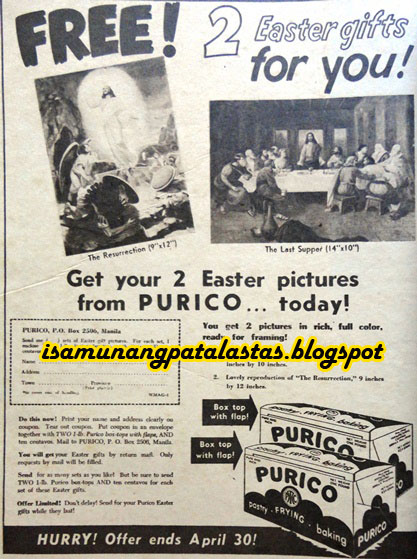
PURICO FREE XMAS FREE PROMO, 1955

PURICO FREE EASTER GIFT PROMO, 1953

Fan photos of the performers and stars were issued for adoring fans to collect in albums. An example is shown above, made perhaps, by an ardent follower of the radio show.

TAWAG NG TANGHALAN TV PROGRAM, hosted by Lopito and Patsy, 1950s.

When PURICO Amaterur Hour was  renamed Tawag ng Tanghalan/Call of the Stage), it was staged for the new television medium,  for which the first TV advertising contract was  signed, after PMC was bought by Procter & Gamble. This further solidified the hold of PURICO on the shortening market. 

UPLIFTING THE PURICO IMAGE WITH A MANILA HOTEL AD,1960

The rise of liquid cooking oils eased out PURICO from the store shelves by the 1970s, until it totally disappeared altogether in the 1980s.

SOURCES:
PROGRESS Magazine 1956,
Radio Stars from Purico Radio Show, www.flyandfleablogspot.com

Wednesday, November 27, 2019

253. Procter & Gamble PMC: PERLA SOAP, Early Print Ads 1951-1957


Since its early beginnings in the first decade of the 20th century, the business of Procter & Gamble PMC has been rooted in the production of vegetable shortening and detergent soap. When Philippine Manufacturing Co. (PMC) –then still wholly Filipino-owned—was incorporated in 1913, a new objective was set to manufacture and sell coconut oil. That time, there was only one coconut oi mill in the Philippines, so PMC set up its own oi mill and pressed its first copra in 1914.
 
PERLA, LOTS MORE SUDS, FEWER RUBS! print ad, 1951
The first coconut-oil based product from PMC were edible products beginning with Purico vegetable shortening in 1919. When P&G of Cincinnati, Ohio acquired PMC in 1935, it continued this venture, putting up its own plant, but the operations were halted during the war when Japanese forces occupied the plant in 1942.
 
PERLA WHITE SOAP,  print ad, 1951
But when thing settled, P&G PMC resumed its operations, rebuilt the plant,  and forayed into coconut oil-base soap production. That was how PERLA came to be in 1949, one of the very first white detergent bars made from pure coconut oil and natural ingredients.
 
WHITER, BRIGHTER CLOTHES with PERLA, 1953
As believers of advertising, P&G PMC began advertising PERLA in 1951. The first print ads basically promised many conveniences—“lots more suds with fewer rubs”, “gets whites white—no yellowing”, “no color fading”. “safe as clean water”.
 
BIG, HANDY NEW PERLA, print ad, 1955
Later, PERLA’s benefit became more focused, with the addition of a “sunshine ingredient”—Supersol—for the whitest, brightest of clothes.

It would take over 2 decades before PERLA found its niche when repositioned as the soap that gently cleans clothes—especially those made of delicate fabrics like undergarments, lacey apparel, lingerie and heirloom clothes. This insight actually came from PERLA users themselves who stood by the gently cleaning ability of the soap—as it was made from pure, natural ingredients.
 
PERLA, print ad, 1957
In fact, a secondary usage was also unearthed. Apparently, women were also using PERLA to wash their faces as part of their skincare regimen. Thus, the added benefit of “keeping hands in good condition after every washing” was incorporated in its messaging thru the 1980s. the advertising was handled by Ace-Compton Advertising, and later by Publicis-Jimenez Basic in the mid 1990s.
 
PERLA, today, in 3 variants. Photo: Perla FB page
PERLA was sold to SCPG Asia-Pacific, a manufacture of soaps, detergents and washing Powders  after 1994. Currently, Mt. Makiling International Oil, Inc. is  toll manufacturer of PERLA,  housed by SCPG Asia-Pacific Inc.  After 70 years, the iconic white bar—PERLA—is still around, with new variants (Blue) and revitalized formulation (with papaya extract) to keep up with the demands of the times.

SOURCES:
Perla FB Page, https://www.facebook.com/perlaphilippines/
Then and Now, Progress Report Magazine, 1958