Showing posts with label dairy products. Show all posts

Friday, March 13, 2026

540. WHEN MAGNOLIA MILK PRODUCTS CAME IN BOTTLES

MAGNOLIA started as an ice cream brand in 1925, but it wasn’t long that it began to carry dairy products—as basic as milk, for instance—sold in bottles. By the pre-war years, the company’s MAGNOLIA MILK had become an established brand, sold carafe shaped clear glass bottles, and promoted for its taste and health benefits.

The years that followed showed MAGNOLIA’s bottles dairy lines expanding. In 1957, a milk-based chocolate drink, Choco-Vim, came out in bottles of various shapes—one looked like a soda bottle, but most came in short, squat bottles with sloping sides and a small opening.

Around the 60s, the dairy bottles were standardized. The clear bottles had straight sides, ending with a narrow opening, with an applied blue colored label bearing the distinctive blue Magnolia logo , the product name, and topped by a scrimped carboard crown, further protected and sealed by a pull-out-tab.

Both its white milk product, now branded as Magnolia Fresh Cow’s Milk, and its new Magnolia Chocolait line—introduced after the phase out of Choco-Vim—sported these kinds of bottles and were used all throughout the 70s. In 1975, Magnolia Whole Cow’s Recon Milk, a reconstituted fortified milk.

In the 1980s, San Miguel Packaging Products (SMPP) began introducing innovations in packaging designs. The former straight sided bottle lost its rounded corners, and assumed a more streamlined round shape with a short neck and mouth, with a more contemporary applied color label. The name Magnolia, in small case letters, both in open and solid types, circumscribed the middle of the bottle.

This was used across all its milk products line, including the Magnolia Low Fat Milk, a premium milk introduced in 1984. When the fruit juice drink line was launched that same year, they were also packaged in the same bottle.

MAGNOLIA LOW FAT MILK, PRINT AD, 1984

To address tampering issues, a new Tamper Resistant Seal was added to safeguard the freshness and purity of  Magnolia milk products, as well as its bottled juice products.

MAGNOLIA BOTTLES WITH TAMPER RESISTANT SEALS, 1984

By the late 1980s, packaging for products have shifted to using tetra packs and PET bottles, which have the advantage of being lighter, cheaper to produce, and easier to dispose. Carton-based aseptic Tetra packs and flexible doypacks, for example, were more hygienic, thus preserving the integrity of the product. They were easy to carry, saved store space, and even came with their own drinking straws. PET bottles were recyclable, lightweight, and less likely to be broken.

A CASE FOR MAGNOLIA GLASS BOTTLES, 1987

Magnolia made an effort to extoll the virtues of its bottled milk products when it put out an omnibus ad that proffered the benefits of glass bottles. But it was soon clear that the end in sight for glass bottles---and eventually Magnolia would abandon glass bottles for their milk products altogether, shifting to standing tetra packs for their Fresh Milk, Full Cream Milk, Low Fat and Flavored Milk.

Tuesday, February 3, 2026

538. Those Adorable DARIGOLD KIDS of the ‘60s: Then and Now

When readers opened their magazines in 1963, they were treated to a spread of colored ads of DARIGOLD MILK featuring wide-eyed, happy-looking kids—perfect models of the milk’s promise of healthy goodness and tender love.

By that time, DARIGOLD was the No. 1 milk brand in the country, backed by its savvy marketing and well-crafted advertising, professionally made by its ad agency, Philprom, founded by Pete Teodoro in 1945. Not bad for the evaporated milk brand that had to be imported all the way from Seattle to be introduced in the Philippines in 1953.

The 1963-1964 campaign was launched first with a lead-off print ad featured 2 vignette shots of a young mom with her school-age daughter holding a glass of milk in one hand. In the foreground are two younger siblings with their toys, showing the boy giving her little sister a peck on her cheek.

A separate ad was spun off using the version with the two siblings being wowed as they are handed with a glass of DARIGOLD Milk.

The next in the print ad series showed a fair-haired girl holding a glass of DARIGOLD Milk with the headline:  “More, more, more…DARIGOLD gives you more!”. A jingle based on that line was created by the agency and became a national hit.

The last ad was a Black & White ad with 2 spot colors, touting the leadership position of DARIGOLD, which by then was the most preferred and best-selling brand. A curly-locked boy in a DARIGOLD shirt leading a trike race was the main visual, to drive home the point of the no. 1 milk in the market.

A quick search of the identities of the kiddie models yielded so many fascinating facts that are now inextricably linked with the milk brand’s history. In the 60s, the country head of DARIGOLD was Mr. Louie Benitez, a member of the prominent Benitez Family that included statesman and educator Dean Conrado Benitez and senator Helena Tirona Benitez.


Louie’s sister, Leila Benitez was known as the First Lady of Philippine TV, famous for hosting the first Student Canteen, and, what else—DARIGOLD Jamboree in 1965. Even DARIGOLD’s ad agency had a Benitez connection; Fred Benitez was a co-founder of Philprom.

It was no wonder then that the models in the aforementioned print ads were also Benitezes—Mr. Louie Benitez’s own wife and children.The kick-off ad that showed a Mom and her daughter, was no less than his wife Nena Mapa-Benitez and daughter Annie, on her lap. Annie now lives in Copenhagen, Denmark.

The two kissin’ kids with their toys on the floor are siblings Ricky and Pia Benitez. Ricky Benitez grew up and worked in his father’s trading company. He is now a Pastor who lives in Bacolod.

 Pia, now Mrs. Yupangco, is an artist and a freelance writer. In her college years, she became an intern at J. Walter Thompson where she bagged a 7-Up talent gig. Her father, however, thumbed down the idea of her out-of-town shooting, and thus ended her short modeling career.

 “We were nepo babies before it became uso 😆”, recalls Pia when asked how she became a DARIGOLD model. “My dad Louie Benitez was general manager of Darigold in the Philippines, that’s how!.  Even my grade school batch got to go to the Darigold manufacturing and repacking facility!” Pia also vaguely remembers shoting a DARIGOLD TV commercial at the Magallanes Park by the Philprom ad agency.

Soon, the original “nepo babies” were joined by more Benitezes—their cousins! In the 2nd print ad, the winsome child with her glass of DARIGOLD was portrayed by Mitos Benitez (now Yñiguez). She was the daughter of Mario Benitez—brother of Louie, more well-known as the founder of the classic MARIO’s, the hugely popular Italian Restaurant, located in Baguio. Today, Mitos  continues the family’s restaurant business tradition, by running the highly-rated Hill Station , a comfort food restaurant at Casa Vallejo in Baguio City.

Mitos’ brother—Anton Benitez, on the other hand, was the curly-haired trike rider  speeding ahead of other cartoon racers in the 3rd print ad. A La Salle graduate, Anton along with brothers Fil and Marlo now runs MARIO’s, which recently opened a branch in Clark Field, Pampanga.

 DARIGOLD’s  life cycle was cut short in 1976 when it ceased production due to contractual obligation problems. But for the Benitez kids, there was no crying over spilled milk. They have all moved on from being accidental commercial talents for an icon brand built by their father, to even more important matters like earning their education, acquiring skills and venturing into different careers, based on their passions—all pursued well, and successfully. DARIGOLD, in a special way, has proven to be “so good for the whole family”—as its longtime slogan says,

SOURCES:

FB Messenger interview with, Pia Benitez-Yupangco

Contributed photos from the Benitez children

Photo od the Benitezes as adults, from their FB groups. 

Photo of Mitos Benitez , by Wig Tysmans

Many thanks to Lisa Nepomuceno-Mapua for facilitating contact with the Benitez siblings.

Saturday, December 13, 2025

534. Sure to Please! DUCHESS CHEDDAR CHEESE, 1960-62 Ads

All-New! All-Fresh! All-Flavorful! DUCHESS Cheese Intro Ad, 1960

DUCHESS CHEDDAR CHEESE, a product of PACOSTA Dairy Products (Pacific Costa Packing Corp.), was launched in the Philippines in 1960. DUCHESS was a processed Australian cheese that came with Mellow and Sharp full-flavored cheddar to suit one’s taste. Along with Pacosta Ice Cream, it was one of the short-lived products of the Quezon City-based dairy business.

DUCHESS CHEDDAR Christmas Ad, 1962

In Pacosta’s heyday, it relied on TV shows sponsorship for their product advertising and promotions, starting in the 1950s with  “Our Pacosta Show”.  Later, it sponsored “The Dee Marquez Show” that aired every Wednesday, at 6:30 P.M., on  DZAQ TV- Channel  3, Wed. 6:30 PM.

Products of Pacosta were distributed by Smith, Bell & Co.Young and Baldwin Inc., Ong Sit & Co., Muller & Phipps (Manila) Ltd. 

Thursday, July 3, 2025

519. KLIM Powdered Whole Milk by Borden, 1935-1967 Print Ads

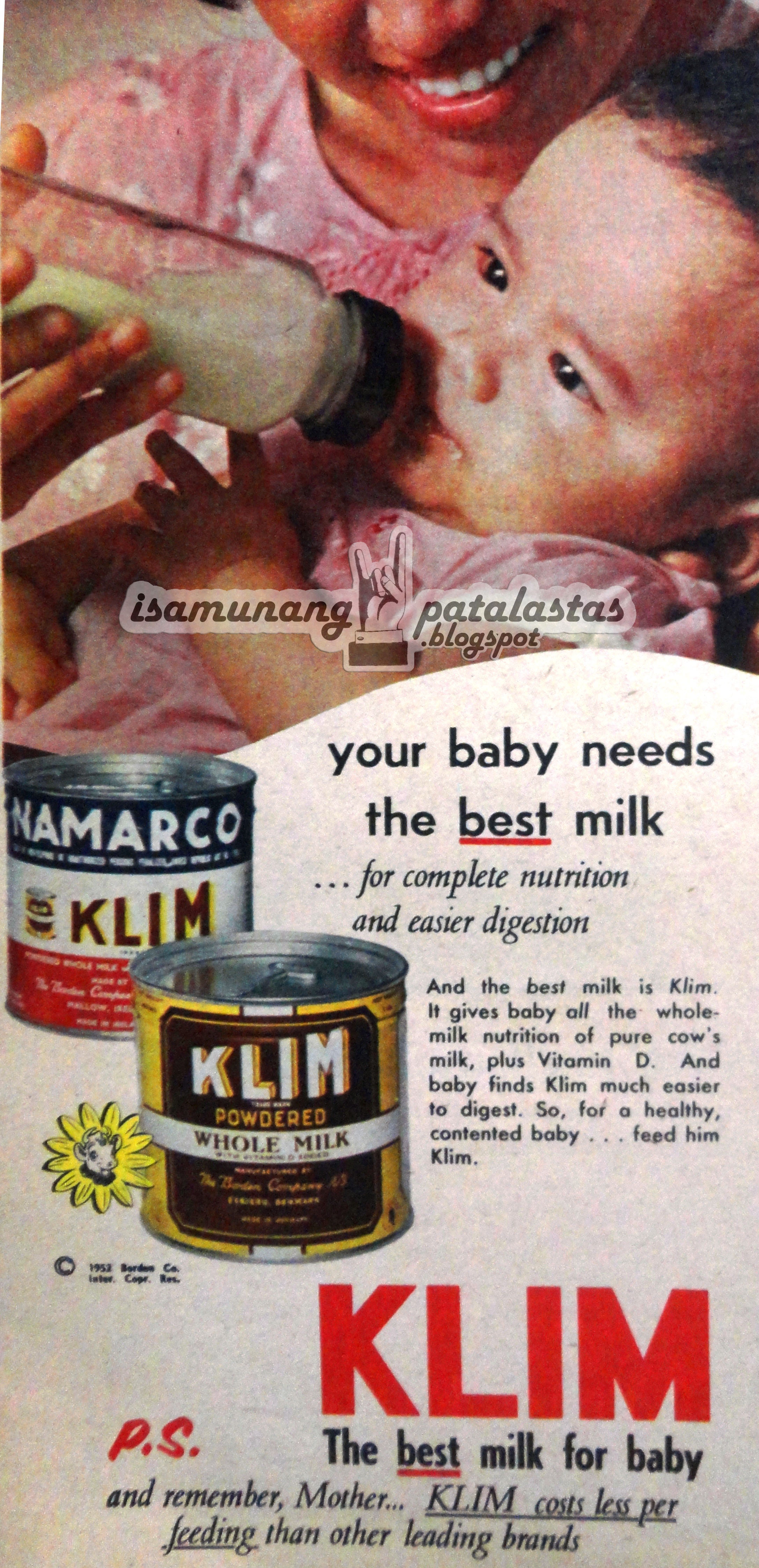
1965 KLIM AD "Best Milk for Baby"

KLIM Powdered Milk is one of the oldest milk brands available in the Philippines, but the product version sold here was made by Borden Co., a well-known U.S.-based dairy company that had its beginning in the 19th c. Early ads featured the slogan "Spell it backwards”.

EARLY 1935 PHILIPPINE KLIM AD

The brand KLIM had an even earlier history though, that began in 1920, when the Merrell-Soule Company of Syracuse, New York improved the spray-drying method patented by Robert Stauf in 1901, a process that dried milk into  powder. Merrell-Soule replaced regular milk with condensed milk, resulting in a dehydrated whole-milk powder that kept not only its nutrients, but also did not spoil quickly.

WORLD CHAMPION BOXER 'FLASH" ELORDE FOR KLIM,1957

KLIM Powdered Milk was sold in cans, and just a few spoonfuls mixed with water can give babies and kids the pure wholesome goodness and flavor of real cow’s milk. As KLIM can stay fresh without refrigeration, it was perfect for use in humid, tropical places. Hence, KLIM was brought to the Philippines as early as the 1930s, imported and distributed by the Getz Brothers.

KLIM achieved success in the Philippines, and its advertising played up on its completeness, value for money, and the convenience of no refrigeration. In the 1960s, NAMARCO-branded KLIM products were launched in support of the National Marketing Corp. which aimed to help Filipino retailers procure products at reasonable prices and promote economic welfare.

1966-67 KLIM AD
Over the years KLIM used tri-media advertising to push the product, using celebrity endorsers that included world champion boxer Gabriel “Flash” Elorde in the late 50s and a young Lea Salonga in the early 80s who popularized the jingle “I love KLIM…wow-..woww..woww.wow..I Love Klim!”.

1966-1967 KLIM AS
In 1998, Nestle acquired KLIM from Borden, which filed for bankruptcy in 2020. That same year, New Dairy Opco LLC won Borden's assets via an auction, becoming the company's new owner. KLIM Powdered Whole Milk is still being manufactured by Nestlé to this day, assuring us that this iconic brand will endure for more generations to come.

Wednesday, April 23, 2025

511. The Milk Formula Trusted For Infants: PELARGON from Nestle, 1957-1971 Ads

PELARGON MODERN MILK, 1968 Print Ad

Before the advent of infant formula powdered milk like S-26 and NAN, there was PELARGON, a full-milk powder formula for babies, developed by Nestlé in 1934. It became a favored alternative to breastmilk as it was enriched with lactic acid bacteria for easier infant digestibility.  PELARGON gained popularity after World War II, as mothers made a switch from breastfeeding to bottle-feeding.

LACTOGEN ACIDIFIED POWDERED MILK, 1957 Print Ad

In fact, many mothers and children in the 60s and 70s recall PELARGON as their ideal firstborn formula. PELARGON was pure, full cream pasteurized cow’s milk, acidified with lactic acid for improved assimilation, then fortified by the addition of dextrins—maltose, sucrose, starch, vitamins A&D, thiamine, niacin, ascorbic acid and iron citrate.

PELARGON’s protein content and fat globules are similar to breastmilk. It forms soft, easily digestible gastric curds, and provides a formula adequate in all nutrients known to be essential for the regular feeding of normal, premature or weak infants.

IMPROVED FORMULA PELARGON, 1971 Print Ad

Filipro  Inc. introduced PELARGON to the Philippines only in the late 1950s after the war curtailed their importation activities, and things began to improve. The brand was promoted through advertising, using America-made ads featuring Caucasian babies and parents from the 60s thru the 70s.

PELARGON still exists today, no longer in the Philippines, but in South Africa, where it is known as NAN-PELARGON, as NAN and PELARGON were once individual brands owned by Nestle.

Saturday, March 15, 2025

506. MAGNOLIA MILK IN CANS, ca. 1970

MAGNOLIA EVAP & CONDENSADA, Print Ad, ca. 1970s.

MAGNOLIA, the finest name in dairy products, was known for it fresh,  bottled milk and milk chocolate products. All that changed ij 1970, when MAGNOLIA went into the production of evaporated and condensed full cream milk products--in tin cans. Canned evaporated and condense milk were the most available and most popular forms of milk products that were used on a daily basis then, for a variety of uses.

MAGNOLIA  EVAP and CONDENSED MILK were supported with tri-media advertising, complete with a memorable jingle that found its way on TV and the radio airwaves.

"ANG GATAS MAGNOLIA, EVAP O CONDENSADA

PABORITO NG PAMILYA, MASARAP TALAGA!"

The canned milk did not last long when more modern forms of packaging were intriduced in the 1980s--the Tetra pak. The reconsituted milk in casn were phased out as there were more established brands that weere deeply entrenched in the market, like LIBERTY, DARIGOLD, DUTCH BABY, ALASKA,  which, in a few years would be replaced by tetra milk.

Today, Borden manufactures evaporated and condensed milk under the MAGNOLIA name, but these are not connected in any way related to the MAGNOLIA Inc. of the Philippines.

Sunday, October 8, 2023

443. Brand Stories: CHE-VITAL Cheese and Dairy Products of New Zealand Creamery, 1958

THE NEW CHEESE EXCITEMENT! Print Ad, 1967

One cheese brand with a long history in the Philippines—65 years in 2023—started out as CHE-VITAL Pasteurized Cheese made by New Zealand Creamery Inc. It was actually a company that was established in 1958 as a joint venture of the New Zealand Dairy Board. The arrangement was that the local company would provide the technology to manufacture the dairy products but this deal fell through.

CHE-VITAL. Golden rich, deliciously nourishing, 1967

A later partnership with Golden State of California in the 1960s (part of the American conglomerate, Foremost Dairy Group) resulted in a company called Golden State Phils., which was tasked with marketing and distribution of Golden State products. This partnership was eventually cancelled, and the local company founder decided to send his managers to Australia and NZ for training to learn the modern way of dairy product manufacturing.

CHE-VITAL CREAMERY BUTTER, Prind ad, 1967

With the new-found expertise, the company was set to relaunch under a new name. As it was taking too long for the Securities and Exchange Commission to approved the name, the founder revived the first company name-New Zealand Creamery, and so from 1962 onward, it had kept that name.

A CHE-VITAL CHRISTMAS, Print Ad 1978

The company’s best-known and best selling product turned out to be their CHE-VITAL cheese products, led by CHE-VITAL Pasteurized Cheese in 1962. One of the first cheese food brands in the market, CHE-VITAL was made from Australian dairy ingredients and packed in blocks.  CHE-VITAL became a favorite for making sandwiches, canapes, desserts and pastries.  By 1978, the cheese line came to include CHE-VITAL BLUE (Cheddar, packed in circular tin cans), CHE-VITAL Cheese Balls, CHE-VITAL Ham or Pimiento, and QBB Cheddar. There was also CHE-VITAL Fresh Butter, introduced in 1967.

CURRENT PRODUCT LINE, Source: New Zealand Creamery FB Page

Today, New Zealand Creamery continues to be productive as ever, still making longtime favorite CHE-VITAL: CHE-VITAL Pasteurized Process Cheese Food, CHE-VITAL Quickmelt, CHE-VITAL Cheddar, CHE-VITAL Fresh Creamery Butter. Still going strong is its  QBB Cheddar. Another powerhouse brand includes QUES-O Cheesefood, QUES-O Supermelt, QUES-O Cheesy Spread, and O-K Processed Filled Cheese Spread, a price brand. The company also makes the premium Queensland Butter in Cans, Queensland Pure Creamery Butter, Golden Crown Butter Compound, and Dairy Magic Margarine, used for cooking and baking. Indeed, with New Zealand Creamery cheese and dairy brands still around—the good life is yours to enjoy, on and on!

 SOURCES:

FB Page, New Zealand Creamery, https://www.facebook.com/newzealandcreameryinc

New Zealand Creamery Inc. website, https://newzealandcreameryinc.com/

Saturday, June 10, 2023

427. 7 YEARS OF MISS MAGNOLIA WINNERS, 1974-1980

MISS MAGNOLIA, the search for the dairy company's brand ambassador ran for 7 years.

In 1974, the Magnolia Division of San Miguel Corporation, the country’s leading maker of dairy products, and “the finest name in ice cream”, embarked on a PR event to elevate the brand image of its ice cream line. 1974 was an auspicious year, as the country was all agog at the prospect of holding the 1974 Miss Universe Beauty Pageant in Manila.

THE FIRST MISS MAGNOLIA, VIVIAN AVILA, 1974

A year before, our very own Bb. Pilipinas, Margarita Moran won the 1973 crown in Greece, a feat first achieved by Gloria Diaz only 4 years before, in 1969. This was the start of modern day beauty contest mania that continues to this day among Filipinos. 

MISS MAGNOLIA received extensive national coverage in its time.

So, Magnolia jumped into the pageant bandwagon and organized an annual contest to find their own “Miss Magnolia”, a brand ambassador envisioned to be the face of the wholesome ice cream brand, a corporate spokesperson for the ice cream division, and an product endorser and model of Magnolia’s popular line “Flavor of the Month”.

"FLAVOR OF THE MONTH" GIRL

 With the help of its ad agency, J. Romero & Associates, the quest for the first “Miss Magnolia” was organized and staged at the posh Hyatt, with 5 finalists. “Miss Magnolia” gained enough traction in the next few years and became a major media event, receiving extensive coverage at the same level as established national beauty searches.

THE LAST MISS MAGNOLIA, DINDIN LOPEZ

It had a successful 7-year run, producing winners all noted for their wholesome, winsome kind of beauty, their impeccable background and  educational attainment. Some went on to become well-known figures in the fields of entertainment, showbusiness, broadcast and PR industry. Here once more are the 7 Miss Magnolia beauties from 1974-1980.

VIVIAN AVILA, 1974 MISS MAGNOLIA. The first Miss Magnolia, Vivian “Viv” Avila was a 21 year old commerce graduate of UST. She was the college muse, a corp sponsor, and a  member of her school’s dance troupe. A working student, she was a receptionist at the Hospital of Infant Jesus after school, and modeled part-time. Avila was also the top graduate of Cora Doloros Modelling School. She holds a string of beauty titles:  Miss Summer Sports and Miss Tourism Mindanao. At the time of the contest, she was connected with Grolier’s as education counselor. The four other finalists were: Diana Robinson, Malou Camesa, Leni Palaypay and Rebecca Villavicencio.

MARIA CHRSITINA VALERIANO, 1975 MISS MAGNOLIA. 18-year old Ma. Christina “Mari” Valeriano was a 2nd year A.B. Psychology major at St. Paul when she won Miss Magnolia 1975.

MALOU PEREZ, 1976 MISS MAGNOLIA. Malou Perez emerged as the 1976 Miss Magnolia during the finals at the Hyatt Regency. She was a product of Poveda, and the University of the Philippines, where she took up Psychology.  Perez also forayed into print and commercial modelling in her time. She later went to La Salle for her MBA. Her finalists included Tonette Pineda (2nd), Lydia Mabanta (3rd) and Chiqui Toledo (4th). Mabanta became the wife of singer Jim Paredes of APO Hiking Society. Toledo joined Cathay Pacific.

GINA ARAGON, 1977 MISS MAGNOLIA. Another U.P. coed went on to win Miss Magnolia 1977, in the person of Gina Sarena Aragon a Hotel and Restaurant Administration student. Aragon was an active member of UP Junior Management Association, and an avid athlete. Her early schooling were spent at St. Scholastica College. She has appeared as a TV ad model for a toothpaste and tissue commercial. There were 12 finalists that year, including Susan Brodett, Yolanda de Dios, and Jocelyn Domingo.

MARY MASSAB, 1978 MISS MAGNOLIA. Maryknoller Mary Massab was chosen as Miss Magnolia 1978, but found greater fame post-Magnolia, as part of the original cast of the hit movie “Iskul Bukol” (1980), based on the popular Tv series starring Tito, Vic and Joey, and “My Juan and Only”, with Dolphy and Panchito (1982). She is now Mrs. Carandang.

JOANNA PARAS, 1979 MISS MAGNOLIA. In 1979, Joanna Paras was acclaimed the winner of the Miss Magnolia title. The daughter of a Procter & Gamble executive Renato Paras and Aurea Gutierrez, Paras was a 3rd year Marketing and Management student of Assumption, a Dean’s Lister, no less, when the contest beckoned. A member of the famed Bayanihan Dance Troupe, she has traveled extensively and has perfomed in Europe, South America, U.S. and some socialist countries. Her court included Ruby Ann Bonanza (2nd, an HRM sophomore0, Joy Alindada (3rd,  a senior Psychology student), and Nadine Ramirez (4th, staff nurse, Philippine Heart Center). Bonanza appeared in one movie, “Condemne”(1984), and then joined the PR division of Magnolia.

GERALDINE LOPEZ, 1980 MISS MAGNOLIA. Geraldine “Dindin” Lopez was the last Miss Magnolia, elected in 1980. It was a hotly contested battle between her and another Geraldine—Geraldine “Dina” Bonnevie.  But the popular University of the Philippines-HRM student pipped her in the finals. After her reign, she took up her MBA at the Asia Institute of Management, and joined the banking industry, with stints at Citibank, PBCom and Security Bank, She is now Mrs. Nakpil. Her court included included runner up Dina Bonnevie (actress, dubbed as ‘Drama Queen”), Thelma Aranda (3rd, TV newscaster at RPN , turned children’s book author, now Mrs. Sugay), and Ma. Lourdes “Malu” Maglutac (TV host, now Mrs. Chiongbian).

SOURCES/CREDITS:

I am indebted to Mr. Tony Paat for providing the photos and news clippings of Vivian Avila, Malou Perez, Gina Aragon, Mary Massab. Many thanks, Tony!

Sunday, February 5, 2023

411. CHEEZ WHIZ by Kraft Foods: Spreading Cheese, Spreading Smiles, since 1967.

TASTE THE CHEEZ WHIZ DIFFERENCE, 1968

Kraft Foods Inc. (founded in 1923) introduced CHEEZ WHIZ as one of its first products way back in 1967. It was an easy, quick, and convenient way to make cheese sandwiches as the processed cheese spread so easily!

Processed cheese foods actually contain regular cheese that has been reprocessed along with additional ingredients such as emulsifiers and stabilizing agents, such as xanthan gum or carrageenan, and owes its tangy flavor from additional ingredients. Annatto is used for coloring. Credit goes to food scientist Edwin Traisman (1915–2007) and his team which developed the product and which Kraft launched in several U.S. states in late 1952.

SPREAD SMILES, Cheez Whiz Ad, 1975

It took 15 years for CHEEZ WHIZ to be made available in the Philippines, but once it was launched, it became a much loved cheese spread—the only one in the country—and steadily built a loyal patronage among cheese snack lovers. 

The orange-yellow creamy cheese was packaged in reusable glass bottles, and  found other various usages in Filipino households. CHEEZ WHIZ was used as sauce for macaroni and spaghetti, for hotdog bun sandwiches and as taco and corn chip dips.

TASTES LIKE NO OTHER, CHEEZ WHIZ Ad, 1981

CHEEZ WHIZ was a constant presence in supermarkets and groceries, and was a staple in a mother’s shopping list. Which is why probably, advertising was sporadic through the decades; it had a dedicated following that the brand needed only a bit of marketing push. It even introduced a variant, CHEEZ WHIZ Pimiento, which contains real pimiento (cherry pepper) bits.

TESSIE TOMAS for CHEEZ WHIZ, Print Ad 1993

In 2012, Kraft Foods Inc. was renamed Mondelez International ( a coined term combining the Latin “mundus”, or world + “delez”, a word derived from “delicious”) . It continuous to be a global company engaged in confectionary, food, beverage and snack business.

 WATCH CHEEZ WHIZ TVC 15  'Hidylin" Here:
Source: DRPS One - PH TV Ad Archive Channel

CHEEZ WHIZ in the Philippines has become more active in the Philippines today, wit regular TV and online advertising, as the product is also available from online shopping platforms. Its current selling message is hinged on the promise of “building strength” through nutritious breakfasts, employing Olympic weightlifting gold medalist. Hidylin Diaz as its brand endorser.

SOURCES:

Cheez Whiz FB Page: https://www.facebook.com/CheezWhizPH/

Cheez Whiz-wikipedia: https://en.wikipedia.org/wiki/Cheez_Whiz

Mondelez website: https://www.mondelezinternational.com/

 Cheez Whiz TVC 2022 15s with Hidilyn Diaz (Philippines), https://www.youtube.com/watch?v=-Qq7CZdY2fs, Uploaded by DRPS One - PH TV Ad Archive Channel