Showing posts with label beverages. Show all posts

Tuesday, January 6, 2026

536. And you thought Presto only made chocolates: PRESTO COFFEE, 1962

PRESTO COFFEE INTRO AD, "Magnifico!", 1962

“When you want-a good-o coffee, get PRESTO! It’s the very best-o!”

The local PRESTO brand of the Gokongwei-founded Consolidated Food Corp. (CFC)  is so well-associated with chocolate products-chocolate powder drink, cocoa, chocolate bars. Many have forgotten that its pioneer product was a coffee brand.

In 1961, after John Gokongwei Sr,  surveyed the local coffee landscape, decided that there was room more for new coffee brands. The market leader then was the post-war brand Café Puro of Commonwealth Foods Inc., which, by 1951, had become the no.1 selling coffee brand, a position it kept till the 1960s.

And so, New PRESTO COFFEE was launched in 1962—a 100% soluble coffee made from a unique blending process of choice coffee beans. Thus, PRESTO COFFEE claims to have a livelier aroma, and real perk-up flavor. An illustration of a distinctive bemoustached Italian coffee connoisseur accompanied the print ad.

The PRESTO Coffee brand, however was no match to Commonwealth Foods’ popular line of coffee brands that are so well-entrenched in the market. Nestle’s Nescafe, on the other hand, was gaining ground due its more premium image backed by a massive advertising budget.

So, Gokongwei looked at another more viable product venture—and saw SERG’s, which practically monopolized the chocolate market. In the second half of the 60s, CFC introduce a chocolate drink under the PRESTO Brand to test the market. Shortly after, it expanded to include chocolate products. The PRESTO chocolate line began to gain traction in the market, and the PRESTO coffee brand was discontinued. The rest is history for its successful chocolate line that came to include PRESTO ice cream, PRESTO Tivoli  and PRESTO fun fruit drinks.

CFC however, never forgot its coffee beginnings and launched Great Taste Coffee in the 70s. With its superior taste, product quality, and better, more sophisticated marketing support, Great Taste also became a huge better-late-than-never success for CFC.


Thursday, November 6, 2025

530. DOLE Canned Pineapples and Fruit Drinks, 1968-1984

The brand that briefly gave icon brand Del Monte a run for its money was DOLE Philippines, which, with its array of canned pineapple and fruit drinks, was looked at as a threat to the former’s monopolistic pineapple business.

DOLE Philippines began operations in 1963 with Dolefil, a major producer of fresh and canned pineapples located in Polomolok, South Cotabato. The company's history in the Philippines is linked to the worldwide expansion of its parent company, which, in 1903 started the mass-production of canned pineapples in Hawaii. The pineapples were grown in the vast pineapple plantations that were processed in the company’s manufacturing facilities, which were canned to the highest standards,

By 1965, Dolefil made its first shipment of 30,000 cases of canned pineapple products to the US. At this time, DOLE products were being marketed and advertised in the Philippines, beginning with the canned pineapple products (chunks, crushed,  tidbits) and juices (pineapple, pineapple orange, pineapple strawberry).

DOLE products became popular options to Filipinos, as well as their mixed-fruit juices. To maintain quality control, Dolefil put up its own can manufacturing plant in 1968, and a packaging plant in 1976.

Things were going well for DOLE, until the more established Del Monte Phils.went all-out in advertising, featuring well-strategized and well-crafted TV commercials from the ad agency, McCann-Erickson, that were targeted at lower-middle classes. After all, pineapple juice was a staple drink in practically all-Filipino events, much like soda.

In 1990, Stanfilco, another Dole operation in the Philippines, merged with Dolefil. In 2013, Dole Phils. was  turned over to Itochu Corporation, and became the majority owner of DOLE plc, a global producer and marketer of fresh fruits and vegetables. This means that it has significant ownership of DOLE's Asian fresh produce and worldwide packaged foods businesses , and has also been expanding DOLE's pineapple production in the Philippines. 

Wednesday, August 13, 2025

522. Let's Raise a Glass or Two!: CAFE PURO, Various Glass Premium Ads, 1966-69

At the peak of its business, Commonwealth Foods Inc., producer of Instant CAFÉ PURO, held the distinction as the First and Largest Coffee Plant in the Far East, with the Biggest in Sales in the Philippines. It’s flagship brand CAFÉ PUROand its variants Le Café and Café Bueno, was a market and industry leader, known for its professionally-done advertising, and the regular consumer promotions.

Instant CAFÉ PURO was a leader in packaging innovation, the first to come out in glass jars with plastic caps—that were actually, usable decorative drinking glasses. These premiums had added-appeal to consumers, as you not only get coffee, you also get to keep the glass that you can use daily, so you can be regularly reminded of the coffee brand that gave it away to you—Free.


The most popular CAFÉ PURO collectibles that added immensely to the brand’s success were exclusively designed glasses that often came in sets. Chief among these were the CRYSTAL GLASS Collection, which featured applied “starlight” designs, with a flip-off plastic cap. These first came out in 1966, advertised on weekend and women’ magazines.


The CRYSTAL GLASS promo was so successful that the next year, the FOLK DANCE glass series was launched, which proved to be their biggest packaging promo ever. These were the first truly collectible glasses, that also came with matching shakers and pitchers. Each carried an ACL (applied color label) design of the country’s famous folk dances, rendered in stylizes drawings.

Singkil, Tahing Baila, Maglalatik, Itik-Itik and Tinikling were among the illustrated dances that were featured on the glass. To this day, these Café Puro FOLK DANCE series are sought after by advertising collectibles fans. (see separate article about these glasses on this blog.)

In 1968, a more premium-looking glass set was offered; The Instant Café Puro RAINBOW GLASS collection. The colors of the rainbow are all aglow in the glasses with gradating vivid hues of Orange, Yellow, Blue, Violet, Green and Purple.

Unfortunately for CAFÉ PURO, Nescafe, which initially came out in unsightly tin cans, improved on the packaging idea, and came out with their own glass collection that became truly classic—the straight-sided clear diamond-cut glass. Where Café Puro was giving out large glass jars with tin caps, Nescafe was offering classy 4-sided mutli-purpose glass canisters with glass and plastic stoppers. Simple and durable, sales took off for Nescafe, and the drinking glass and glass canisters became ubiquitous in  homes, office canteens, food stalls and wayside carinderias. With its massive market budget, product line extensions, and coffee expertise, Nescafe would bypass CAFÉ PURO by the 70s.,

 That being so, CAFÉ PURO remains a beloved brand, remembered for its full-bodied aroma and taste, as we as for its glass giveaways,  which, in their time, were the most attractive, well-made utilitarian tableware that every housewife would be proud to own.


Friday, June 20, 2025

518. GOYA CHOCOLATE PRODUCTS, Print Ads, 1967-69

GOYA OMNIBUS CHOCOLATE DRINKS, 1968

One of the more popular brands of made-in-the-Philippines chocolate products is GOYA, a joint venture started in 1956 by the enterprising  Chua and Vilabrille families, under the company name GOYA Products, Inc. The first products were actually coffee and cocoa powder mixes.  The cocoa line proved to be more viable, so GOYA expanded to making instant chocolate mixes and chocolate-flavored beverages. Eventually, GOYA would extend its line to include chocolate bars and confections that proved to be successful, favored for its affordable price and chocolatey goodness.

FROM COCOA DRINKS..TO MILK CHOCOLATE TREATS, 1967

This led to Nestlé acquiring the local company in 1996, and was promoted actively through seasonals and regular advertising. Eight years later, in 2006, Petra Foods, a Singaporean food company —now known as Delfi Limited--- bought GOYA from Nestle, which continues to oversee its manufacture and marketing promotions in the Philippines, as well as in other Asian regions.

GOYA has had several relaunches, and is positioned to cater to the medium-end and lower-end brackets. But GOYA also has premium variety, a flanker product that is also part of the portfolio, and still affordably-priced.  

GOYA ALMOND CRUNCH with a Toblerone-type packaging,1969

From the plain cube-sized chocolates, GOYA now produces dark chocolates, dark mint chocolates, white chocolates, almonds dipped in chocolates, crunchy bite-size chocolates and even choco-covered biscuits. GOYA is into spreads, syrups and baking ingredients too—so long as it’s got chocolates.

The chocolate products are manufactured in a 3-hectare plant in Marikina City that has been globally-certified for its quality and taste. The iconic GOYA is now a heritage brand favored, recognized, and much-loved by generations of Filipino chocolate lovers. The GOYA brand continues to endure, providing chocolate enjoyment to Filipinos young and old alike, that is envisioned by Delfi Ltd. to prosper and grow even morem in the years to come.

Tuesday, May 16, 2023

423. MAGNOLIA FRUIT DRINKS, "Truer to the Fruit!", Print Ads. 1983-1990

In the early 1980s, SMC-MAGNOLIA entered the lucrative juice and juice drink market with a brand called Nature’s Best Orange Drink. It had also introduced in 1981, a premium bottled fruit juice brand called Magnolia Juice, in Orange, Mango and Guyabano flavors. Nature’s Best proved to be more viable, especially with the growing shift from bottled packaging to the cheaper, recyclable tetra-pack cartons.

TRUER TO THE FRUIT, Launch Ad, 1983

Magnolia eventually dropped the more expensive bottled juice line and retained Nature’s Best for some time, only to be incorporated in a new fruit drink line introduced in 1983:  MAGNOLIA FRUIT DRINKS in single-serve tetra cartons with straws.


The launch materials include a Radio Jingle that was composed and sung by the Apo Hiking Society, with the catchphrase: “Give me the fruit…or give me Magnolia”, commissioned by its agency Ace-Saatchi & Saatchi.

LISTEN TO MFD RADIO BY APO HIKING SOCIETY, 1983 HERE:


 The MAGNOLIA FRUIT DRINKS line would expand to include Buco (Coconut water), Mango,  Guyabano (Soursop), and Calamansi (Philippine Lemon) juice flavors. The carton-packed fruit drinks survived the 90s decade, and would be reformulated several times.


In 2000s, MAGNOLIA FRUIT DRINKS reverted to PET bottles and crowned bottles. Today the MAGNOLIA FRUIT DRINK line is applied to bottled products (Grape and Orange Flavors) advertised in tandem with their fruit-based HealthTea line,

SOURCES:

1983 Magnolia Fruit Drinks Radio Ad featuring The Apo Hiking Society, https://www.youtube.com/watch?v=_NdqRBUYaNg, uploaded by 莢豌豆本舗 2018.


Friday, September 2, 2022

388. HORLICK’S MALTED MILK, 1927-1930 Ads

HORLICK'S PHILIPPINE AD, 1930s

HORLICK’S  is a sweet malted milk hot drink powder developed by British-born founders and brother  James and William Horlick way back in 1873. It was first sold as "Horlick's Infant and Invalids Food," soon adding "aged and travellers" to their label. In 1918, World War I  British soldiers brought it to India, where it achieved popularity as a family drink.

In Britain, HORLICK’S  was a favorite bedtime, while in other markets, it was promoted as a breakfast drink. It was in the 1920s that HORLICK’S MALTED MILK reached the Philippines and hailed as “the drink for all ages”.  HORLICK’S contains extracts of malted barley and wheat, mineral salts and milk, ingredients needed for ideal nutrition.

Early  Phil. HORLICK'S AD, 1927

The primary markets of this imported milk brand were undernourished Filipino children and women who are both beauty and health-conscious. It was sold in glass jars by druggists and leading grocers, and had the backing of doctors and nurses.

 The imported product was available through the next decades. There were even HORLICK’S Malted Tablets what were sold as candy, and which were supplied to the U.S. and UK. Troops as energy-boosting treats during the war. These HORLICK’S Tablets also became available in the country.

HORLICK'S GLASS PREMIUM, 1950a

HORLICK’S came under the ownership of  GlaxoSmithKline (Consumer Healthcare) in Australia, Bangladesh, Hong Kong, India, Jamaica, Malaysia, New Zealand, South Africa, Sri Lanka, and the U.K. until it was acquired by Unilever in 2018. The icon brand with a rich history is still in production today.

Sunday, July 24, 2022

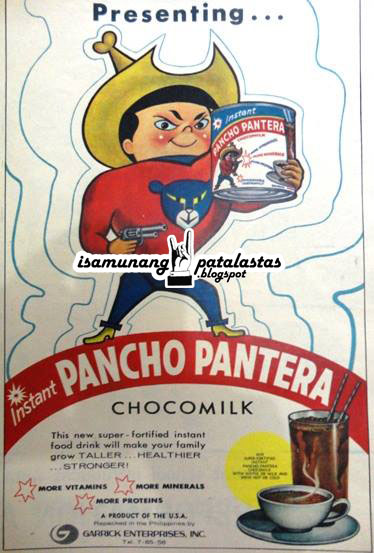
382. PANCHO PANTERA Instant Chocomilk, 1965

PANCHO PANTERA is an instant chocomilk powder drink that was widely popular in Mexico, introduced in the Philippines in 1965. Its product label claimed it is U.S. made and that the vitamins-and-minerals-fortified product was repacked in the Philippines by Garrick Enterprises Inc., owned and operated by Ricardo Quintos (father of Paul and Michael who were murdered by hired killers of his political opponent in Mindoro).

WATCH A MEXICAN TV AD OF PANCHO PANTERA CA. 1967

But PANCHO PANTERA is a heritage brand from Mexico, sold and enjoyed for over  90 years, before folding up in 2021. Along the way, the brand  was bought by a succession of blue-chip companies, from Procter & Gamble to Mead Johnson,

 PANCHO PANTERA had a brief shining moment in Philippine marketing, advertised in full color ads in magazines, and  TV, with an animated cartoon commercial featuring a cowboy mascot and a catchy jingle.

PANCHO PANTERA MASCOT, updated

In less than 2 years, PANCHO PANTERA would disappear from the local market, but Filipino children growing up in the 60s still vaguely remember the cowboy kid that ran through te TV screen, a picture of a healthier, stronger, taller kid, brought up with chocomilk that is PANCHO PANTERA!

SOURCE:

Choco Milk y Pancho Pantera en 1967, uploaded by Telenostalgia Nov. 20, 2011. https://www.youtube.com/watch?v=XAgUdUPJINA


Tuesday, June 28, 2022

378. Carnation COFFEE-MATE NON-DAIRY CREAMER, "Perfect Harmony" Campaign, 1989

CARNATION COFFEE-MATE Perfect Harmony AD, Piano, 1989

CARNATION is an evaporated milk product company  created in 1899, and its Carnation Evaporated Milk first made its presence in the Philippines in the early 1960s. Evaporated milk were favored in the country then, but Carnation made product extensions, including condensed milk, instant powdered filled milk, and a liquid coffee creamer---first introduced in 1974—Carnation COFFEE-MATE in cans.

 But Philippine households believed in cost-efficiency; since evaporated milk was already available at home, coffee-drinkers in the family used the same milk as coffee creamer. As expected, Carnation COFFEE-MATE Liquid Creamer didn’t quite succeed in the market. 

LIQUID COFFEE-MATE AD, 1974

It was only in the early 1980s, that a Carnation COFFEE-MATE Non-Dairy Coffee Creamer in powdered form, was re-introduced to the Philippine market. The non-dairy creamer was already popular in the U.S. since the mid to late 1960s, clearly positioned as a coffee partner. The new Carnation COFFEE-MATE had a better level of acceptance, despite it being perceived as a premium product.

In 1985, Nestlé acquired the Carnation Company, and the Carnation name was removed from the brand name. In 1989, its ad agency, Advertising and Marketing Associates (AMA) relaunched COFFEE-MATE with a new campaign entitled “Perfect Harmony”. The campaign echoed the perfect-for-coffee message of the older U.S. campaign. It made sense as Nestlé also produced the best-selling Nescafe Coffee brand

CARNATION Omnibus Ad, 1984

The brand embraced its premium image, and that was translated in classy, sophisticated  ads that were mostly in black and white tones, and printed on the glossy pages of magazines. A jar of COFFFEE-MATE was featured alongside cups of coffee, with black-and-white piano keys and chessboard as backdrops. The poster-like ads had little copy—jut “Perfect Harmony” in glowing white fonts.

The TV commercial was memorable for its mellow jazz-laced  jingle with a sexy  saxophone solo as the singers sing-- “COFFEE-MATE and your coffee..go together in perfect harmony..”. The “Perfect Harmony” campaign was rather unexpected in coffee advertising, as most commercials of the time featured situations and vignettes, lasting for over 2 years. 

CARNATION COFFEE-MATE Perfect Harmony AD, "Chess", 1989

Now branded Nestl COFFEE-MATE, the product continues to be available in the market and is available in stand-up packs. Flavored COFFEE-MATE (Hazelnut, Vanilla, Caramel) were launched in  2007-2013. The new liquid form was re-introduced in 2018. Its advertising presence continues to be active, with commercials produced on a regular basis. 


Thursday, November 11, 2021

350. Pop from the Past: GOODY ROOT BEER

GOODY PRINT AD, ca. 1960
GOODY ROOT BEER was produced by the U.S.-based Goody Company Minneapolis. F.F. Halili Enterprises in Balintawak acquired the license to bottle this vintage soda favorite, It is interesting to note that F.F. Halili Enterprises was owned and founded by Fortunato F. Halili, the governor of Bulacan.  Its Balintawak brewery produced the short-lived Halili Beer which was looked at as a first real threat to San Miguel Beer.

Pic: pinterest

Halili had also entered into an agreement with Mission Beverages, a U.S. company established in 1956 which was in the business of the wholesale distribution of beer, ale, porter, and other malt beverages.

GOODY ROOT BEER was manufactured in the late 1940s, but it only arrived on Philippine shores in the late 1950s, after F.F. Halili became one of its international bottlers. It came in clear bottles with the Goody Boy trade character on the neck, as well as on the crown.

 The back of the bottle reads: "Wholesome and Refreshing, Contains-carbonated water, sugar, flavor derived from natural roots, herbs and barks, colored with caramel color. Bottled under authority The Goody Company Minneapolis, Minn. Bottled by F.F. Halili, Balintawak, Quezon City Exclusive Distributor for the Philippines."

GOODY ROOT BEER was promoted in B&W and colored ads in magazines. This 1960 ad describes GOODY as “the softdrink with a SNAP!”, with a promise to give drinkers drinkers “the full feel of refreshment…tingling all the way down!”

GOODY ROOTBEER MERCHANDISING. Pix: worthpoint.com

Today there is a GOODY root beer brand in the Philippines mande to order from Intercor Food Products (IFP) Manufacturing Corporation, but which has nothing to do with the original American brand.

Wednesday, October 13, 2021

346. Pop From The Past: Canada Dry HI-SPOT

CANADA DRY HI-SPOT, 1962 Print Ad

Canada Dry Beverages, which was founded in 1923 by P.D. Saylor and Associates, reached the country in the 1950s when the Canada Dry Bottling Co.  of the Philippines was put up in Parañaque, Rizal, by authority of the Canada International Corp. New York, U.S.A. 

One of its short-lived products that was launched here was HI-SPOT Lemon Soda, a bubbly, sparkling lemon-y soft drink introduced in 1965. Hi-Spot was overshadowed by more popular Canada Dry products like Uva, Tru-Fruit Orange, Kola Champagne, so production was discontinued.

Wednesday, September 15, 2021

342. Pop from the Past: AVENUE BEVERAGES

AVENUE BEVERAGES Print Ad (1956) & BOTTLE.

AVENUE beverages were manufactured in the 1950s by Avenue Aerated Water Co.,in Grace Park, Caloocan. This 1956 print ad lists 6 tasty Avenue flavors: Red Berry, Orange, Sarsaparilla, Cream Soda and Pineapple. Avenue sold for 10 centavos per bottle and remained available all through the 60s.

SOURCES:
Avenue Beverages & Soda Bottle, courtesy of Siglo Antiques & Collectible

Tuesday, August 3, 2021

335. Brand Stories: JULEP BEVERAGE SYRUP, 1964

FROM THE MAKERS OF OVALTINE---JULEP! Intro Ad, 1964

The fruit juice syrup that took the coutnry by storm was introduced in 1963, as JULEP Beverage Syrup, touted as coming from “the  makers of Ovaltine”, which by then was an established brand. Associated British Foods plc (ABF) was a leading British multinational food processing and retailing company that specialized in sugar products and ingredients. Through the years, its subsidiaries in the Philippines included Novartis, Wander AG and currently, ABF Group.

COOL RELAXATION WITH JULEP, 1964

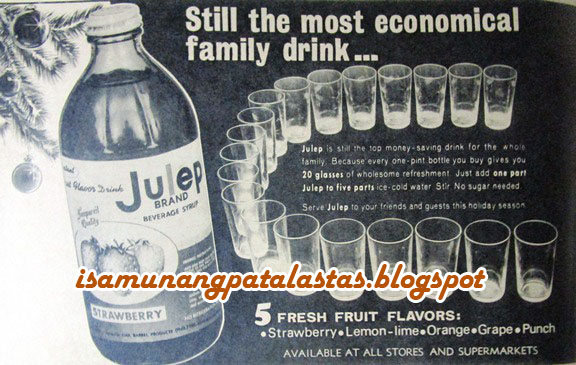
JULEP found a ready market in the Philippines as it was a pioneer liquid concentrate brand—long before Sunquick and Sunny Orange Drink. It was available in 5 refreshing flavors: Grape, Lemon-Lime, Orange, Punch and  Strawberry. All one had to do was add 1 part JULEP to 5 parts water, and you’re ready to enjoy its fruity goodness. One pint of JULEP makes from 20-22 glasses, so it was economical too.

SO REFRESHINGLY DELICIOUS--JULEP! 1967 Ad

The black and white launch ads of JULEP came out in 1964, and soon, Filipino consumers couldn’t get enough of the new fruit juice; never mind if it left colored stains on the mouth. The brand became the most popular juice drink in the Philippines, and the name JULEP became a byword. Its advertising became even more sophisticated with full-blown campaigns rolled out in 1967—all featuring photographic ads in color.

ZESTY, FLAVORFUL JULEP, 1969 Ad

ZESTY, ECONOMICAL JULEP, 1969 Ad

JULEP had a good run, driven primarily by its economical price, but by the late 60s and early 70s, there were newer brands that competed for attention. All of a sudden, JULEP was looked at as on old-fashioned brand, not “in” with the young set which was looking for more innovation and appealing flavors. Mothers, too, were more discerning, and were ready to invest more in better quality drinks.  Competitors like Sunquick, took to TV advertising with commercials featuring pop jingle, hipper-looking teens, in fun-filled vignettes. SUNKIST, on the other hand, was driven mainly by its made-in-America image, a tack that TANG would later adapt in its Philippine launch. It also didn’t help that the company that originally made JULEP underwent a series of mergers and acquisitions that led to the dropping of the brand in the product portfolio. In the 80s, Sunny Orange took over as the more popular orange brand in the mass market.

THE MOST ECONOMICAL FAMILY DRINK, 1966 Ad


Sunday, July 18, 2021

332. ISUAN SOFT DRINKS, of ISUAN Inc. 1935-1937

ISUAN SOFTDRINKS PRINT AD, 1937

One of the most popular line of softdrinks of the 1930s Philippines is the ISUAN brand (pronounced E-Swan), produced by ISUAN, Inc. The softdrinks were made from the famous ISUAN Mineral Water, sourced and bottled at Deep Hot Springs, Km. 66, Los Baños, Laguna. Aside from the all-purpose mixer , Soda Water, the flavors include Tru-Orange and Ginger Ale. Another sub-brand Dixo-Cola was added to the ISUAN line around 1935.

FORMULA FOR REFRESHMENT, ISUAN, 1935

ISUAN GINGER ALE & TRU-ORANGE, 1935

WHISKY-ISUAN, 1930s

DIXO-COLA, by ISUAN, 1930s


Thursday, June 3, 2021

326. Everybody Loves COCOA RICOA by Philippine Food Industries Inc., 1962 Ads

COCOA RICOA was the pioneer product of the  Philippine Food Industries, Inc. when it bgena its operations in the chocolate processing and manufacturing plant along EDSA in Mandaluyong in 1956. The brand became a traditional favorite for chocolate lovers, using COCOA RICOA for the chocolate breakfast drinks, cakes, custards, ice cream, cookies and other chocolate-based goodies.

The product was advertised heavily in color ads that often carried recipes to promote its varied usages, although the chocolate powder was mostly used for hot and cold drinks. COCOA RICOA was also produced in blocks, and in sweetened powder and syrup form, for versatility of use. 

It attained such popularity that in 1962, a thematic campaign was launched to create a”bandwagon effect” for the brand. “Everybody Loves Cocoa Ricoa” featured every member of a Filipino family attesting to COCOA RICOA’s flavorsome, chocolatey appeal as used in their specific favorite choco treat: Lola for her “champorado”, Lolo for his “Chocolate Español”, Mama for her chocolate cake, and so on. 

Today, COCOA RICOA is still being produced, led by its  COCOA RICOA Breakfast Powder, still in its familiar, but modernized deep turquoise packaging by Commonwealth Foods, Inc, which  has owned the brand since 1968. COCOA RICOA is one of the few trailblazing, locally-produced chocolate product brand that has survived the test—and taste—of times, inspite of the  greater availability of imported brands in the Philippine market, proof that after all these years, “Everybody loves COCOA RICOA!”