Showing posts with label medicines. Show all posts

Wednesday, April 20, 2022

369. MORE AMUSING BRAND NAMES YOU WON’T BELIEVE WERE USED IN THE PHILIPPINES (part IV)

Last of a 4-part series of some of the most amusing, unusual, and sometimes, weird-sounding names ever coined for real products, that were available in the Philippines –from the 1930s to the 1960s.

REUTER’S  SOAP. Brand Name For: Skin Soap

The early toilet soap designed to beautify a woman’s complexion is a trademark of Lanman & Kemp-Barclay & Co., Inc. The company, itself was founded in 1808 by Robert I. Murray and its business was conducted under the firm name Murray & Lanman in New York.  The brand name--REUTER’S SOAP-- has nothing to do with the world-famous news bureau. It was named after its creator, Dr. John Reuter. The classic bar soap was sold in the 1950s under its Spanish brand name, Jabon de Reuter, in the Philippines. The company still is in cooperation today with headquarters in Westwood, New Jersey, and continues to sell the soap.

SAKITALIS. Brand name for: Medical plaster

Now here’s another direct-to-the-point name for a pain-soothing medicated plaster—SAKITALIS (Aches away!).  The wordsmith had an easy time with this brand name, and even though it sounded like the aforementioned “Katialis”, it is still distinct in its category. SAKITALIS, which contains belladonna, was “the most effective plaster pan reliever”—in distinctive pink color! It was available in the late 1950s at all drugstores,  distributed by Colossal Drug Store. But the coming of made in Japan Salonpas, obliterated it, and by the 1970s, Salonpas became the dominant plaster brand, for its superior efficacy—not to mention its catchy, classy name that has become an everyday term for  a pain relieving plaster for all body parts.

SILENT NIGHT. A Brand Name for: Perfume and Lotion

Yes, Virginia, there is such a perfume brand called SILENT NIGHT, ‘ a perfume masterpiece made by Countess Maritza of New York, U.S.A.”. It was locally distributed in local stores in 1962. But wait,  there’s also a SILENT NIGHT Lotion to complement it. Like a line from the carol, was it also tender and mild,? With a name like that, how can you miss? As the ad suggests—“it’s best to give on Christmas!”. One wonders if it is inappropriate to give SILENT NIGHT on other occasions, say, like birthdays and Valentines,

TANSAN. A Brand Name for: Mineral Water

It’s okay to drink the TANSAN!!!The crown cap revolutionized the glass bottling industry when it was invented in 1897 by William Painter. The first drink that featured the crimped tin cap was called TANSAN, a bottled mineral water marketed by Clifford Wilkinson in the early 1900s. The brand name TANSAN–believed to be of Japanese origin–has now come to mean crown caps in Filipino. The product first came out in straight-sided bottles, and then in small, bulb-shaped green bottles with the name in relief.  In its 1920s ads, TANSAN was proclaimed as a 100% pure, sourced from “natural waters free from all earthly deposits.” Being “radium-active,” TANSAN possesses many medicinal qualities, proven against stomach disorders.

VIN DÉSILES. A Brand Name for: Tonic wine

The brand name of this revitalizing drink popular in the 1950s seem anachronistic as it sound like the name of contemporary Hollywood action star, Vin Diesel. But it was produced long before the action star of “XXX” and “The Fast and the Furious” was born.  VIN DÉSILES, a wine-based drink that claims to restore energy and appetite, and was distributed by Oceanic Commercial, Inc. in the Philippines. It may not have inspired the name of action star Vin Dieeel, but it sure is power-packed like him!

SOURCE: By the Author. Originally appeared on esquiremag.ph under the title: Funniest Filipino Brand Names in the 20th Century - Esquire , https://www.esquiremag.ph/culture/lifestyle/old-brands-philippines-a2289-20190211-lfrm4


Tuesday, February 8, 2022

362. MORE AMUSING BRAND NAMES YOU WON'T BELIEVE WERE USED IN THE PHILIPPINES, Part II

Part II of some of the most amusing, unusual, and sometimes, weird-sounding names ever coined for real products, that were available in the Philippines –from the 1930s to the 1960s.

***********

BARRY’S TRICOPHEROUS, Brand name for:  Hair Tonic against baldness, thinning hair and dandruff

BARRY’S TRICOPHEROUS was introduced in the late 1840s by "professor" and former New York wig-maker, Alexander C. Barry. The term “tricopherous” alone  conjures many images—either a serious, incurable disease or the name of an extinct dinosaur. But despite its name, the product did surprisingly well.  Barry exhorted his customers: “Stimulate the skin to healthful action with the Tricopherous, and the torpid vessels, recovering their activity, will annihilate the disease.” Apparently, that worked for many satisfied men. The product contains 97% alcohol, 1.5% castor oil, and 1% tincture of cantharides (Spanish fly), which supposedly help stimulate the scalp’s blood supply.  BARRY’S TRICOPHEROUS is still being produced and sold today by Lanman & Kemp-Barclay & Co.

GALISATUM: Brand Name for: Skin Ointment

GALISATUM Lunas Galis was a skin ointment developed by Dr. Carlos Jahrling of Botica Sta. Cruz in the 1930s. Dr. Jahrling was a German pharmacist from Offenbach who opened his own business in Manila.“Galis” was an all-encompassing local  term for any skin conditions. “-Atum” was a suffix that was  commonly used in pharmaceutical products  like “mentholatum”and “petrolatum”.  GALISATUM with Lunas Galis sounds more like an incantation or a Latin spell to improve skin condition, especially when you say it thrice.  But it does relieves prickly heat, chafing, pimples, mange, eczema, dandruff and  maladies with mysterious names like Dhobie’s Itch (another term for Jock’s Itch) and Hongkong Foot (a slang for athlete’s foot), as this ad from 1936 claims.

GAYTOP: Brand Name for: Concentrated Hairdressing and Conditioner

Before gay language became more elaborate, it was okay to for Helene Curtis to dub its latest hair conditioner product.  GAYTOP. Nothing wrong with that--in the late 1950s. Today, GAYTOP sounds so suggestive with its homo-erotic undertones;  it seems to reveal  one’s orientation and preferred sexual role—especially when talked about in a beauty parlor! Indeed, if this product were around today, it will be a “brand that dares not speak its name”.

JAGGING JAGGING: Brand Name for:  Face Powder and Pomade

There really is no reason why a  cosmetic product guaranteed to make you “lovely to look at” be named JAGGING JAGGING. It is nonsensical, unfeminine and the sound is far from mellifluous. But  Chun Huat Pomade Factory, the manufacturer, did just that, making it hard to believe that Jagging Jagging  is indeed,  a “girls’ favorite”. Ad from 1934. 

KULSO-ALIS: Brand Name For:  Anti-diarrhea, anti-dysentery

Another product coming from Dr. Jahrling’s Botica St. Cruz is  KULSO-ALIS, a concoction with a brand name that comes from “Kulso” (diarrhea, loose bowel movement) and “Alis” (to be free from, begone). It was a common way to coin brand names for products this way, bewildering the Pilipino name may be to a foreigner. Perhaps this anti-LBM medicine was really meant to target local market only.It is interesting that Kulso-Alis lists  opium as one of its ingredients. Ad from 1937

 (This article originally appeared in the online magazine Esquire Philippines www.esquiremag.ph, on 11 Feb. 2019, under the title "Funniest Filipino Brand names in the 20th Century", commissioned from the author, Alex del Rosario-Castro)

Saturday, January 15, 2022

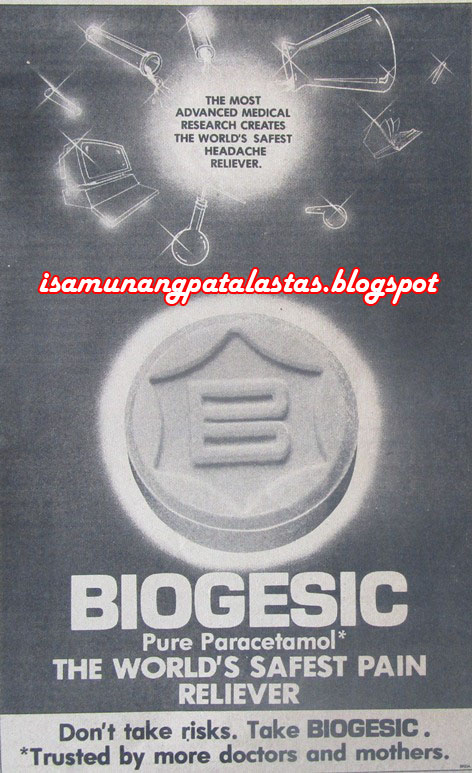
359. Out-of-Stock, but Never Out-of-Mind: BIOGESIC, Print Ads 1987

DON'T TAKE RISKS, TAKE BIOGESIC, Print Ad, 1987 

BIOGESIC  has been in the news lately, as the popular paracetamol brand has suddenly gone out of stock—along with analgesic, anti-pyretic, cold and cough medicine brands-- in the midst of the ongoing covid surge. The supply situation was so bad that even one netizen asked John Lloyd, current BIOGESIC endorser, for the much-needed tablets.   

A Biogesic out-of-stock  meme circulated during the covid surge, CTTO

BIOGESIC has been in the market for over 50 years, a product of the pharmaceutical firm, United Laboratories, Inc. (UNILAB). For decades, anti-fever and pain brands available  locally were paracetamol and aspirin-based, like Cortal, Cortapen, Medicol, Bayer’s Aspirin. The introduction of acetaminophen products expanded the market, and by the late 1970s, Tylenol, the widely-used American brand from McNeilab of Johnson & Johnson, was launched in the Philippines, along with its cold medicine counterpart, CoTylenol.

Tylenol became a huge threat to BIOGESIC and other local brands, as it was sold on the basis of safety—it does not cause stomach upset like aspirin does, which can irritate the stomach lining. Tylenol was also sold on its American leadership (America’s #1 Pain reliever), to capitalize on the so-called colonial mentality of Filipinos. 

CHILDREN'S BIOGESIC SYRUP PARACETAMOL, 1987

All that changed when Tylenol products in the U.S. were laced with cyanide in 1982 by still-unknown criminals, resulting in 7 cyanide deaths in Chicago. The product was pulled out of the Philippine market, and by 1986, BIOGESIC took over the safety theme with the absolute claim: “The World’s Safest Pain Reliever”—in reference to its pure paracetamol ingredient, not the brand. In 1987, a children’s syrup version was even introduced.

BIOGESIC never let go of this safety positioning, and has served the brand well, especially when the “Ingat” campaign, featuring celebrity actor John Lloyd Cruz, was launched in 2007. Marketing pundits believe that the consistent brand messaging of BIOGESIC  paved the way for Filipino consumers to continue trusting the product for aches, fever, and pain, as it continues to be the leading choice for paracetamol in the market—if people can only find it in drugstores today!

SOURCE: John Lloyd and 9 Years of “Ingat”. The Manila Times: https://www.manilatimes.net/2015/05/23/lifestyle-entertainment/show-times/john-lloyd-and-nine-years-of-ingat/185906, 23 May 2015

Saturday, January 8, 2022

358. AMUSING BRAND NAMES YOU WON’T BELIEVE WERE USED IN THE PHILIPPINES, Part 1

(This article originally appeared in the online magazine Esquire Philippines www.esquiremag.ph, on 11 Feb. 2019, under the title "Funniest Filipino Brand names in the 20th Century", commissioned from the author, Alex del Rosario-Castro)

What’s in a brand name? A brand name defines and differentiates a product from its competitors in the eyes of the customer. So important are brand names that they can make or break a product—an urban legend has it that a car maker once named its new vehicle “Nova”, not knowing that “no va” meant “not going” in Spanish.

Would you go to a coffee house called “Cargo House” or “Pequod”? Those names by the way, were considered for your now favorite Starbucks. Then, there’s Lithiated Lemon, a lemon-lime drink introduced in 1929. But when renamed 7-Up, sales increased six-fold. On the other hand, there are perfect brand names like “Jollibee”, “Hapee” and “Mr.Clean” that evoke positive images of joy, clean living and fun.

Before marketing experts offered their brand-naming services, many makers of products just coined their own brand names, resulting in amusing, unusual and sometimes, weird-sounding names.

***********

ANALGINA: Brand Name for a Medicine Syrup for rheumatism and headaches.

ANALGINA is the name of this cure-all also indicated for diarrhea, neuralgia, cramp, breastache, backache, indigestion and cough. At first impression, it has a name seemingly coined from two delicate parts of the human female anatomy—well, at least that’s how it reads.  But the first part of the brand name is derived from ‘analgesia” , which means “relief from pain”.  With the  suffix added however, ANALGINA, as a brand name, doesn’t evoke anything medicine-y; rather it sounds like a disease!  In 1929, you can buy ANALGINA over-the- counter at Botica Insular along Quesada St. in Manila. Just don’t say the name out loud.

ASEMBLEA FILIPINA: Brand Name for : Local cigarettes

Why would someone name a cigarette brand after the Philippine Assembly (ASEMBLEA FILIPINA) ? Well, Simeon Roque y Compania,  maker of these “cigarillos” in Betis, Pampanga, just did. In fairness, the inauguration of the Philippine Assembly in 1907 was a major event, as that gave a glimmer of hope to Filipinos for self-rule. To the local cigarette maker maybe, that historic milestone is worth celebrating with a puff of a “cigarillo” stick. The cigarette label of “ASEMBLEA FILIPINA” cigarettes even contain a short poem in the vernacular, exhorting customers Philippine-made products, not imported ones—and exhortation to nationalism, at a time we needed it most.

ATOMIC / ATOMI-CHLOR: Brand Name for :  Pomade / Pesticide

The atomic age began when the first nuclear bomb was detonated in 1945 that led to the bombing of Hiroshima and Nagasaki  which ended World War II. It also started our fascination with atomic designs and organic forms,  inspired by atoms, missiles and rockets, that found their way in product designs and even in brand names. Such is the case with two different products sold and manufactured locally in the 50s .The first is ATOMIC Solid Brilliantine, a men’s pomade brand available in glass jars. What can this pomade do? Will it split the atoms in your hair?  Will you be positively charged? We may never know as this product had a short shelf life.

Another is ATOMI-CHLOR, a liquid product formulated to rid pet dogs and your lawn of  fleas, ticks and insects. This Chlordane-based product came out in 1951. One is wont to wonder if ATOMI-CHLOR had radioactive properties that killed these pests. But we now know that Chlordane is a chemical compound classified as an organic pollutants hazardous to animals, and even human health. Oops.

BAGONG LITAO: Brand Name for Local cigarettes

Another strange name for a cigarette brand is “BAGONG LITAO” (Newly-Appeared), locally made and rolled in Pampanga by a certain Martin Torres. Even the front panel illustration is rather odd: it shows 3 Filipina women in baro’t saya—and they are not even smoking.  For cure, BAGONG LITAO is a reference to the new arrival of the product. But wouldn’t the name become obsolete in a year or so? Because by then, it will no longer be new. It will no longer be BAGONG LITAO, right? Hmmm, I need a smoke. 

BALATKINIS: Brand Name for a Skin Ointment

Katialis is the most successful and most popular local skin ointment in history, with a formula developed by Dr. Lorenzo C. Reyes. Its name was derived from Kati+ Alis (Itch Away) . But the actual concoction was done by his chemist brother, Manuel, who mixed the ointment at the Locre Laboratorio in San Lazaro, Manila. After a decade, Manuel struck it on his own and developed his own product in  that, like Katialis, promised to eradicate: “galis, buni, pigsa, tagihawa, butlig, anan,pekas alipunga at sugat na maliliit”.  Manuel also named it like Katialis—combining Balat + Kinis to come up with the brand name BALATKINIS  (Smooth Skin).  Launched in 1947, BALATKINIS, the copycat product with a copycat name proved to be short-lived.  

Monday, November 9, 2020

296. BREACOL with XYLOPOL: Stops Cough Faster…Fastest! Print Ads 1957-1969

BREACOL WITH XYLOPOL, 1960 Ad

One of the leading cough medicines that enjoyed nationwide success in the 1950s  is BREACOL with XYLOPOL. It was a product of Sterling Drug, an American global pharmaceutical company before it merged with Winthrop-Stearns,Inc. It had performed exceedingly well in Latin American countries, and so, when it was time for BREACOL to be rolled out in Asia, the company chose to launch it in the Philippines in the mid 1950s, and later, in Singapore 

BREACOL, 1957 Ad

BREACOL with XYLOPOL claims to stop cough faster, in 5 ways: it destroys germs, soothes irritation, stops throat tickle, loosens phlegm and medicates deeply. Later, the “ideal cough remedy for the whole family”. In the days before the ad industry had a regulatory board, BREACOL even went for the superlative, by claiming that it “Stops Coughs Fastest”. 

BREACOL, 1958, 1959 "HIS 'n HERS" Ads

The first BREACOL ads had copy that were direct lifts from foreign ads, and had clip-art illustrations of foreign-looking models. For better appeal, spot color (Red) was added to the prints ads. Photography was rarely used.  For over a decade, BREACOL was a leading presence in the cough market, challenged by Vick Chemical Company, which was already I the market at just about the same time with its Vicks Cough Drops. In time, Vicks Cough Syrup was introduced as well, which was heavily pushed in print and the rising radio medium. 

IDEAL FAMILY COUGH REMEDY AD, 1960

BREACOL could not simply compete with the resources of Vicks (marketing giant Procter and Gamble took over it) as the latter cornered the cough and cold market with such products as Vaporub, Inhaler, cold tablet, and nasal drops.

STOPS COUGH FASTEST! 1961 BREACOL AD

After several years,  XYLOPOL seemed like old news. In 1969 BREACOL reformulated and rebranded itself as DEXTRO-BREACOL with DXM, in reference to the Dextromethorpan which suppresses the signals in the brain that trigger cough reflex. It was hardly a unique ingredient, as most cough syrups were also dextropmethorpan and guaifenesin-based. 

DEXTRO-BREACOL REFORMULATED, 1969

Still, BREACOL plodded on, supported by core loyalists who remember the 50s brand fondly. Happily the brand name is still around today, through the Singapore-based  Invida, a specialty pharma company formed by a joint venture between Quintiles, Temasek and Zuellig. Invida commercializes  different pharmaceutical products of superior quality and markets them worldwide. Invida counts BREACOL as one such proven brand.

SOURCE:

Sterling Drug: https://en.wikipedia.org/wiki/Sterling_Drug

Thursday, September 17, 2020

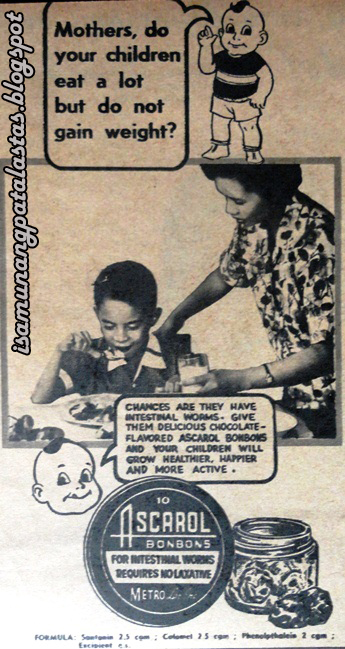
297. ASCAROL BONBONS, by Metro Laboratories, Inc. (1957-1969)

ASCAROL BONBONS, in chocolate flavor, 1957

One of the most popular deworming drugs in the 1950s, was ASCAROL brand, produced by Metro Laboratories, Inc. Metro was then a leading pharmaceutical company that made popular products as Dhobinol (skin ointment), Elixir Auri-Bromide and Metrotussin (cough medicine).

ASCAROL Print Ad, 1957

Ascariasis, or roundworm infestation, was a common children’s condition in the post-war 50s, and the most prevalent in agricultural Philippines. The soil-transmitted parasitic worms can cause severe abdominal pain, fatigue, vomiting, anemia, distended abdomen, itching, and malnutrition and weight loss in kids.

ASCAROL print ad, 1960 

 As liquid antihelminthic medicines tended to be distasteful for kids, Metro Laboratories made the product in chocolate-flavored candy forms---ASCAROL BONBONS. The albendazole-based bonbons, came individually-wrapped in a glass jar,, which children can enjoy like candy,  while being treated for their infestation. No laxatives were required.

 ASCAROL Print Ad, 1969

ASCAROL BONBONS were promoted in print ads, from the 50s to the 70s, becoming household names, and proven the most effective worm expellant for decades. The rise of new  and very affordable multi-worm products halted ASCAROL’s market success. Combantrin, for example, is Pyrantel-based, which required only one dose to eliminate all types of worms, and yet it is gentle on the stomach.

 The brand name Ascarol today, is used by Laboratorio NeoFarmaco of Ecuador, in their de-worming product that is just as popular as the Philippine brand of old.

Thursday, April 2, 2020

273. The Alcohol that’s Got It All: GREEN PINES ALCOHOL by Union Carbide


Union Carbide Corp. (founded 1917), is more famous for its brand of car batteries and alkaline batteries. But through its chemical division, Union Carbide  is also a producer of ethylene, a basic chemical made from components of crude oil and natural gas. Ethylene is converted into polyethylene to produce ethylene oxide, which is used by the company in the making of ethylene glycol,  solvents, and—alcohols.

In July 1971, the Union Carbide introduced to the Philippine market, its new GREEN PINES RUBBING ALCOHOL. It mentholated alcohol fives an instantly cool feeling on skin.  It has soothing wintergreen for comfort that lingers.


Packed in Tru-grip bottle, GREEN PINES, also has a flow regulator to avoid spillage. And it’s guaranteed pure. No wonder, GREEN PINES claim is that this is the “alcohol that’s got it all”.

Too bad GREEN PINES didn’t survive the decade. Just like the current situation caused by the corona virus, the alcohol went out of stock before the decade was over. Today, Union Carbide is now wholly owned by the Dow Chemical Co.

Monday, September 2, 2019

238. Brand Stories: BIODERM OF International Pharmaceuticals, Inc., 1962-68.

EARLY BIODERM AD, 1962

The very popular BIODERM Ointment, used in the treatment of skin ailments and infection was a product of the Wong Brothers, founders of the International Pharmaceuticals, Inc, (IPI) in Cebu. In 1959, The Wong brothers--George., Pio Sr., David Sr., Sergio,  and Sixto—bought the efficascent formula first developed by Miguel Chiong known as “Efficol” , giving them the right to manufacture the product in their own laboratory that would become IPI. Through door-to-door marketing and effective sales push, Efficascent Oil, as the product was now branded, became a national success.

This led IPI to develop more products using their own formula, and in 1961, the company came up wirh Dr.Wong’s BIODERM Ointment in tins.
 
BIODERM PRINT ADS, 1967
BIODERM Ointment contains antiseptic, antibacterial and antifungal ingredients beneficial in the treatment of ringworm, eczema, blackheads, pimples, furunculosis, acne, skin itch, white spots (ap-ap), athlete’s foot, hand itch, barber’s itch, insect bites and other skin irritations on the head and on the body. It is also effective for prickly heat, dhobie itch, mange, Hong Kong foot, and itching dandruff.

It was first advertised in 1962 as Dr. Wong’s BIODERM—Effective Treatment for Skin Ailments. BIODERM, with its modern image and formulation, gave Katialis, a leading cream for various skin conditions for decades, a stiff competition, becoming another success.
 
BIODERM PRINT AD, 1968
BIODERM was actively advertised through the 60s, and in the succeeding decades, and these early ads show how its advertising, marketing and pomotions evolved. Eventually, with the brand’s success, a BIODERM germicidal soap was developed, which also gained following.

Today, these two BIODERM products are still going strong in the market. BIODERM has helped grow IPI, which allowed it to expand its portfolio to include not just liniments, consumer health products, home care, food supplements, veteriany products, medical equipment and pesticides.

Monday, April 29, 2019

218. Plop-plop, Fizz-fizz, Oh what a relief it is!: ALKA-SELTZER Print Ads, 1956-57

ALKA-SELTZER, 1956 PHILIPPINE AD.

The most well-known  effervescent antacid and pain reliever in the 50s—ALKA SELTZER—became available in the Philippines as an imported product in the late 1920s, but it was only around 1951 that it was actively promoted. Made by Dr. Miles Medicine Co. of Indiana, U.S. in 1931, ALKA-SELTZER had 3 active ingredients—aspirin (for fever and pain), sodium bicarbonate (antacid) and citric acid (for effervescence)
 
SPEEDY appears in this 1957 Alka-Seltzer ad.

When advertised, ALKA-SELTZER was indicated for the relief of headache, fever and pain, acid stomach, indigestions and hangovers. It was one of the most advertised products in the world, and its commercials were among the most popular. 

Speedy, created in 1951 as the product mascot, was also one of the most recognized advertising character in history, and was extensively used in magazine ads that saw print in the Philippines,

The memorable "Plop, plop, fizz, fizz" ad campaign made its appearance in the Philippines featuring the animate mascot and a hit jingle. 

It was conceptualized by Paul Margulies, a Madison Avenue creative executive, and father of actress Julianna Margulies. The vintage 60s ad showed 2 ALKA-SELTZER tablets dropping into a glass of water instead of the usual one, which caused sales to double.  In 1976, the campaign was successfully revived, with jingle sung by Speedy.

WATCH THE ALKA-SELTZER TV AD HERE:
published by Steve Stout, 23 Apr. 2007

By the time Miles Laboratories was bought by Bayer in 1979, ALKA-SELTZER had disappeared from botica shelves, It is now only available as an imported product, which one can now order online.


 SOURCES:
Alka-Seltzer TV Commercial. uploaded by Steve Stout, published on April 23, 2007.   https://www.youtube.com/watch?v=bxjb2UJZ-5I
Alka-Seltzer Just a reliefe Away, pinterest.com

Saturday, October 27, 2018

188. For Aches, Pains, Trancazo: CAFIASPIRINA, Print Ads 1936- 1962

CAFIASPIRINA INK BLOTTER, Premium/ Giveaway. 1950s.


Bayer, the drug company that would give the world it most popular pain medicine—aspirin—was founded by German Friedrich Bayer on 1 August 1868. 

From manufacturing chemicals, it engaged in producing pharmaceutical products, and in 1899, Bayer Aspirin was introduced and the medication proved to be a universal success for the relief of minor aches, pains and fever.

Between the two World Wars,  new aspirin brands and aspirin-based products flooded the market. Brands like Aspro (Australia), St. Joseph’s, Burton’s and Molloy’s  (U.S.) were marketed internationally. In Latin America, Bayer produced a pain and fever relief brand fancifully called CAFIASPIRINA, coined from the Spanish word for "caffeine" combined with  "aspirin" (acetylsalicylic acid) , its 2 main ingredients.
 
EARLY CAFIASPIRINA PHILIPPINE AD, 1936

PRE-WAR CAFIASPIRINA AD, 1940

CAFIASPIRINA became a popular pain medication brand in Latin American countries, like Brazil, Argentina, Chile and even in Spain and Portugal  in the mid 1920s, where it was heavily advertised. By 1936, CAFIASPIRINA ads began making their appearances in Philippine magazines. It quickly established itself as a trusted fever and pain relief medication.
 
1951 FOOT ADS


Cortal, introduced in the 1950s, proved to be a worthy rival of CAFIASPIRINA, and both engaged in marketing wars. To push CAFIASPIRINA, an illustrated cartoon figure of a Filipina nurse began appearing on its print ads, most of which were drawn as comic strips.
 
NURSE CAFI, brand mascot, 1951

CAFIASPIRINA Comic Strip Ad, 1955.


Thus, Nurse CAFI joined the league of comic characters like Kenkoy and Capt. Cortal as brand icons to sell products in the marketplace. The illustration of Nurse CAFI, finished in 1948 but used only in 1951 ads, shows her in a typical white uniform holding a giant CAFIASPIRINA tablet foil pack. She appeared not only in print ads but also on botica merchandising signs with the battlecry--"Stop Pain! Feel Fine Again!",
 
NEW FORMULA CAFIASPIRINA, Print Ad, 1957

TRIPLE-ACTION CAFIASPIRINA, 1959.

In the course of 10 years CAFIASPIRINA was advertised on the basis of quick action (“works faster than wonder drugs”), efficacy (“goes straight to the source of pain”) , safety (“does not affect the heart”), and formulation (“ 3 marvelous pain fighters”). The brand actively was promoted in point-of-sale, through botica merchandising materials, premiums and giveaways.
 
RARE, ENAMEL SIGN FOR A BOTICA, Merchandising giveaway. 1950s

Cortal, however, was perceived as a more modern medication, and would eventually wrest market leadership from CAFIASPIRINA. CAFIASPIRINA advertising began tapering off in 1962, in favor of Bayer Aspirin ads, and such new product launches as St. Joseph’s Aspirin, also by Bayer. By mid 1960s, Cortal had become the best-selling pain relief brand in the Philippines. 

CAFIASPIRINA, strip ad, 1962

Today, CAFIASPIRINA continues to be produced by Bayer and remains a strong, loyal following in Spanish-speaking countries.

SOURCES: