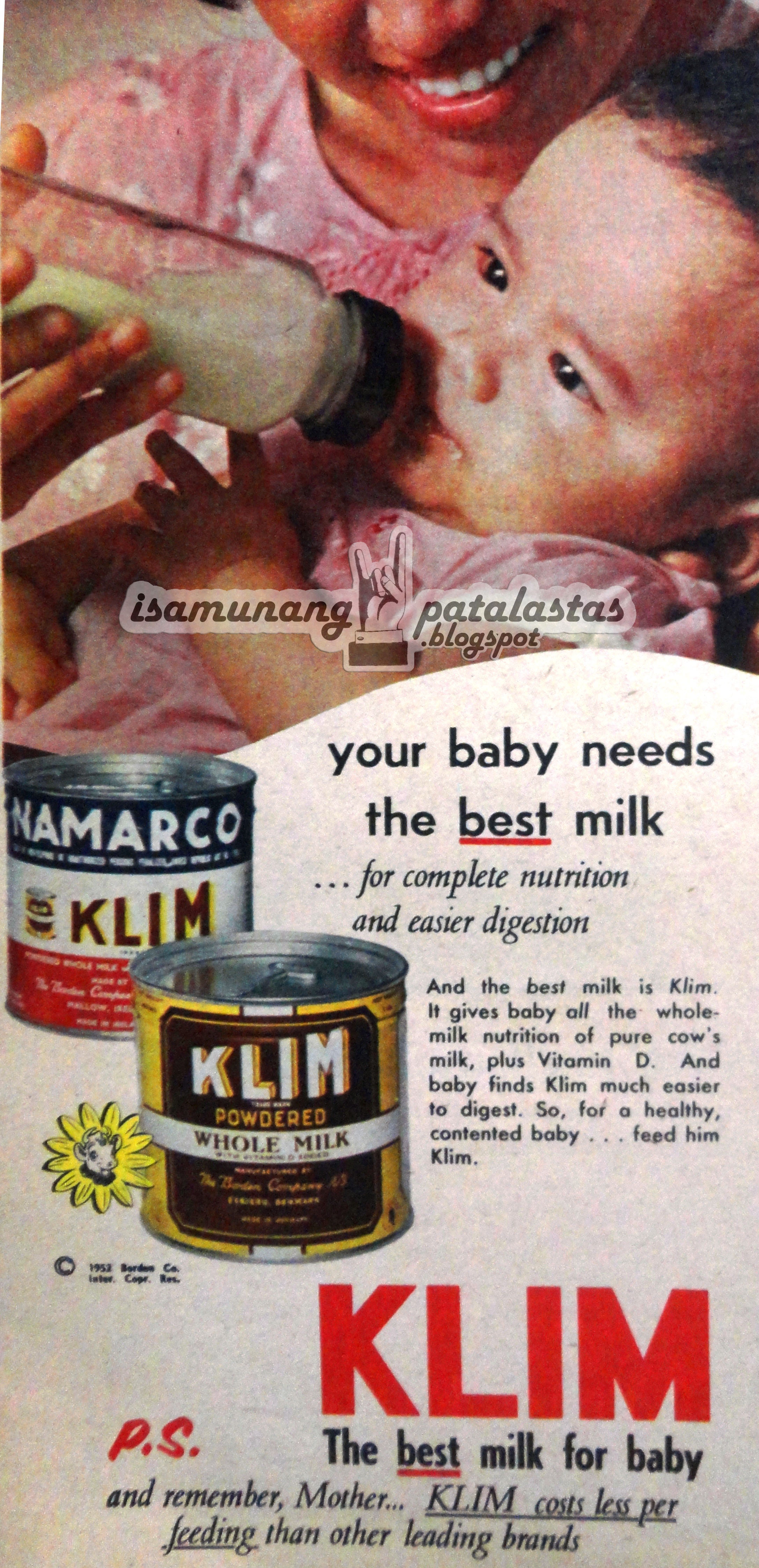
KLIM Powdered Milk is one of the oldest
milk brands available in the Philippines, but the product version sold
here was made by Borden Co., a well-known U.S.-based dairy company that
had its beginning in the 19th c. Early ads featured the slogan "Spell
it backwards”.
EARLY 1935 PHILIPPINE KLIM AD
The
brand KLIM had an even earlier history though,that
began in 1920, when the Merrell-Soule
Company of Syracuse, New York improved the spray-drying method
patented by Robert Stauf in 1901, a process that dried milk intopowder. Merrell-Soule replaced regular milk
with condensed milk, resulting in a dehydrated whole-milk powder that kept not
only its nutrients, but also did not spoil quickly.
WORLD CHAMPION BOXER 'FLASH" ELORDE FOR KLIM,1957
KLIM Powdered Milk was sold in cans, and
just a few spoonfuls mixed with water can give babies and kids the pure
wholesome goodness and flavor of real cow’s milk. As KLIM can stay fresh
without refrigeration, it was perfect for use in humid, tropical places. Hence,
KLIM was brought to the Philippines as early as the 1930s,
imported and distributed by the Getz Brothers.
KLIM achieved success in the Philippines,
and its advertising played up on its completeness, value for money, and the
convenience of no refrigeration. In the 1960s, NAMARCO-branded KLIM products
were launched in support of the National Marketing Corp. which aimed to
help Filipino retailers procure products at reasonable prices and promote
economic welfare.
1966-67 KLIM AD
Over the
years KLIM used tri-media advertising to push the product, using
celebrity endorsers that included world champion boxer Gabriel “Flash”
Elorde in the late 50s and a young Lea Salonga in the early 80s who
popularized the jingle “I loveKLIM…wow-..woww..woww.wow..I
Love Klim!”.
1966-1967 KLIM AS
In 1998,
Nestle acquired KLIM from Borden, which filed for
bankruptcy in 2020.That same year, New Dairy Opco LLC won Borden's
assets via an auction, becoming the company's new owner. KLIM Powdered Whole Milk is still being
manufactured by Nestlé to this day, assuring us that this iconic brand will
endure for more generations to come.
Nestlé’s MILO began wresting the title of “Olympic Energy
Drink” from arch rival OVALTINE in 1968,
when the popular chocolate malt beverage began running an ad that proclaimed
itself as the “Choice of the ’68 Olympics”. On the other hand, OVALTINE had
touted in its 1972 ads that it had been in every Olympics since 1932. It was to
be the last time that OVALTINE—an aging brand on a decline--would call itself “the
official energy drink of the Olympics since 1932”.
MILO took over that claim that same year, bannering that “modern
day athletes need a modern energy drink”, while casting shades on Ovaltine as “old
stand-bys are simply not enough”. MILO’s Olympic Energy campaign thus began
officially in 1972 (Munich) followed by the next edition in Montreal (1976).
In 1980, the Summer Olympics were scheduled to happen in
Moscow, Soviet Union, from Jul. 19-Aug. 3, 1980, the first games to be held in
an Eastern bloc country. It was to be one of the most controversial stagings in
the history of the Olympics.
A year before, Soviet had invaded Afghanistan, causing the United States and other Western
countries to boycott the 1980 Moscow Olympics. Sixty six countries boycotted
the games entirely, including the Philippines, and only 80 nations converged at
the Moscow Games, the smallest number since 1956.
In retaliation, the Soviet Union and other Eastern Bloc
countries (except Romania) boycotted the 1984 Summer Olympics in Los Angeles. An
alternative international sporting event, the Goodwill Games, was created by
Ted Turner in reaction to the political troubles surrounding the Olympic Games
of the 1980s.
Nevertheless, Filipro Inc., Nestlé’s local manufacturer in
the Philippines, came up with their MILO Moscow Olympic Ads in 1980, despite
the country’s non-participation.
The ad was austere in its message, preferring to
“salute the Olympic Year”, with the Moscow reference as just as subhead.
Perhaps to make up for the lost Olympic momentum, MILO launched a SUPER ATHLETES
Promo, with collectible plastic figures of athletes in action in every can. These
were to be played using SUPER SPORTS gameboards published in select magazines and newspapers.
MAGGI RICH MAMI NOODLES "Woman in a Shoe" PRINT AD, 1989
By the
late 1980s, MAGGI RICH MAMI NOODLES was already an established instant
noodle brand from Nestlé. It was supported by annual advertising campaigns
developed by Ace-Saatchi & Saatchi Advertising.
One such
notable tri-media campaign was inspired by a nursery rhyme “Old Woman Who Lived
in a Shoe”, that originally talked about an old mother’s dilemma over her many
children.
WATCH THE MAGGI RCH MAMI NOODLES "Nursery Rhyme" TVC HERE:
Source: Youtube Video uploaded by AlanChan80
The popular
Mother Goose rhyme was given a new spin, in which the many versions of MAGGI
RICH MAMI NOODLES were presented as the perfect answers to satisfying a
large brood. The copy retained the rhyme format, but rewritten this way:
“There
was a woman who lived in a shoe
She
had so many children, and she knew what to do
She
gave them some MAGGI RICH MAMI NOODLES
Rich delicious
noodles, in rich flavorful soup
Steaming
hit and hearty, to the delight of the whole group
“Tasty
Chicken!” “Real Beefy!”
“Zesty
Chicken Asado!” “Spicy Curry!”
“Mmm,
love ‘em, mom!”, they said,
And
she kissed them all soundly, and sent them to bed".
The
sales promotion component of this campaign was a giveaway activity book, MAGGI
RICH MAMI NOODLESNursery Rhyme Games, that contained coloring pages, dot-to-dot,
puzzles and games.
CREDITS:
Advertiser:
Nestlé MAGGI
Agency: Ace-Saatchi
& Saatchi Advertising
Creative
Director: Cid V. Reyes
Copywriter:
Isabel Beltran / Art Director: Bingo Bautista
MAGGI is an
old brand named after Julius Maggi, who, in 1872 took over his father's mill in Switzerland,
and introduced product innovations for the kitchen. Before Filipro became
Nestlé Philippines in 1986, it had already acquired the MAGGI brand.
Its early products were meant to compete against the more
established KNORR products, hence the launch in 1980 of MAGGI Bouillon Cube and
MAGGI Liquid Seasoning.
MAGGI Liquid Seasoning
may look like soy sauce, as they are made in the similar way and are rich in
umami. But Maggi is made from hydrolyzed wheat protein with a flavor that is
deeper and more complex than soy sauce.
The all-out launch of MAGGI Liquid Seasoning in 1980 included a TV commercial with a
mother as presentor, and these series of print ads visualizing the theme “Wakes
up the flavor of…”. Familiar dishes like
Macaroni, Pork Chop and Siomai were featured in quarter-size color magazine
ads, that appeared in pairs, in leading
magazines.
MAGGI Liquid
Seasoning slowly made a dent on Knorr’s seasoning business, and would be
rebranded in the 1990s as MAGGI Savor.
It continues to be produced today with many variants; other than the Classic
Flavor, it is available in Garlic, Calamansi, Hot Chili and ChiliMansi flavors,
CARNATION is an evaporated milk product company created in 1899, and its Carnation Evaporated
Milk first made its presence in the Philippines in the early 1960s. Evaporated
milk were favored in the country then, but Carnation made product extensions, including
condensed milk, instant powdered filled milk, and a liquid coffee
creamer---first introduced in 1974—Carnation
COFFEE-MATE in cans.
But Philippine households believed in cost-efficiency; since
evaporated milk was already available at home, coffee-drinkers in the family
used the same milk as coffee creamer. As expected, Carnation COFFEE-MATE Liquid Creamer didn’t quite succeed in the
market.
LIQUID COFFEE-MATE AD, 1974
It was only in the early 1980s, that a Carnation COFFEE-MATE Non-Dairy Coffee Creamer in powdered form, was
re-introduced to the Philippine market. The non-dairy creamer was already
popular in the U.S. since the mid to late 1960s, clearly positioned as a coffee
partner. The new Carnation COFFEE-MATE
had a better level of acceptance, despite it being perceived as a premium
product.
In 1985,
Nestlé acquired the Carnation Company, and the Carnation name was removed from
the brand name. In 1989, its ad agency, Advertising and Marketing Associates
(AMA) relaunched COFFEE-MATE with a
new campaign entitled “Perfect Harmony”. The campaign echoed the
perfect-for-coffee message of the older U.S. campaign. It made sense as Nestlé
also produced the best-selling Nescafe Coffee brand
CARNATION Omnibus Ad, 1984
The brand embraced its premium image, and that was translated
in classy, sophisticated ads that were
mostly in black and white tones, and printed on the glossy pages of magazines.
A jar of COFFFEE-MATE was featured
alongside cups of coffee, with black-and-white piano keys and chessboard as
backdrops. The poster-like ads had little copy—jut “Perfect Harmony” in glowing
white fonts.
The TV commercial was memorable for its mellow jazz-laced jingle with a sexy saxophone solo as the singers sing-- “COFFEE-MATE and your coffee..go
together in perfect harmony..”. The “Perfect Harmony” campaign was rather
unexpected in coffee advertising, as most commercials of the time featured
situations and vignettes, lasting for over 2 years.
Now branded Nestl COFFEE-MATE,
the product continues to be available in the market and is available in
stand-up packs. Flavored COFFEE-MATE
(Hazelnut, Vanilla, Caramel) were launched in 2007-2013. The new liquid form was
re-introduced in 2018. Its advertising presence continues to be active, with
commercials produced on a regular basis.
KLIM was one of
the early American milk brands that found its way to the Philippines, through
importer Getz Bros. in the early 1930s. the brand is “MILK” spelled backwards,
first createad in 1920 by Merrell-Soule Company of Syracuse, New York. It was developed
as a dehydrated whole-milk powder for use in the tropics, where ordinary milk
tended to spoil quickly, so it was perfect for the Philippines. In fact, during
World War II, it was included as part of the military jungle rations of the
U.S. Army and was used by the Red Cross to feed prisoners of war
KLIM was advertised as early as 1935 in the Philippines, and was actively promoted through the decades, especially through its peak years in the 60s.
In 1960, the Borden company sought the services of rising professional boxer, GABRIEL “Flash” ELORDE (b. 25 Mar. 1935/ d. 2 Jan. 1985), who made his professional debut at the age of 16 in 1951, against Kid Gonzaga. He was the most well-known boxer in the country by that time, and lost only twice in his first 14 fights. But he gained international prominence when he became the Junior Lightweight Champion of the World against Harold Gomes.
Elorde and his family, which included wife Laura, two boys
and daughter, appeared in the 2-color print ad for KLIM—The Complete Milk--where he claims that “My family keep in
shape with KLIM”. “That’s why, I
think every family should drink this milk”, he suggests, “my family always
drinks KLIM at mealtimes”.
By the end of his long and illustrious boxing career in
1971, Elorde had a achieved a record that is hard to beat: The first Filipino
boxer to hold the WBA and WBC World Title belts, the first to become a World
Super Featherweight/Junior Lightweight Champion, and the first to hold longest
the Junior lightweight division title--7 years 3 months. Elorde retired with a
record of 88 wins (33 KOs), 27 losses and 2 draws.
Even in retirement, Elorde was a visible presence on
Philippine media, due t his association with San Miguel Beer. He was tapped to
appear in a 1984 commercial for the world-famous beer along with Bert Marcelo
and Rico J. Puno, entitled “Pulutan”, where he delivered the punchline “isang
platitong mani”. The commercial was voted the year’s best TV ad for 1984.
Considered as the greatest super featherweight champion of
all time in WBC history, he was inducted into the World Boxing Hall of Fame in
1988 and the International Boxing Hall of Fame in 1993. Elorde also made itof
the 80 Best Fighters of the Last 80 Years by Ring Magazine, the world’s leading
publication on the sports of boxing. Two of his grandsons, Juan Miguel and Juan
Martin Elorde, have followed in his footsteps as boxers.
BEAR BRAND Sterilized
Milk is an iconic milk brand with a
long history in the Philippines, one of the first brands to be imported locally
at the turn of the 20th century. It is no wonder that “Marca Oso”,
as it was popularly called, became a part of the everyday life of Filipinos for
many generations. The heritage story also inspired the creatives of Advertising
and Marketing Associates (AMA) Consolidated to use this angle in crafting BEAR BRAND’s new campaign around 1981, producing a "Decades" TVC that used vignettes to show how the milk brand played a role in nourishing Filipino families, under the theme--"The special milk trusted for generations"/
Few years down the road, around 1988, a refreshed campaign was launched again for BEAR BRAND, usin te same thematic line, but executed differently.
WATCH THE BEAR BRAND TVC HERE:
The result was an epic, jingle-based commercial that was
unprecedented in terms of length (a minute and a half!) and cost—a novel idea at that time. The agency
came up with a series of period commercials situating BEAR BRAND in the lives
of Filipinos through decades, adding the line, "So much a part of our lives", to the original positioning statement "The special milk trusted for
generations”.
The commercials were noted for their grand production
design, period sets and wardrobe, plus wonderful casting. The main commercial was pure nostalgia, prefaced by the jingle line “I remember yesterday, the world
was so young….” , shows a 1930s scene where family members visit grandma. A
young boy is prodded to “dance with Lola”, with courtesy shots of family
members drinking the milk.
A picture is taken by the boy’s father as lola and grandkid dance. Fast forward to the 1980s. A young girl points to the same picture, now old and framed, and points to the young boy. She asks an oldish man by her
side—“Is that you Lolo?”. To which the senior citizen replied—“Yes…Look at my
mole!”. We realize he was the same little boy 5 decades ago! The story comes full circle when the Lolo
starts dancing with her granddaughter.
The BEAR BRAND
“Generations” commercial not only became famous for its jingle, and memorable
dialogues, but an urban legend developed around the other girl talent (the one
wearing a ribbon) who is allegedly a
ghost. Her face, people say, is never seen in the commercial, and in the end
shot, she mysteriously isnot present!
The campaign lasted through the early part of the 1990s.
There has never been another BEAR BRAND ad that reached the level of prominence
and popularity that this campaign has achieved;in fact, most children of the ‘80s are quick to recall and sing the
jingle that began wistfully with—“I remember yesterday..”
CREDITS:
ADVERTISING AGENCY:
AMA Consolidated / CREATIVE DIRECTOR;
Eva Perez
ART DIRECTORS: Franz
de Castro, Roel Sunga / COPYWRITER: Joyce
Bustamante
CLIENT: Nestlé
Philippines
SOURCES:
Bear Brand old Commercial, https://www.youtube.com/watch?v=pBCguyjreXs, uploaded by Marwin Manuel, 17 Dec. 2009.
Dela Torre, Visitacion. Advertising in the Philippines, Its Historical, Cultural and Social Dimensions. Tower Book House. 1989.
Before the 1960s decade, there were just a handful of
coffee brands in the market—like Hills Bros. and Chase & Sanborn, which
were American imports. Then, Commonwealth Foods, Inc. began manufacturing the post-war
brand CAFÉ PURO, and by 1951, it had become the no.1 selling coffee brand
nationwide, a position it held until the 1960s came along.
This was when more coffee brands came into the fray--Consolidated
Food Corporation (CFC), founded in 1961 by John Gokongwei Jr., introduced BLEND 45, an affordable coffee that
became known as “the people’s coffee”, with its budget-friendly price and
favorable taste.
NESCAFE, was
introduced in the mid 50s decade by Nestlé, and aggressively advertised in the
60s.
With more competitors coming into the picture, all sorts
of promotions were launched to entice customers and add more product value. Using
a reusable packaging as added product value was an old—but a proven tried and
tested idea. It came naturally for coffee brands too. In the post-war 50s,
coffee brands still came in round tins, including NESCAFE.
Then, with the advent of instant coffee brands, wide-mouth
glass jars were utilized, and discarded or sold after use. But what if the
packaging had more utilitarian value after the product has been consumed?
CRYSTAL ANNIVERSARY GLASS WITH FLIP-OFF CAP, 1966 Print Ad
This led to the idea of packaging instant coffee in drinking
glasses that could be used long after the last coffee drop has been sipped. The
glass serves also as a remnder of the pleasure of the coffee-drinking experience.
It also helped that specially-designed, set-building glasses encouraged repeat
purchases as they became collectibles.
CRYSTAL ANNIVERSARY GLASSES, 199 Print Ad
The free, giveaway glasses were given fanciful names to
appeal to consumers’ eye. As expected, market leader CAFÉ PURO came out first with its “Crystal Glasses”--to celebrate its 15th anniversary-- with flip-off plastic caps in 1966.
GLASSES, PITCHER AND SHAKERS FROM CAFE PURO, 1967 Ad
The promotion
was so enthusiastically received that the next year, CAFÉ PURO launched their “Philippine Dance” glass series—with not
just 12 glasses but also coffee shakers to collect.
CAFE PURO RAINBOW GLASSES, 1969 Print Ad
In 1969, CAFÉ PURO
offered its “Rainbow Glasses” collection, with “colors a-glow-glow”! There
were 6 colors of glasses to choose from.
IMPERIAL CRYSTAL GLASSES FROM BLEND 45, 1967 Ad
Not to be outdone, BLEND
45 came up with its “Windsor Crystal
Party Glasses” and “Crystal Imperial
Glasses” offer, which were all successful. The more premium NESCAFE introduced its decaffeinated brand in squat "diamond" glasses with
repeating diamond shapes in raised relief. Many of these glasses could still be
found being used in many Filipino homes to this day, still stored and kept in
glass cabinets after all these years.
NESCAFE ESPRESSO IN DIAMOND GLASS, 1975 Ad
Eventually, the promotions came to include storage jars,
pitchers,--and with the surge in popularity of coffee houses—coffee mugs in
glass and ceramic, like what NESCAFE and
CAFÉ PURO use. BLEND
45, meanwhile, has done away with glass bottles and uses only foil packs
today.
1980 was an Olympic year and to tide on the sporting
craze, MILO—theOlympic Energy
Drink-- launched its Free SUPER ATHLETES
Promo. These were giveaway standing plastic athele figures given away with
every tin of MILO.
There were 8 athletes to choose from—Gymnast, Shotputter,
Football Player, Diver, Torch Bearer, Runner, Javelin Thrower and Weightlifter.
They were available in Red, Blue, Green and Yellow Colors.
Photo used with permission. Nicky Hernandez Collection
The SUPER ATHLETES
can be collected for playing the MILO
Super Sports Game. The gameboards could be clipped from selected magazines
and newspapers.
However, there was a major boycott of the Moscow Games in
1980, as a potest for the Soviet invasion of Afghanstan. This resulted in the
non-participation of major countries including U.S.A. and other western nations,
and the organization of the alternative Goodwill Games. Similarly, in the next
1984 Olympics, the games were boycotted by Russia and the eastern bloc
countries.
It is good to know that the 30th Southeast Asian
Games in the Philippines, which is wrapping up this week, continues to uphold the spirit of
sportsmanship and friendly competition, untouched by politics and contentious
politicians. Here’s to all the SUPER
ATHLETES of the SEA Games!!
CREDITS: Many Thanks to Nicky Hernandez for the use of his Super Athletes collection photo.
THE WORLD'S NO 1-NIDO, Mother and Daughter, Print ad. 1990
“Look at me, son, you’re
my no. 1..”
Smile at me hon, you’re
my no.1
And there’s no
treasure that I will cherish but you..”
The most successful campaign for NIDO Fortified® Full Cream Milk Powder began in the 1980s,
capitalizing on the stature of the brand as the world’s no. 1 powdered full
cream milk.
Throughout its over 20 year-run, the “No. 1” has been attached not
only to NIDO, but also to children (‘The
World’s No. 1 Child—your Child”) and even to mothers themselves. So, what mom
can refuse such a proposition?
NIDO,
developed in 1944, has been around in the Philippines since the early 1960s,
imported by Filipro Inc-- along with Milkmaid and Nescafe—before it became Nestlé
Philippines in1986. The earliest known NIDO print ads date from 1963.
As the
nutritionally-enriched NIDO rose to
become a major competitor for other milk-based products, it also faced
criticisms from promoters of breast-feeding, leading the advertising board to
require adding tags in powdered milk advertising reminding mothers that “breastmilk
is still best for babies”.
FOR THE WORLD'S NO.1 CHILD, Mother version, Print Ad, 1983
In 1983, Advertising and Marketing Associates (AMA) was
assigned the NIDO account, and
headed by executive Greg Macabenta, conceptualized the “World’s No. 1” thematic campaign
that catapulted the milk brand to national popularity.
FOR THE WORLD'S NO.1 CHILD, Father version, Print Ad, 1983
Initially, the campaign made use of foreign imagery—Caucasian
mothers, fathers and their kids, set in some European highlands-- perhaps to
allude to NIDO’s western origins.
WORLD'S NO.1 FATHER & SON, Print ad, 1990
A
song, with lyrics written by Greg Macabenta and set to music composed by
award-winning composer Caloy Agawa, accompanied the lush, emotional visuals of
parent and child interacting. This time, local Filipino talents were cast for
the NIDO commercials.
THE WORLD'S NO. 1, Father & Sons, print ad, 1990
It was the memorable “You’re my No. 1” jingle that really
struck a chord in the minds of consumers, and the line became widely associated
with NIDO, and was rearranged many
times for use in other commercial platforms.
WATCH "YOU'RE MY NO.1" MTV VERSION
as sung by Sharon Cuneta (2008)
Even when NIDO was
moved to Publicis Manila due to agency alignment, the campaign was refreshed
and used. In 2008, an MTV was produced featuring megastar Sharon Cuneta and her
children, singing an extended version of the song. A later jazzed-up,acoustic version in 2014 also paired Cuneta with singer-songwriter Barbie Almalbis to appeal to younger
mothers.
Today, NIDO
has been expanded into a range of milk products that claims to offer
"nutrition solutions for each stage of childhood" (e.g. for toddlers,
for school-age, etc).