Showing posts with label Purico. Show all posts

Monday, October 13, 2025

527. A Free Christmas Gift from PURICO--BEAUTIFUL 3-DIMENSION BELEN! Promo Ad, 1953


PURICO was the very first product manufactured by Philippine Manufacturing Company (PMC), which was later bought by Procter & Gamble. Purico , a cooking-frying-baking lard, came out in 1919 and was promoted extensively though field marketing, advertising and sales promotions.

For Christmas 1953, Purico offered a full-color 3-dimensional cardboard Belen (nativity scene)  that one can have by presenting a boxtop flap plus 10 centavos. The pop-out belen set features cut-out figures and scenery-- "amazingly lifelike!", as the ad proclaimed.

An actual example of the giveaway Nativity set is shown below, plus he complete advertising copy that details the mechancis on how to get the Christmas cardboard Belen free.

YOUR FREE XMAS GIFT FROM PURICO!
BEAUTIFUL 3-DIMENSION BELEN—IN BRILLIANT Full COLOR

 Perfect Christmas touch in your home! Heavy cardboard BELEN with cut-out figures and scenery. Just open and spread up. Amazingly life-like! But remember, only requests by mail will be answered.

For each Belen you want, send One (1) boxtop with flap from any size Purico carton and 10 centavos.. You will get you Belen by return mail. Send for as many as you like but be sure to enclose 1 Purico box-top with flap AND 10 centavos for EACH Belen you want.

.

If the coupon in this advertisement is already usedm  just print your name, aand address on the Purico box-top you send. Add the name of this magazine and the date at the top of the page. Send 10 c with each box-top for each Belen you want.

Don’t delay! Offer ends December 15!

Saturday, March 6, 2021

313. WHITE BAND SHORTENING, Philippine Refining Co.’s (PRC) Answer to PMC’s Purico

 
WHITEBAND  SHORTENING PRINT AD, 1955

In the  early 1950s,  PMC’s (Phil. Manufacturing Co.)  Purico was lording it over as the no. 1 shortening in the Philippines—good for frying, baking and cooking.  PRC (Philippine Refining Co.) was in direct competition with most of the products of PMC, particularly beauty bars, health soaps and detergents. Not to be outdone, the company came up with WHITEBAND SHORTENING, for frying, baking and sautéing. Instead of being packed in cartons, WHITEBAND initially came in tin pails.  Later, the shortening was packed in colorful and re-usable plastic pails. 

WHITEBAND RECIPE AD, 1957

To differentiate it from Purico which featured everday dishes and recipes, WHITEBAND touted its promise of giving luxury-taste to dishes. It even resorted to copying Purico’s recipe ads, endorsed by a ‘a famous home economist, Betty King. It is interesting to note that Betty King was also used in Australia by World Brands Pty Ltd and promoted as one of the leading ladies of Australian cookery. In  reality, she doesn’t exist. She was, no doubt, inspired by the equally fictional Betty Crocker in America. WHITEBAND ceased to exist by the early 1960s, soundly trounced by Purico’s effective and massive marketing and advertising support.

Thursday, December 3, 2020

299. THE CHRISTMAS TREE IN PHILIPPINE ADS, 1935-1978

FILIPINAS LIFE ASSURANCE COMPANY, 1935 Print Ad

The Christmas tree--a decorated evergreen tree or an artificial tree of similar appearance—is an iconic symbol of Christmas. The putting up of Christmas tree to celebrate Christmas began in Germany when Christian peasants began bringing in trees trimmed with paper flowers, fruits and tinsel—inside their homes in the 16th century. 

The custom caught on with outside of Germany in the second half of the 19th century, including America, thanks to the German settlers.The first record of one being on display was in the 1830s put up by these new immigrants in Pennsylvania.

The American brought the Christmas tree tradition to the Philippines during their occupation of our islands. By the late 1920s, Filipinos were putting up Christmas trees in their homes, along with the ubiquitous native parol.  The tradition became popular among Filipinos, that they localized the holiday tree—using walis tingting or tambo, dried twigs and branches (with added cotton to simulate snow),  and even strings!

Like the Parol, the charm of the brightly-lit and decorated Christmas tree became a design inspiration—integrated in ad layouts, and appearing on print advertisements during the Christmas season. Here are a few examples:

YCO PAINTS & FLOOR WAX, 1961

PURICO  CHRISTMAS TREE PROMO, 1955

RADIOWEALTH RADIO-PHONO, 1957

A COCA-COLA CHRISTMAS, 1958

RADIOWEALTH TELEVISION SETS, 1961

COCOA RICOA, 1961


PHILIPPINE CHARITY SWEEPSTAKES, 1962

FITA BISCUITS, 1963

AJINOMOTO CHRISTMAS, 1964

SHELLANE, 1966

PHILIPPINE CHARITY SWEEPSTAKES, 1967

ALEMAR'S YULETIDE DISCOUNT, 1978
PHILIP MORRIS , 1966


Sunday, March 1, 2020

268. THE DELA ROSA BROTHERS: Model Marketers for VICKS and OLD GOLD


Philippine moviedom was at its brightest in the ‘40s and ‘50s with the luminous presence of one talented family of from Lubao: the de la Rosas. The family of performers, children of Feliciano dela Rosa and Rosario Lim,  were all involved in the movies in different capacities. They included Africa dela Rosa, a character actress and a writer and Purita, who dabbled in acting but is more well-known as the 1st wife of Pres. Diosdado P. Macapagal.

Two siblings would join them in the acting bandwagon and would rise to great prominence. ROGELIO DELA ROSA (born as Regidor de la Rosa on 12 November 1916), the older of the two, would become the golden boy of 1930s-50s Philippine Cinema. Discovered for the movies by director Gregorio Fernandez, the strapping 6-footer was introduced to film mogul Don Jose Nepomuceno in 1929.

His launch movie in 1932 was with a Filipina-European mestiza, Rosa del Rosario (the 1st high-flying Darna) , entitled Ligaw na Bulaklak. Other early works included Diwata ng Karagatan for Parlatone Hispano Family (1936) and Bituing Marikit, Sampaguita Pictures (1937). But Rogelio de la Rosa was most known for his team-up with Carmen Rosales, d

His most acclaimed role yet was in the 1955 movie Higit sa Lahat, directed by Gregorio Fernandez. He not only earned a Famas Best Actor Award for his role, but also won the 1956 Asian Film Fest Best Actor Award in Hong Kong.


The popularity of the Dela Rosa brothers earned them a few commercial endorsements. ROGELIO did a print ad for OLD GOLD Cigarettes in 1953. Old Gold was introduced in 1926 by the Lorillard Tobacco Company and, was one of the more famous cigarette brands in the Philippines, thanks to advertising.The OLD GOLD print ad is cross-promoted with dela Rosa’s 1953 movie ,”Sa Paanan ng Bundok”, in post-production at that time. In 1953, Lorillard began advertising king-size Old Gold side by side with the standard brand. in 1957, it added a filtered variety as well.

After retiring from the movies, he entered politics, got elected as a Senator, ran for Presidency, only to retract his candidacy to give way to brother-in-law Diosdado. He then became an ambassador to Sri Lanka, Cambodia. His last assignment was in The Hague, Netherlands, a post he held until his death on 10 November 1986.

Just like his siblings, JAIME DE LA ROSA (b. 1920)  forayed into movie acting. With his debonair looks, Jaime too, was destined to take center stage and follow his own star.

He was studying Law when the teen was first featured in the Eastern Pictures movie, Anak ng Lansangan (Children of the Streets) in 1939, using the screen name Tommy de la Rosa. Soon,  he was cast successively in 3 movies in supporting roles: Cadena de Amor, Bawal na Pag-ibig  and Kahapon Lamang.

His rising career was momentary halted by the War, but right after, in 1951 , Jaime was cast in the 1st ever Darna movie, starring Rosa del Rosario, as the lead’s love interest. In 1953, he was Fredo, the human lover of the fabled mermaid beauty, Dyesebel, played by  Edna Luna. Both movies catapulted him to stardom.


JAIME DELA ROSA dabbled in radio, where he hosted program for PMC. Thus, he became a drumbeater for PURICO as well as COCA-COLA, where promotional postcards of him were made, ca. 1953.

The ‘50s decade can be considered as Jaime’s heyday, with a string of hit movies for LVN like Satur , Galawgaw (a role identified with Nida Blanca),  Anak ng Pulubi,  and Medalyong Perlas. In 1956, Jaime was nominated for the Best Actor FAMAS award his gritty performance in the movie Kumander 13.

When television was introduced in the Philippines, Jaime became one of the new medium’s pioneers, hosting ABS-CBN’s Caltex Star Caravan


In 1959, JAIME DELA ROSA was tapped by VICKS to push VICKS INHALER. VICKS then had an expanded product line that includes Vaporub, Formula 44, Impact  and Cough Drops. Along with Jaime, movie stars like Jean Lopez and Luis Gonzales endorsed VICKS INHALER. 

Just like his brother, Jaime entered the world of politics. He served as a councilor of Manila and eventually became the city’s Vice Mayor. He died in service, on 18 September 1996.

Today, the dela Rosa brothers are considered true movie icons and role models of the film industry, their stars shining the brightest in the gilded age  of Philippine Cinema.

Monday, February 17, 2020

266. Brand Stories: PURICO, Procter & Gamble PMC, 1917


The Philippine Manufacturing Co. is largely the history of modern vegetable shortening in the country.

ALWAYS PURE, ALWAYS RICH, PURICO! 1940 Ad

In 1917,  it employed a chemist whose assignment was to start production of shortening and other edible products.  Near the end of 1919, the first-ever vegetable shortening manufactured in the Philippines was launched. It was noted for its purity and richness that it was named PURICO—a term coined from combined words “puro” (pure) and “rico” (rich), as Spanish was still widely spoken then.


SO PURE, SO RICH...PURICO COOKS MORE! A pair of print ads, 1955

These qualities were underscored in slogans and headlines like “Always Pure. Always Rich,” and “So pure..so rich..Purico cooks more!”PURICO was sold in carton blocks with the familiar yellow label, and were widely available nationwide—from the tiniest sari-sari stores, to the biggest groceries in the islands.

EVERYDAY FOODS WITH PURICO, 1953 PRINT AD


PURICO MAKES IT PERFECT,a pair of PURICO Print Ads, 1954

The products of PMC were promoted over the radio, then the leading mass medium before the advent of television. PURICO sponsored "The PURICO Amateur Hour,

TOLINDOY, CONDE UBALDO, PURICO FAN PHOTOS, 1950S

The PURICO Amateur Hour featured the brightest stars of the radio, dishing out songs and skits and what-have you--from Tolinday and Chichay, announcers Ira Davis and Conde Ubaldo, actresses Rebecca Gonzales, Lily Miraflor and singing discoveries like Milagros Bernardo.

PURICO FAN PHOTOS OF CHICHAY, REBECCA GONZALES, ETC.

The radio program attracted bigtime stars (Rogelio de la Rosa, Rosa Rosal, among others) and gained a nationwide following. PURICO and other PMC brands are credited today for ushering in the golden age of Philippine broadcasting.

PURICO FREE XMAS FREE PROMO, 1955

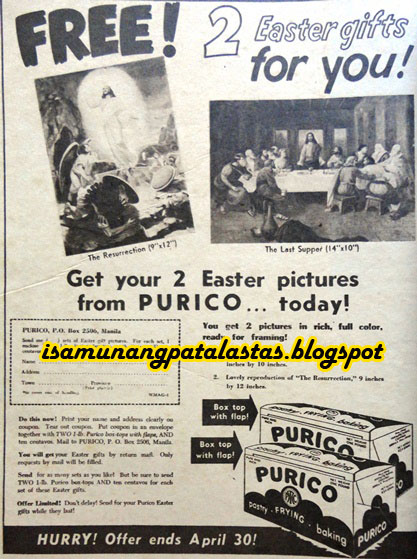
PURICO FREE EASTER GIFT PROMO, 1953

Fan photos of the performers and stars were issued for adoring fans to collect in albums. An example is shown above, made perhaps, by an ardent follower of the radio show.

TAWAG NG TANGHALAN TV PROGRAM, hosted by Lopito and Patsy, 1950s.

When PURICO Amaterur Hour was  renamed Tawag ng Tanghalan/Call of the Stage), it was staged for the new television medium,  for which the first TV advertising contract was  signed, after PMC was bought by Procter & Gamble. This further solidified the hold of PURICO on the shortening market. 

UPLIFTING THE PURICO IMAGE WITH A MANILA HOTEL AD,1960

The rise of liquid cooking oils eased out PURICO from the store shelves by the 1970s, until it totally disappeared altogether in the 1980s.

SOURCES:
PROGRESS Magazine 1956,
Radio Stars from Purico Radio Show, www.flyandfleablogspot.com

Saturday, March 31, 2018

156. Happy Easter from PURICO, 1953


Procter and Gamble PMC’s leading cooking product, PURICO, was a highly advertised and promoted brand during its heyday. For its 1953 Holy Week offering, PURICO gave away 2 religious pictures of The Last Supper (14 x12 in.) and The Resurrection (9 x 12 in.). To get these, one had to mail a letter addressed to PURICO’s post office box, enclosed with a filled-out  magazine coupon,  2 PURICO boxtops with flaps, and 10 centavos. The pictures were mailed back by PURICO, for framing by the happy customer, to be reflected upon on Easter!

Sunday, December 20, 2015

33. DECK YOUR HOMES WITH A BELEN AND A CHRISTMAS TREE FROM PURICO!


A PREMIUM XMAS BELEN--FREE FROM PURICO! 1953

PURICO was the very first product manufactured by Philippine Manufacturing Company (PMC), which was later bought by Procter & Gamble. Purico , a cooking-frying-baking lardcame out in 1919 and was promoted extensively though field marketing, advertising and sales promotions. For Christmas 1953, Purico offered a full-color 3-dimensional cardboard Belen (nativity scene)  that one can have by presenting a boxtop flap plus 10 centavos. The pop-out belen set features cut-out figures and scenery-- "amazingly lifelike!", as the ad proclaimed.

SPARKLING XMAS TREE, FREE FROM PURICO. 1955.

In 1955, Purico launched another Christmas giveaway promo--this time a sparkling Christmas Tree offer--for just 1 Purico boxtop plus--25 centavos! (over 100% increase from their 1953 promo!). The cardboard Christmas Tree stands 12 inches and comes with 20 shiny ornaments. Like the Belen, the premium is available only by mail. 

Merry Christmas, from Purico!