Showing posts with label radio advertising. Show all posts

Sunday, November 16, 2025

531. Brand Stories: SUNFLOWER CRACKERS by Croley Foods Mfg. Inc.

The first crackers available in the Philippines were soda crackers—those tasteless, lightly salted rectangle or square-shaped biscuits with the signature pinprick holes and break marks. They were so named because they were simply made with white flour and leavening agent, baking soda,  to make them crispy.

 Popular local soda cracker brands included those made by Fibisco and Lion Brand that were commonly available in most stores in the 1950s era. In 1962, M.Y. San shook the cracker market when it introduced Skyflakes, a more flavorful and crispier saltine cracker that has a creamier taste. It took off and became a hit, favored by students, office workers and snack lovers to instantly assuage hunger, Skyflakes came in handy cellophane packs for individual enjoyment and in tin cans.

For nearly2 decades, Skyflakes dominated the saltine cracker market—until a family owned bakery in Manila, established way back in the 50, became big enough to grow into a biscuit company in the 60s, calling itself the New London Biscuit Manufacturing Company.

In the late 70s, the biscuit plant, located in Novaliches, developed a wafer-thin, extra-crispy cracker that was more savory. Even the biscuit’s color, a shade of yellow-orange, appeared more appealing. It was priced much cheaper too, and the first batches were bagged in cellophane packs. The product, when launched, was called SUNFLOWER CRACKERS.

The massive response to these flavorsome crackers—crunchier than Skyflakes, tastier and cheaper too—was unexpected. Suddenly, crackers were no longer boring, they can have great appetite appeal too! Much like munching potato chips, you can’t eat just one! And you really can,  because SUNFLOWER CRACKERS were very much affordable.

The new brand in the market posed as a real threat to the market leader, latching on to its superior taste, rather than on plain crispness, which Skyflakes flagged in it slogans. In the 1980s. the company was restricted and re-branded as Croley Foods Mfg. Corp., with modern machines and new biscuit technology, The first major initiative was to claim the “taste” positioning among biscuit brands by introducing flavored variants.

LISTEN TO SUNFLOWER CRACKERS RADIO HERE:

By 1984, SUNFLOWER CRACKERS were available in Chicken, Adobo, Pizza, Onion & Garlic—as well as sandwich cream versions: Lemon and Strawberry Sandwich. Today, Croley Foods continue to expand its cracker, biscuit and cookie line under several trade names. Some of the flavor offerings have been streamlined to include Original, Chicken flavor, Pizza, and Cheese flavor. There are more crea-filled sandwiches flavors too with the addition of Mango Sandwich, Blueberry Sandwich, Coconut Sandwich and Orange Sandwich.

SUNFLOWER CRACKERS is now one of the top exports in UAE countries  catering to Filipino expatriates. It is also doing well in China. It may not have dislodge Skyflakes which continues to be the market leader to this day, but like Skyflakes, it is well on its way to becoming an icon brand, having established itself as a major and significant player in the biscuit industry for its commitment to food excellence, in its desire  to satisfy and enrich the diverse tastes of Filipino consumers.

SOURCES:

Croley Foods website: https://croleyfoods.com/company/

Croley Foods: Filipinos’ choice for mildly sweet cracker snacks, https://filipinotimes.net/news/2019/08/01/croley-foods-filipinos-choice-mildly-sweet-cracker-snacks/


Thursday, September 12, 2024

485. 1988 Creative Guild's Radio Ad of the Year, ROYAL TRU-ORANGE "Ganito Talaga Ang Buhay", RC 30s

KID STUFF. In 1988, the Radio Ad of the Year was part of a best-selling campaign that hepled endear a softdrink to its young Pinoy market in an unprecedented way. The softdrink was Royal Tru-Orange, a purebred Pinoy product of faithful old McCann Erickson client Coca-Cola Bottling Co. The campaign debuted in TV and introduced a character destined to be one of the immortals of local Philippine advertising, an amiable, wonderfully regular adolescent named Joey, played by a charismatic young La Sallite named RJ Ledesma.

The very first ad began with the jingle strain: “Ganito talaga ang buhay…”, and the first words of Joey’s lighthearted, causally delivered flashback narration which proved to be the durable and permanent opening salvo for a series of ads harping on the natural goodness of the product and how it fitted in, just as naturally, with the ups and downs of a wholesome young protagonist’s life.

The campaign extended into radio advertising , of which the winning “Mantika” was an involving example. As he McCann creative director Letty Javier recounts, she and copywriter Kathleen Mojica collaborated on a scenario straight from everyman’s childhood experience.

The TV ads have Joey mingling with friends, going to school, and eventually falling in love and maturing over a span of several memorable years. RJ Ledesma practically grew up under the consumer’s watchful eye.

The radio commercial however, harked back to those embarrassing, pre-pubescent moments where every boy would die before being caught running a sissy errand for mom  in this case, buying a bottle of cooking oil from the neighborhood sari-sari. A bottle of Royal Tru-Orange proves the ideal cover-up in the presence of Joey’s pal, Jake, who, it turns out, was set to buy something just as sissy—bagoong. The pals are on equal footing, such all too familiar chores and the very real feelings of apprehension and relief, and the viewer concludes, are part of growing up. It’s a good thing that the softdrink is around to provide company, or even security, in the face of the possible bad trips of this complicated age.

Even without the powerful TV visuals, “Mantika”  effortlessly  captured the awkwardness, as well as the little triumphs  of Filipino adolescence, and softdrinks guzzlers everywhere were invariable touched.

CREDITS:

CLIENT: Coca-Cola Bottling Co.

Product:  Royal Tru-Orange

AGENCY: McCann Erickson, Phils.

Executive Creative Director: Emily Abrera

Associate Creative Director: Letty Javier

Copywiter:  Kathleen Mojica

Producer: Jing Abellana

SOURCES: PERFECT 10: A Decade of Creativity in Philippine Advertising, published by the Creative Guild of the Philippines,1995. Written and edited by Butch Uy and Alya Honasan.


Wednesday, March 31, 2021

316. She Likes To Teach the World to Sing: SUPERSTAR NORA AUNOR FOR COKE, 1972


One of Coca-Cola’s most globally successful and popular advertising campaign was launched in 1971, conceived by McCann-Erickson executive Bill Backer. While in an airport in Ireland waiting for his next flight, he saw people in a huddle, chatting and laughing while having their Cokes. Inspired by the sight, he wrote “I’d like to buy the world a Coke..” on a table napkin. He discussed the lyrics with songwriter Roger Cook and Roger Greenaway, who set the words to a tune that they had used before for a song “True Love and Apple Pie” and ha the folk group the New Seekers record it as a Coke radio jingle.

THE NEW SEEKERS' VERSION "I'd Like to Teach The World to Sing"

THE HILLSIDE SINGERS COKE VERSION:

The jingle became a monster hit for the New Seekers (it reached the Billboard Top 15) that a TV commercial was produced entitled “Hilltop” . The band couldn’t make it to the shoot so a new group, The Hillside Singers,  were tapped to sing the Coke version of the song. 

WATCH "I'D LIKE TO BUY THE WORLD A COKE" TV HERE:

The commercial featured a group of  young people from all walks of life, coming together on a hilltop, while holding their Coke and singing to this new version  of  “‘I’d Like To Teach the World to Sing  (In Perfect Harmony). The Hillside Singers earned a Gold Record award from the Recording Industry Association of America. In addition to creating chart-busting records, the Coca Cola campaign went down in history as one of the greatest marketing campaigns of all time.

 NORA AUNOR VERSION "I'd Like To Teach the World To Sing"


The ‘Hilltop’ campaign was aired in the Philippines, but a local adaptation of the campaign was done by McCann Erickson in 1972 featuring superstar Nora Aunor no less--then at the pinnacle of her career. 

She did a full-tri media campaign, supported by sales promotions (Coke gave away autographed pictures of Guy and her Coke), and music marketing on radio via a full song recording of the hit jingle “I’d Like to Teach the World to Sing”, that was included in one of her long-playing albums under Alpha Records. 

Of course, three years later, she was singing a different tune. Coke was no longer it for Guy—she was having her Pepsi Day!


SOURCES:

https://www.wideopencountry.com/, 'I'd Like to Teach the World to Sing': The Story Behind the Classic Coca-Cola Jingle,

Youtube: “ The New Seekers - I'd Like To Teach The World To Sing 1972 with Lyrics”, https://www.youtube.com/watch?v=ZWKznrEjJK4, uploaded by islander8

Youtube: Hilltop Remastered, https://www.youtube.com/watch?v=C2406n8_rUw, uploaded by the Coca Cola Company, 4 April 2016. 

Youtube: “I'd Like to Teach the World to Sing (1972) by Nora Aunor (HD)” https://www.youtube.com/watch?v=1VJ3hz-nXCQ, uploaded by Edgar Ebro Videokeking2018 on 5 June 2019.

Hillside Singers: https://www.youtube.com/watch?v=ASe7ioPis6I, Uploaded by Lorri Hafer, 7 Aug. 2015

The Hillside Singers, https://en.wikipedia.org/wiki/The_Hillside_Singers

Tuesday, April 28, 2020

277. 1989 Creative Guild’s Radio Ad of the Year: Glaxo’s DEQUADIN , “Do Re Mi” RC 30s.


(THIS WEEK’S POST IS A TRIBUTE TO MR. RAMON R. JIMENEZ JR. (14 Jul. 1955/d. 27 Apr. 2020),, or simply MONJ to his colleagues, whose passing at the age of 64 is mourned the Philippine advertising industry that he inspired. After his illustrious career, he was named as the Secretary of the Department of Tourism, promoting the country via his well-received and hugely successful campaign “It’s More Fun in the Philippines” . Back in 1989, MonJ was already making waves as a co-CEO (together with his equally talented wife, Abby Lee Jimenez) of a small agency, Jimenez & Partners. One of their joint works was a celebrated commercial written for DEQUADIN, which was named as the the year’s best radio ads by the Creative Guild of the Philipines, in a tie with Colgate’s “Nguya” radio ad.)
**********

The year 1989 marked the first time that two radio ads tied for the year’s honor. The first ad “DEQUADIN Do, Re,Mi” showed a novel way to present an undeniably antiseptic product, a throat lozenge, whose previous advertising exposure was limited to scientific testimonials in what Jimenez/DMB&B co-CEO Abby Jimenez calls “the pesteng ahem tradition”. The client, pharmaceutical firm Glaxo, had been advertising for 6 or 7 years, using the same authority figure in a white coat, but there was very little product awareness. “There was a need for truly impactful advertising:.


Abby’s co-CEO husband,Mon Jimenez Jr. , discovered that Dequadin’s biggest competition was a decidedly non-medical little green candy called Storck. “The earth-shaking news was that everybody knew you couldn’t die of a sore throat. People were simply not taking sore throat seriously as Glaxo was. So we had to lighten up a little”.

The solution was to produce “a commercial that celebrated the end result”, according to Mon. “We wanted a clear demonstration of throat power”, Abby adds, and that earch for “the well-est throat in the world” led the Jimenezes to young tenor Nolyn Cabahug, who blew the agency away with his o-the-spot demonstration.

LISTEN TO THE DEQUADIN AD 
BY CLICKING THIS LINK:

As for possible jingles, several operatic pieces were eliminated until the agency was left with the simplest jingle of all. Abby recalled how, as children, she and her bother would try to outdo ech other by singing higher and higher notes. Cabahug ended up delivering an up-front powerful series of octaves that begins a capella and builds up to a convincing crescendo.

The TV ad begins with a frame of the tenor’s face, but the radio commercial takes off with pure sound. It is onely when Cabahug pauses before the last “DO” of his 3rd octave  that the product makes its perfectly-timed appearance. “the final note is brought to you by DEQUADIN”—no explanations or product analyses necessary. By this time, listeners who have been impressed Cabahug’s formidable range are absolutely amazed by what the product has allowed him to do.

The radio commercial did not only catapult DEQUADIN to new heights of consumer familiarity. It also did much to the career of Cabahug, now one of the country’s opera stars, and for classical music in general. Plus “Do Re Mi” was the campaign that turned a small agency called Jimenez and Partners into the powerhouse of creative work that it is considered today.

SOURCE:
This article originally appeared on:
Perfect 10, A Decade of Creativity in Philippine Advertising, pubished by the Exeutive Committee of the Creative Guild of the Philippines, First Edition 1995.  pp.76-77

VIEW ON THE 3RD, by JOJO BAILON, Nolyn Cabahug for Dequadin, https://www.facebook.com/watch/?v=2009299202443075
DoReMi pix: https://www.bethsnotesplus.com/2012/01/do-re-mi-songs.html

Dequadin pix: honestbee.ph

Monday, February 17, 2020

266. Brand Stories: PURICO, Procter & Gamble PMC, 1917


The Philippine Manufacturing Co. is largely the history of modern vegetable shortening in the country.

ALWAYS PURE, ALWAYS RICH, PURICO! 1940 Ad

In 1917,  it employed a chemist whose assignment was to start production of shortening and other edible products.  Near the end of 1919, the first-ever vegetable shortening manufactured in the Philippines was launched. It was noted for its purity and richness that it was named PURICO—a term coined from combined words “puro” (pure) and “rico” (rich), as Spanish was still widely spoken then.


SO PURE, SO RICH...PURICO COOKS MORE! A pair of print ads, 1955

These qualities were underscored in slogans and headlines like “Always Pure. Always Rich,” and “So pure..so rich..Purico cooks more!”PURICO was sold in carton blocks with the familiar yellow label, and were widely available nationwide—from the tiniest sari-sari stores, to the biggest groceries in the islands.

EVERYDAY FOODS WITH PURICO, 1953 PRINT AD


PURICO MAKES IT PERFECT,a pair of PURICO Print Ads, 1954

The products of PMC were promoted over the radio, then the leading mass medium before the advent of television. PURICO sponsored "The PURICO Amateur Hour,

TOLINDOY, CONDE UBALDO, PURICO FAN PHOTOS, 1950S

The PURICO Amateur Hour featured the brightest stars of the radio, dishing out songs and skits and what-have you--from Tolinday and Chichay, announcers Ira Davis and Conde Ubaldo, actresses Rebecca Gonzales, Lily Miraflor and singing discoveries like Milagros Bernardo.

PURICO FAN PHOTOS OF CHICHAY, REBECCA GONZALES, ETC.

The radio program attracted bigtime stars (Rogelio de la Rosa, Rosa Rosal, among others) and gained a nationwide following. PURICO and other PMC brands are credited today for ushering in the golden age of Philippine broadcasting.

PURICO FREE XMAS FREE PROMO, 1955

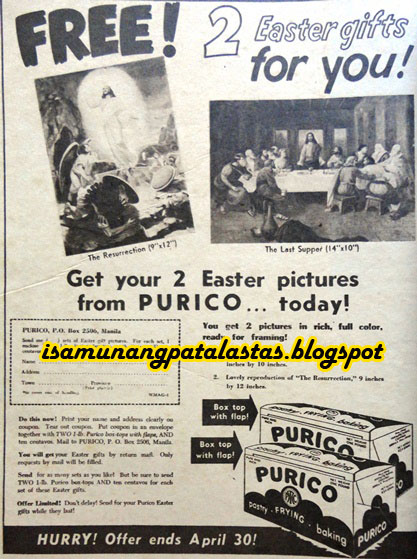
PURICO FREE EASTER GIFT PROMO, 1953

Fan photos of the performers and stars were issued for adoring fans to collect in albums. An example is shown above, made perhaps, by an ardent follower of the radio show.

TAWAG NG TANGHALAN TV PROGRAM, hosted by Lopito and Patsy, 1950s.

When PURICO Amaterur Hour was  renamed Tawag ng Tanghalan/Call of the Stage), it was staged for the new television medium,  for which the first TV advertising contract was  signed, after PMC was bought by Procter & Gamble. This further solidified the hold of PURICO on the shortening market. 

UPLIFTING THE PURICO IMAGE WITH A MANILA HOTEL AD,1960

The rise of liquid cooking oils eased out PURICO from the store shelves by the 1970s, until it totally disappeared altogether in the 1980s.

SOURCES:
PROGRESS Magazine 1956,
Radio Stars from Purico Radio Show, www.flyandfleablogspot.com

Tuesday, September 25, 2018

184. “Magandang Umaga Sa Iyo!”: Nestlè SUNRISE Soluble Coffee, 1987.

SUNRISE COFFEE, in new Flavor-Rich Granules form, relaunch ad, 1988.

In 1987, Nestlè Philippines developed a local coffee product that was totally separate and different from their premiere flagship brand, Nescafè Coffee. It was envisioned to be a price brand, to make coffee more accessible to more Filipinos. Named as Nestlè SUNRISE, the coffee blend came in the form of flavor-rich granules—so one need only a small amount to make a rich cup of coffee.

Nestlè assigned the product to Ace-Saatchi & Saatchi, and the agency went to work right away in crafting the communication strategy. The brand name inspired the way Nestlé SUNRISE would be positioned—it would be pushed as your first cup of morning coffee, for morning people who need a quick picker-upper to warm up the start of their day.

Though Nestlé SUNRISE was meant to be a popular price brand, care was taken by the agency to create a campaign hinged on beautiful Filipino traditions. Former DOT secretary Ramon Jimenez Jr., was the lead creative director who crafted the launch campaign, together with his team.

WATCH "SUNRISE COFFEE" LAUNCH AD HERE:
Source: View on the 3rd Jojo Bailon

It was he who came up with the theme: “Magandang Umaga sa Iyo”, which is charmingly Filipino. It shows an aspect of typical Filipino habits such as the warmth and vibrance of exchanging morning greetings among people from all levels of socio-economic strata.

This campaign came alive in 3 memorable TV 30s commercials: that were all designed to be morning situations:  “Bride”, “Spoon”,  and “Delivery”.


The “Bride”begins with a slow music that introduces viewer to a Father character, deep in reverie, while sipping a cup of Nestlé SUNRISE. Slowly, he sees a figure walk down the stairs—it is her daughter, dressed in a wedding gown, and the soon-to-be wed bridge greets his father with  “Hi, Papa”. Very quickly, the misty-eyed Father sees his daughter as a young girl, then is jolted back to the present time. The Father escorts her Daughter out, ready to give her away.


“Homecoming”, the second version shows a middle-aged couple having coffee together. Their small talk turns to their Son—a PMA cadet in Baguio-- whom the Mother misses. Little did they know that at that precise moment, the Son arrives to surprise them with a short visit.


The third version, “Delivery”, shows a couple having an intimate coffee moment together, shot at close range. The Woman drops a spoon, and as the Man bends down to pick it up, he sees someone wearing white shoes entering the room. It is then revealed, as the camera pulls out, that the Couple are a Husband and Wife in a hospital room, and the white shoe-shod figure is actually a Nurse bringing in their newly-delivered  Baby Girl (as foretold by the dropping of a spoon). All the the commercials end with the last strains of the jingle--“Maganda umaga sa inyong lahat!”, a pleasant good morning to all.

WATCH SUNRISE New Flavor Rich Granules" 1988 TVC HERE
with Angelique Lazo
(Credits: The CompanY Singers, posted Sep. 10, 2017)

At the 1987 Philippine Advertising Congress in Baguio City, all three Nestle SUNRISE commercials were recognized, winning Individual Golds at the Araw Awards. The Radio ad—which actually was a full song entitle, “Magandang Umaga”, won a Bronze Award.

MAGANDANG UMAGA SA IYO
Gising na, sa tulog na mahimbing
Lumiliwanag ang dilim,
Pati na ang paningin
Nababanaag mo,
Sa dakong silangan
Ang araw ay sumisilip,
Bumabati, dumudungaw

Magandang umaga sa iyo..
Magandang umaga sa iyo.
Magandang umaga sa iyo..at sa iyo at sa iyo..
Magandang umaga..magandang umaga..
...sa inyong lahat!

CREDITS
 ADVERTISER: Nestle Phiilppines
CLIENTS: Levi Castillo, Ed Trivino
AGENCY: Ace-Saatchi & SaatchiAdvertising, Inc.
CREATIVE DIRECTOR: Ramon Jimenez Jr.
ART DIRECTOR: Kits Yamsuan / COPYWRITER: Alex R. Castro
ACCOUNT MANAGEMENT: Sandra C. Puno
ACCOUNT EXECUTIVE: Richelle Mendoza
TVC PRODUCER: Paul Suarez
CASTER: Mario Sarmiento

PRODUCTION HOUSE: Image Films
DIRECTOR: Neil MacDonald
COMPOSER: Charo Unite, Ramon Jimenez Jr.,Alex R. Castro
RADIO JINGLE SINGER: Rene Martinez
JINGLE PRODUCTION HOUSE: Empire Studio

SOURCES:
Sunrise Coffee TVC ith Angelique Lazo; https://www.youtube.com/watch?v=wq2iuGIomWM
published by The CompanY Singers, published on Sep. 10, 2017.

Monday, February 12, 2018

150. THE LOST JINGLES OF D.O.T.: "Huwag Maging Dayuhan sa Sariling Bayan”, ca. 1986-87

It was just  after the People Revolution, sometime in late 1986. Filipinos were still reeling from the events of February when a peaceful revolution ousted Marcos which forced him to flee the country. 

Everyone was getting ready for a clean start, and one priority was rebuilding the battered economy. The DEPARTMENT OF TOURISM, under the new leadership of Sec. Antonio Gonzales, with undersecretary Narzalina Lim, decided to ask the help of advertising agencies to come up with a concept for the country’s Domestic Tourism campaign.

It made sense to call upon Filipinos first to rediscover their own, beautiful country as nationalistic pride was at its highest at this time. Ace-Saatchi & Saatchi Advertising was asked to pitch an idea, and the creative team--led by Creative Director Jimmy F. Santiago, who eventully wrote the slogan-- came up with a winning campaign theme that is still being quoted to this day: “Huwag Maging Dayuhan sa Sariling Bayan” (English translation” Don’t Be A Stranger in your Own Paradise”).

Part of the agency pitch was the presentation of jingle studies so that the concept can be better illustrated, and these two initial studies, with different melodies for the two versions  (Pilipino and English), were composed by jinglemaker, Caloy Agawa. For some reason, the D.O.T. jingle project  never pushed through, and these two studies were never finalized and produced.

For the first time, these jingles are being presented here:
LISTEN TO "HUWAG MAGING DAYUHAN" 
JINGLE HERE:

 LISTEN TO "DON'T BE A STRANGER 
IN YOUR OWN PARADISE" JINGLE HERE:

CREDITS:
AGENCY: ACE SAATCHI & SAATCHI ADVERTISING
CREATIVE DIRECTORS: Cid Reyes, Ramon Jimenez Jr., Jimmy F. Santiago
LYRICISTS: Pilipino Version: Jimmy F. Santiago / English Lyrics: Alex R. Castro
COMPOSER: Caloy Agawa / PRODUCER: Paul Suarez

Thursday, January 25, 2018

148. Brand Stories: LIWAYWAY GAWGAW, 1948

LIWAYWAY GAWGAW ANG GAMITIN. The classic package of the  oldest and
leading cornstarch brand in the country, Source: www.pictame.com

One of the most successful Filipino brand that is still in existence today is a cornstarch product called LIWAYWAY GAWGAW. It found favor in Filipino homes not just for cooking, but also for keeping clothes in shape, and giving them that clean, crisp look while the garment is pressed.

The Chinese-Filipino couple, Chan Lib and See Ying, are credited with launching LIWAYWAY GAWGAW to the Philippine market way back in 1948. They actually began bulk-buying cornstarch from wholesale markets, and re-packaged these in their Pasay home, in consumer-size paper packs for resale and distribution to sari-sari stores.

They gave it the brand name—“LIWAYWAY”—which was in keeping with using native brand names as a wave of Filipino nationalism swept post-war Philippines. 

LIWAYWAY means “dawn”, an appropriate name that presaged the future of a newly independent country, free at last from American rule. Even the package graphics reflected this hopeful optimism. It carried simple, comics-like illustration (sunrise behind mountains with swaying coconut trees on the front, a Filipina in native dress  pressing clothes at the back), the package copy  was composed in pure Pilipino, almost lyrical in style: "Sa minsang gamit ay di ninyo malilimot ang linis, puti at puro na pinanagutan namin" (at first use, you will not forget the clean, the whiteness and purity that we are liable for). Even the instructions for use were written  Pilipino, with words rarely use today: "Ginagawang maaluan at mabilis ang pagplantsa ng damit", 

LIWAYWAY GAWGAW was distributed all over the city in sari-sari stores and became an instant hit with Filipino housewives. The practice of treating fabrics with starch—“almirol”—was still popular then.

Women still wore baro’t saya which had sleeves and panuelos that required starching so they stay straight when worn.  On the other hand, menfolk still donned white Americana cerrada with white pants that had to look crisply white all day long.

Most students and young professionals too, too, wore white shirts to school or to their offices  (polo shirts for students, U.S. trubenized shirts for male office workers) , necessitating the use of ‘gawgaw” to give fabrics a clean finish, free from creases and wrinkles the whole day. LIWAYWAY GAWGAW, when applied to fabrics delivered unsurpassed results, to the great satisfaction of Filipino homemakers.

LISTEN TO "LIWAYWAY GAWGAW' 
RADIO JINGLE HERE:

No wonder, LIWAYWAY GAWGAW became an established Philippine brand, especially when it was promoted in the 60s and 70s using a highly memorable radio jingle, now an icon of our times. The success of the brand enabled the Chinese-Flipino couple to venture into other commodities—from candles, snack goods, coffee to hair products.  Today, their humble business has grown into an Asian empire, thanks to LIWAYWAY GAWGAW, and to the efforts of their visionary son, BENCH founder, Mr. Ben Chan.

SOURCES:
Liwayway Gawgaw (radio ad and jingle with photos), uploaded by Oishi Philippines, March 18, 2012, https://www.youtube.com/watch?v=Z-d_Vg2gsjY
Photo of Liwayway gawgaw: FASHIONABLE FILIPINAS: An Evolution of the Philippine Dress in Photographs, 1860-1960, by Gino Gnzales and Mark Lewis Higgins,
Liwayway Gawgaw product packs, front & back: https://makadto.com/tag/liwayway-gawgaw/
http://www.pictame.com/tag/LiwaywayGawgawAngGamitin

Sunday, October 29, 2017

135. FILIPINAS LIFE ASSURANCE COMPANY JINGLE, 1977


 FILIPINAS LIFE ASSURANCE COMPANY was founded on 27 April 1933, as a subsidiary of Filipinas Compañia de Seguros, in response to the Insurance Commission’s ruling that insurance companies must have separate life and non-life business divisions. The parent company--Filipinas Compañia de Seguros—had been founded earlier in 1913 by Antonio Melian with  brothers-in-law Fernando Antonio and Enrique Zobel  y de Ayala.

The business was briefly interrupted by the war, and when FILIPINAS LIFE resumed its operations, it would flourish and become a dominant name in industrial life insurance for over 30 years thru the 1970s. All the more when FILIPINAS LIFE began advertising on radio, using a high-recall jingle first heard on the airwaves in 1977.

LISTEN TO THE FILIPINAS LIFE JINGLE HERE:

Advertising icon Greg Macabenta of Advertising and Marketing Associates (AMA), penned the lyrics, which was produced by Rusty Velila.  Music was provided by the famed D’Amarillo Studio Orchestra while the singers were billed as “The Filipinas Singers”.Needless to say, the FILIPINAS LIFE Jingle became one of the most widely-heard jingles in the country, catapulting the company topmost in the minds of Filipinos.

In 1990, FILIPINAS LIFE became Ayala Life Assurance Inc. to underscore its transformation into a full-service life insurance company. Twenty years later, it would be renamed BPI-Philam Life Assurance Corp.,( BPI-Philam ) following the sale of BPI’s stake in Ayala Life to Philam Life.

Despite its new name, oldtimers still recall the insurance giant’s former name through the strains of a memorable jingle that woke everyone up in the early morning, singing along with its catchy chorus—FILIPINAS…FILIPINAS LIFE…FILIPINAS LIFE ASSURANCE COMPANY!!


 SOURCE:
Macabenta, Gregg. How to Make a Benta: Anecdotes, Lectures & Articles from the Advertising Wars Paperback – March 28, 2011
youtube, Filipinas Life (famous 70s jingle), posted by limva123, April 9, 2013. 

Wednesday, September 20, 2017

128. 1984 Creative Guild’s Radio Ad of the Year: GILLETTE’s RUBIE BLADE, “Harana” RC 30s.


The Creative Guild’s very frst radio ad of the year drew inspiration from the popular slice-of-life format, but further injected situations with a delightful brand of anticlimactic Pinoy humor.

As Bill Ibañez, then associate creative director of McCann-Erickson, now creative director at Great Wall Avertising and father of the RUBIE “Harana” 30-seconder ad, likes to say “Humor is my specialty. And Filipinos love it when a situation has a humorous twist.”

Source: flickr, Arne Kuilman
The client was Gillette Philippines, a 15-odd-year associate of McCann-Erickson, and the product was RUBIE Blade. When Ibañez took over the account, a popular campaign and a TV campaign starring the late comedian Vic Pacia were already airing. Client wanted to employ radio to encourage the men in downscale rural market to please shave.

“A lot of men out there were still using primitive implements to get rid of their bristles.” Ibañez explains. Such grooming innovations included two coins used as a makeshift tweezers or even splinters of wood. That is, if the gentleman ever bothered with his bristles at all.

Ibañez decided to utilize the popular jingle , which made a simple but very attractive promise, If you shaved with RUBIE, you would look good. “Ahit RUBIE, Ahit Pogi”—the eqution of the brand name with a Filipino slang for “handsome” was only of the cmpaign’s winning elements. Ibañez went a step further by pushing the satisfied user over the deep end; the hero becomes so handsome that, by the end of the commercial, he has a new problem altogether, “He becomes too good-looking for his own good.”

In “Harana”, only one of the several presentations of the delicious RUBIE dilemma, a fellow with the unsavory name of Tiagong Tuchang pays court to Kathleen, whose mother immediately puts the light out on the suitor because of his unshaven state. Calling him “tuchang” , a terribly coarse kind of bristle, is bad enough. “Yung hindi nag-aahit! Yung mukhang piña!”, the mother exclaims, and the listener goes to town figuring out how unbelievably fuzzy Tiago really looks.

RUBIE is presented as a resolution, and the playing of the jingle signifies that the hero has taken matters an razor into his own hands. He returns to Kathleen, who is so taken by the serenade (and the newly-trimmed serenade) that she asks for an encore. The crow of  rooster and a young man’s moan, “Josko, umaga na!” is the final twist and the hilarious revelation of just how many encores the now desirable Tiago was obliged to give.

Listeners began to await the next RUBIE Blade radio commercial like radio drama or comic installments, “The listener knew it was an exaggeration, because there was no attempt to present the situation as logical,” Ibañez recalls. Thus, they laughed heartily at the final turn of events, which, in subsequent versions, always had the hero ending up with more than he bargained for—as in a shotgun wedding, pehaps, or having more than one barrio lass demanding his attention.

From the distinguishing sound effects that set the ads apart from auditory clutter—a series of urgent knocks, or, in the case of “Harana”, the strum of a guitar---to the familiar characters and easily recognizable values, the RUBIE ads hit the Pinoy at his very heart. “They were indigenous and romantic,” Ibañez says. “The strength of the campaign was in fact that people recognized themselves in it.”

Enough to keep RUBIE Blade in the market for years to come.

CREDITS:
ADVERTISER: Gillette Philippines
PRODUCT: Rubie Blades
AGENCY: McCann-Erickson
ASSOCITE CREATIVE DIRECTOR: Bill Ibañez
PRODUCER: Baby Enriquez

SOURCES:
Article written by the late Butch Uy, forPerfect 10: A Decade of Creativity in Philippine Advertising, written by Butch Uy.Published by the Executive Committee of the Creative Guild of the Philippines. 1995, p. 66-67

Tuesday, November 15, 2016

82. Brand Icon: PRISCILLA, THE KOLYNOS GIRL

PRISCILLA aka Presentacion "Esen" Bataclan, Kolynos Girl

 KOLYNOS DENTAL CREAM was an American-made toothpaste brand created by Newell Sill Jenkins in 1908.  It was already being advertised in Philippine magazines in the 1930s. Radio then, was already becoming a popular medium for entertainment and promotion then and many companies in the U.S. used it as a channel for marketing. Kolynos was one such product known for program sponsorships.

Kolynos print ad, 1936. Graphic Magazine.

 In 1936, KZRM held auditions for radio singers and one of those who tried out was a 14 year-old high school sophomore from Cavite—Presentacion Bataclan. So impressed were the executives that they gave her a program of her own—The Kolynos Hour. She made her singing debut in 1936 under the screen name Priscilla. Known on-air as “Priscilla, the Kolynos Girl”, she would become the No. 1 radio personality of the Commonwealth Era.

PRISCILLA, THE KOLYNOS GIRL, with pianist
Ariston Avelino and singer, Rafael Artigas.

 “The Kolynos Hour” ran for just fifteen minutes, every Mondays and Fridays—but it lasted for a good three years. Priscilla became a household name, and the radio station was besieged with fan mails (200 letters a week!) and requests for autographs. She earned the then incredible sum of Php 7.50 a show.


 The Kolynos Girl came to typify the toothpaste belle of radio at her likeable best, her toothsome smile and 14-karat crooning voice popularizing songs like Stardust, I’m in the Mood for Love, My Reverie, All the Things You Are, and When Your Love Has Gone. She recorded for RCA and later, Lebran, Bataan Excelsior and Villar Records.

KOLYNOS TOOTHPASTE AD, 1955. The Sunday Times Magazine

 In the next years to follow, until the outbreak of the War, Priscilla divided her time between the radio and the movies. During the Japanese Occupation, she performed at the Life Theater. It was while headlining a show at the Metropolitan Theater that she met her husband, musician-saxophonist Bernardo Aristorenas, whom she married in 1944.

PRISCILLA, as a professional singer, actress, 1951.

 After the war, Priscilla did camp shows for U.S. armed forces and became active again on-air when radio became a flourishing industry in the 1950s. She, along with the Mystery Singer (Cecil Lloyd), signed up with Station KZRH and got top billing in Philippine Refining Company-sponsored shows.


She free-lanced on “Pepsodent’s Hour (another toothpaste brand!), sang on “Vick’s Variety Show”in 1951 and was in the popular “Student Canteen”.

PRISCILLA, minding her gift shop "Eyeful" along Mabini St. 1966

 Overseas, Priscilla sang in Okinawa for a year at the Castle Terrace Club, then made the rounds of clubs in Taipei and Hong Kong. The Aristorenases returned to Manila in 1964 and put up a souvenir gift shop along Mabini St., called “Eyeful”.

LISTEN TO THE KOLYNOS GIRL
SINGING "TOMORROW NEVER COMES":

 Today, the Kolynos Girl is now an nonagenarian, who resides in relative anonymity and quiet in Alabang Hills. Little does one know that for almost 3 decades, she ruled the airwaves as a singing product ambassador , a broadcast icon, and a leading voice in the golden age of the Philippine radio industry.

 SOURCES:
Sunday Times Magazine, 23 Nov. 1966
Literary Movies Magazine, 1951