Showing posts with label chocolate drinks. Show all posts

Friday, June 20, 2025

518. GOYA CHOCOLATE PRODUCTS, Print Ads, 1967-69

GOYA OMNIBUS CHOCOLATE DRINKS, 1968

One of the more popular brands of made-in-the-Philippines chocolate products is GOYA, a joint venture started in 1956 by the enterprising  Chua and Vilabrille families, under the company name GOYA Products, Inc. The first products were actually coffee and cocoa powder mixes.  The cocoa line proved to be more viable, so GOYA expanded to making instant chocolate mixes and chocolate-flavored beverages. Eventually, GOYA would extend its line to include chocolate bars and confections that proved to be successful, favored for its affordable price and chocolatey goodness.

FROM COCOA DRINKS..TO MILK CHOCOLATE TREATS, 1967

This led to Nestlé acquiring the local company in 1996, and was promoted actively through seasonals and regular advertising. Eight years later, in 2006, Petra Foods, a Singaporean food company —now known as Delfi Limited--- bought GOYA from Nestle, which continues to oversee its manufacture and marketing promotions in the Philippines, as well as in other Asian regions.

GOYA has had several relaunches, and is positioned to cater to the medium-end and lower-end brackets. But GOYA also has premium variety, a flanker product that is also part of the portfolio, and still affordably-priced.  

GOYA ALMOND CRUNCH with a Toblerone-type packaging,1969

From the plain cube-sized chocolates, GOYA now produces dark chocolates, dark mint chocolates, white chocolates, almonds dipped in chocolates, crunchy bite-size chocolates and even choco-covered biscuits. GOYA is into spreads, syrups and baking ingredients too—so long as it’s got chocolates.

The chocolate products are manufactured in a 3-hectare plant in Marikina City that has been globally-certified for its quality and taste. The iconic GOYA is now a heritage brand favored, recognized, and much-loved by generations of Filipino chocolate lovers. The GOYA brand continues to endure, providing chocolate enjoyment to Filipinos young and old alike, that is envisioned by Delfi Ltd. to prosper and grow even morem in the years to come.
Sunday, July 24, 2022

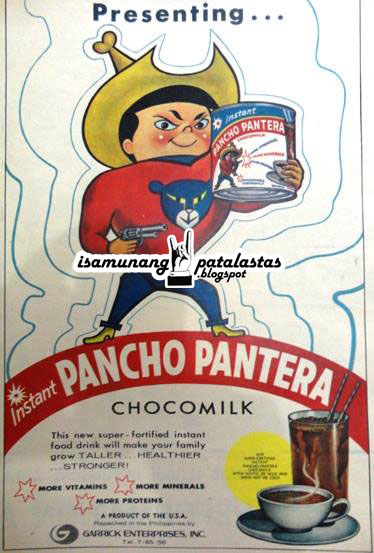
382. PANCHO PANTERA Instant Chocomilk, 1965

PANCHO PANTERA is an instant chocomilk powder drink that was widely popular in Mexico, introduced in the Philippines in 1965. Its product label claimed it is U.S. made and that the vitamins-and-minerals-fortified product was repacked in the Philippines by Garrick Enterprises Inc., owned and operated by Ricardo Quintos (father of Paul and Michael who were murdered by hired killers of his political opponent in Mindoro).

WATCH A MEXICAN TV AD OF PANCHO PANTERA CA. 1967

But PANCHO PANTERA is a heritage brand from Mexico, sold and enjoyed for over  90 years, before folding up in 2021. Along the way, the brand  was bought by a succession of blue-chip companies, from Procter & Gamble to Mead Johnson,

 PANCHO PANTERA had a brief shining moment in Philippine marketing, advertised in full color ads in magazines, and  TV, with an animated cartoon commercial featuring a cowboy mascot and a catchy jingle.

PANCHO PANTERA MASCOT, updated

In less than 2 years, PANCHO PANTERA would disappear from the local market, but Filipino children growing up in the 60s still vaguely remember the cowboy kid that ran through te TV screen, a picture of a healthier, stronger, taller kid, brought up with chocomilk that is PANCHO PANTERA!

SOURCE:

Choco Milk y Pancho Pantera en 1967, uploaded by Telenostalgia Nov. 20, 2011. https://www.youtube.com/watch?v=XAgUdUPJINA


Thursday, June 3, 2021

326. Everybody Loves COCOA RICOA by Philippine Food Industries Inc., 1962 Ads

COCOA RICOA was the pioneer product of the  Philippine Food Industries, Inc. when it bgena its operations in the chocolate processing and manufacturing plant along EDSA in Mandaluyong in 1956. The brand became a traditional favorite for chocolate lovers, using COCOA RICOA for the chocolate breakfast drinks, cakes, custards, ice cream, cookies and other chocolate-based goodies.

The product was advertised heavily in color ads that often carried recipes to promote its varied usages, although the chocolate powder was mostly used for hot and cold drinks. COCOA RICOA was also produced in blocks, and in sweetened powder and syrup form, for versatility of use. 

It attained such popularity that in 1962, a thematic campaign was launched to create a”bandwagon effect” for the brand. “Everybody Loves Cocoa Ricoa” featured every member of a Filipino family attesting to COCOA RICOA’s flavorsome, chocolatey appeal as used in their specific favorite choco treat: Lola for her “champorado”, Lolo for his “Chocolate Español”, Mama for her chocolate cake, and so on. 

Today, COCOA RICOA is still being produced, led by its  COCOA RICOA Breakfast Powder, still in its familiar, but modernized deep turquoise packaging by Commonwealth Foods, Inc, which  has owned the brand since 1968. COCOA RICOA is one of the few trailblazing, locally-produced chocolate product brand that has survived the test—and taste—of times, inspite of the  greater availability of imported brands in the Philippine market, proof that after all these years, “Everybody loves COCOA RICOA!”

Monday, November 23, 2020

298. MILO vs. OVALTINE: The Battle for the Title of the Olympic Energy Drink

OVALTINE & MILO: Official Olympic Energy Drinks

OVALTINE was a chocolate malt drink that was reputedly first produced in Bern, Switzerland in 1865. Originally, it was called “Ovomaltine” as its formulation contains eggs, but a misspelling of the name on the trademark registration application led to the name being shortened to Ovaltine in English-speaking markets. OVALTINE was already advertised in the Philippines as early as 1925.

1972 OVALTINE Ad,Munich Olympics

Since its introduction, OVALTINE had a variety of health claims—from appetite builder, a recuperative drink for convalescing patients, fatigue alleviator, vitality and energy giver.

OVALTINE OLYMPIC AD, 1948. Credit: Alamy

When the Summer Olympics was held in Los Angeles, California, OVALTINE became one of the games’ sponsors—where it was to become the official Olympic energy drink, thus pre-dating MILO’s claim by over 35 years.  In fact, OVALTINE was the health drink sponsor in 9 Olympics!  

OVALTINE OLYMPIC 1948 Tin Sign, Credit: Pinterest

The local MILO print ads however, claimed otherwise: in 1968, it ran ads proclaiming MILO as the choice of the 1968 Olympics. In 1972, it stole the thunder from OVALTINE by headlining the claim in its ads that MILO is the “official energy drink of the Munich Olympics”.

MILO OLYMPIC AD "Official Energy Drink",1972

There was an attempt by OVALTINE to wrest that title from MILO, as that same year, it ran an ad that showed the brand’s consistent presence in successive Olympics from 1932-1972.  But the strip ad was no match for the media juggernaut of Nestlé. And too bad as well—at that time, there really was no advertising regulatory board that the makers of OVALTINE could go tom to file a complaint (the PBA was founded only in 1974).

MILO 1968 MEXICO OLYMPICS AD,  "Choice of the '68 Olympics

OVALTINE let it go, gave up without further fight, and continued with variable thematic promises,  while MILO picked up the “Olympic Energy” title and went to town with that strong, single-minded message in successful campaigns that went on for years, featuring the country’s best and brightest Olympians in its ads. OVALTINE'S loss is MILO's biggest gain.