Showing posts with label fruit drink. Show all posts

Thursday, November 6, 2025

530. DOLE Canned Pineapples and Fruit Drinks, 1968-1984

The brand that briefly gave icon brand Del Monte a run for its money was DOLE Philippines, which, with its array of canned pineapple and fruit drinks, was looked at as a threat to the former’s monopolistic pineapple business.

DOLE Philippines began operations in 1963 with Dolefil, a major producer of fresh and canned pineapples located in Polomolok, South Cotabato. The company's history in the Philippines is linked to the worldwide expansion of its parent company, which, in 1903 started the mass-production of canned pineapples in Hawaii. The pineapples were grown in the vast pineapple plantations that were processed in the company’s manufacturing facilities, which were canned to the highest standards,

By 1965, Dolefil made its first shipment of 30,000 cases of canned pineapple products to the US. At this time, DOLE products were being marketed and advertised in the Philippines, beginning with the canned pineapple products (chunks, crushed,  tidbits) and juices (pineapple, pineapple orange, pineapple strawberry).

DOLE products became popular options to Filipinos, as well as their mixed-fruit juices. To maintain quality control, Dolefil put up its own can manufacturing plant in 1968, and a packaging plant in 1976.

Things were going well for DOLE, until the more established Del Monte Phils.went all-out in advertising, featuring well-strategized and well-crafted TV commercials from the ad agency, McCann-Erickson, that were targeted at lower-middle classes. After all, pineapple juice was a staple drink in practically all-Filipino events, much like soda.

In 1990, Stanfilco, another Dole operation in the Philippines, merged with Dolefil. In 2013, Dole Phils. was  turned over to Itochu Corporation, and became the majority owner of DOLE plc, a global producer and marketer of fresh fruits and vegetables. This means that it has significant ownership of DOLE's Asian fresh produce and worldwide packaged foods businesses , and has also been expanding DOLE's pineapple production in the Philippines. 

Tuesday, May 16, 2023

423. MAGNOLIA FRUIT DRINKS, "Truer to the Fruit!", Print Ads. 1983-1990

In the early 1980s, SMC-MAGNOLIA entered the lucrative juice and juice drink market with a brand called Nature’s Best Orange Drink. It had also introduced in 1981, a premium bottled fruit juice brand called Magnolia Juice, in Orange, Mango and Guyabano flavors. Nature’s Best proved to be more viable, especially with the growing shift from bottled packaging to the cheaper, recyclable tetra-pack cartons.

TRUER TO THE FRUIT, Launch Ad, 1983

Magnolia eventually dropped the more expensive bottled juice line and retained Nature’s Best for some time, only to be incorporated in a new fruit drink line introduced in 1983:  MAGNOLIA FRUIT DRINKS in single-serve tetra cartons with straws.


The launch materials include a Radio Jingle that was composed and sung by the Apo Hiking Society, with the catchphrase: “Give me the fruit…or give me Magnolia”, commissioned by its agency Ace-Saatchi & Saatchi.

LISTEN TO MFD RADIO BY APO HIKING SOCIETY, 1983 HERE:


 The MAGNOLIA FRUIT DRINKS line would expand to include Buco (Coconut water), Mango,  Guyabano (Soursop), and Calamansi (Philippine Lemon) juice flavors. The carton-packed fruit drinks survived the 90s decade, and would be reformulated several times.


In 2000s, MAGNOLIA FRUIT DRINKS reverted to PET bottles and crowned bottles. Today the MAGNOLIA FRUIT DRINK line is applied to bottled products (Grape and Orange Flavors) advertised in tandem with their fruit-based HealthTea line,

SOURCES:

1983 Magnolia Fruit Drinks Radio Ad featuring The Apo Hiking Society, https://www.youtube.com/watch?v=_NdqRBUYaNg, uploaded by 莢豌豆本舗 2018.


Tuesday, August 3, 2021

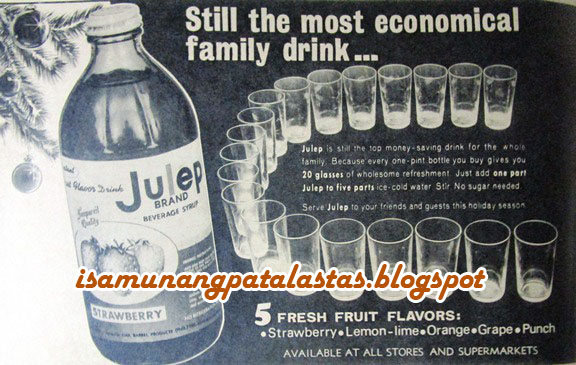
335. Brand Stories: JULEP BEVERAGE SYRUP, 1964

FROM THE MAKERS OF OVALTINE---JULEP! Intro Ad, 1964

The fruit juice syrup that took the coutnry by storm was introduced in 1963, as JULEP Beverage Syrup, touted as coming from “the  makers of Ovaltine”, which by then was an established brand. Associated British Foods plc (ABF) was a leading British multinational food processing and retailing company that specialized in sugar products and ingredients. Through the years, its subsidiaries in the Philippines included Novartis, Wander AG and currently, ABF Group.

COOL RELAXATION WITH JULEP, 1964

JULEP found a ready market in the Philippines as it was a pioneer liquid concentrate brand—long before Sunquick and Sunny Orange Drink. It was available in 5 refreshing flavors: Grape, Lemon-Lime, Orange, Punch and  Strawberry. All one had to do was add 1 part JULEP to 5 parts water, and you’re ready to enjoy its fruity goodness. One pint of JULEP makes from 20-22 glasses, so it was economical too.

SO REFRESHINGLY DELICIOUS--JULEP! 1967 Ad

The black and white launch ads of JULEP came out in 1964, and soon, Filipino consumers couldn’t get enough of the new fruit juice; never mind if it left colored stains on the mouth. The brand became the most popular juice drink in the Philippines, and the name JULEP became a byword. Its advertising became even more sophisticated with full-blown campaigns rolled out in 1967—all featuring photographic ads in color.

ZESTY, FLAVORFUL JULEP, 1969 Ad

ZESTY, ECONOMICAL JULEP, 1969 Ad

JULEP had a good run, driven primarily by its economical price, but by the late 60s and early 70s, there were newer brands that competed for attention. All of a sudden, JULEP was looked at as on old-fashioned brand, not “in” with the young set which was looking for more innovation and appealing flavors. Mothers, too, were more discerning, and were ready to invest more in better quality drinks.  Competitors like Sunquick, took to TV advertising with commercials featuring pop jingle, hipper-looking teens, in fun-filled vignettes. SUNKIST, on the other hand, was driven mainly by its made-in-America image, a tack that TANG would later adapt in its Philippine launch. It also didn’t help that the company that originally made JULEP underwent a series of mergers and acquisitions that led to the dropping of the brand in the product portfolio. In the 80s, Sunny Orange took over as the more popular orange brand in the mass market.

THE MOST ECONOMICAL FAMILY DRINK, 1966 Ad


Tuesday, December 17, 2019

257. HAPPY HOLIDAYS FROM DEL MONTE, Christmas Ads, 1936-1967

DEL MONTE HOLIDAY AD, 1955

The DEL MONTE brand of canned and bottled food products has been around since 1886, and its history is intertwined with the pineapple industry in the Philippines. The named was used by a foods distributor that provided coffee to the Del Monte Hotel in California. The distributor used the same name to produce its canned peaches which were marketed by the California Fruit Canners Association (CFCA) in 1898, a group of  18 West Coast canning companies.

The Cannery of CFCA was built in 1907 and by 1909 was the largest fruit and vegetable cannery in the world. In 1917, it acquired pineapple farms and a cannery in Hawaii and added canneries in Florida and the Midwest, as well as in the U.S.-owned Philippines, in 1926.
 
DEL MONTE CHRISTMAS AD, ca. 1935-36.

The Philippine cannery, called Philpack, was headed by Harry White from 1926-1938, who steered it through start-up years. In Bukidnon, experimental plots were planted with pineapple crowns, until mechanical farming using U.S.-made tractors and trucks modernized the process.

Early DEL MONTE advertising featured products that were imported from the U.S.—cling peaches, cherries and fruit salad—all promoted during the holiday season from the late 1920s thru the ‘30s.
 
DEL MONTE CORPORATE CHRISTMAS Ad, 1961
The War closed down the Philippine cannery but was rebuilt soon after, using surviving pineapple crowns to restart the business anew. Slowly, but surely, the Company gained new packing lines.

It was in the 1950s that Philpack opens its Sales and Marketing offices in Intramuros, Manila, that resulted in more effective, and more professionally done advertising and promotions. Not only did the Cannery expand with a new can plant, but also was equipped with  new processing lines for tomato, papaya and tuna, and a seaport.
 
DEL MONTE PINEAPPLE JUICE, New Year Ad, 1965
By 1967, DEL MONTE products includes fruit juices, catsup, pineapples of different cuts, tomato sauce and even sardines, all actively advertised in magazines and dailies.

On this spread are an array of omnibus Christmas ads featuring DEL MONTE products  spanning the first 40 years of DEL MONTE in the Philippines.

DEL MONTE PINEAPPLE, Print Ad, 1967

Sunday, May 5, 2019

219.Over 20 Glasses of SUNQUICK, Print Ads 1970-71

PICK A QUICK! Sunquick Orange Concentrate Intro Ad,1970

The refreshingly different orange drink that made waves in the Philippines in 1970 was developed by Danish brothers Jep and Flemming Petersen. They succeeded perfecting a process of concentrating real orange juice  and produced a juice drink first launched in the United Kingdom in 1966 as SUNQUICK Orange Concentrate.

Needless to say, SUNQUICK became an incredible success, and the company began advertising in 1968, that propelled the product to eve greater heights. It became an international brand as SUNQUICK in Europe, the Middle East, and Asia—including the Philippines in 1970.

SUNQUICK Orange Concentrate was bottled locally by Marina Sales, Inc. in Mandaluyong, a distribution company that has been in business since 1954.

When it was launched in the Philippines through print and TV advertising, it created by a buzz because of its concentrate form. One need only to add water to make an orange drink that has 5 times more orange juice than ordinary fruit drinks in the market. At that time, only Julep and Sunkist were the only other available orange juice choices.


VALUE-FOR MONEY SUNQUICK MAGAZINE ADS. 1970

The initial interest in SUNQUICK Orange Concentrate was dampened by the perception that it was too expensive for a bottled product. Also, the use of concentrate was largely unknown. So, SUNQUICK embarked on an aggressive value-for-money campaign. One small bottle of SUNQUICK, the ad message conveyed,  could actually make 20 glasses of orange juice drinks!

LISTEN TO THE 1970 SUNQUICK JINGLE 
as sung by The Ambivalent Crowd

A TV commercial was the vehicle for SUNQUICK’s value-for-money message that featured the young, talented members of the Ambivalent Crowd that included Pol Enriquez, Celeste Legaspi, Cynthia Patag, Gigi Escalante, Mae Cendana, Pinky Marquez and Berg Villapando , among others. The much-sought after singing group had Willy B. Cruz as musical director.

REPRICED VALUE-FOR MONEY AD. The original 17 centavos per glass
has risen to 23 centavos due to inflation in 1971.

The Ambivalent Crowd were shown frolicking in what looked like a garden setting, as they sang the memorable “Over 20 Glasses of SUNQUICK” jingle that was specially composed by Jose Mari Chan.

SUNQUICK 1971  MAGAZINE AD

Decades later, SUNQUICK is one of the world’s most popular concentrates, present in over 70 markets. Though no longer active in traditional advertising. its business continues in the Philippines, under  SUNQUICK Philippines, finally established in 2012.

1970 SUNQUICK FLAVORS: Orange, Lemon, Mandarin Orange, Grapefruit

Other than the flagship brand, SUNQUICK, its line has expanded to include Lemon, Mango, Pink Guava & Strawberry, Mandarin, Blackcurrant, Ice Tea Lemon and Tropical flavors—perfect summer refreshment for the family! 

2019 SUNQUICK FLAVORS. Share the Joy of 8 Flavors!

These are supported through merchandising, sales and online promotions. Concentrating on great taste for many years now, SUNQUICK has truly succeeded in its mission embodied by its new slogan: “Share the Joy!”

SOURCES:
Sunquick Philippines FB page
Sunquick History: https://www.sunquick.com/

Wednesday, April 3, 2019

215. Brand Stories: ZEST-O, the No. 1 Juice Drink (1981)

ZEST-O ORANGE JUICE DRINK, 1990 Print Ad.

 The country’s best selling juice drink was conceived by self-made magnate Mr. Alfred M. Yao,  who rose from humble beginnings to become the founder of one of the most successful homegrown business in the country today. Mr. Yao took over the care of his family at age 12, when his father died. Five years later, the young entrepreneur who did not even finish high school, took a bank loan of Php3,000 to put up a printing press, which proved to be very viable.

While on a 1979 business tour in Europe, he chanced upon a new packaging technique introduced by French inventor, Louis Doyen, back in 1962. He introduced a specially-shaped plastic bag that can be aseptically filled with liquid products, that could stand on its own. Called “doypack”, it was significantly cheaper than traditional carton packaging.

To test the new packaging, the rising businessman mixed juices in his kitchen and packaged them in doypacks. He was so satisfied with the results that in 1981, he decided to shift his attention to creating a beverage company known as SEMEXCO Marketing Corporation, with ZEST-O Orange Juice Drink as its lead product. The jucie drink in its innovative foil pack with a plastic straw was launched that same year.
 
SEMEXCO COPRORATE AD, 1989
ZEST-O was enthusiastically received by the market, as it was so affordably priced, and had a really refreshing orange flavor that can be cooled easily in its own foil pack. It wa handy, could be disposed easily,  and provided more value for one’s money. ZEST-O soon became widely available nationwide, and overtook leading brands to emerge as  the no.1 juice drink in less than a decade—replacing more expensive sodas and juices during parties, meriendas, and funeral wakes!

WATCH ZEST-O 2006 TVC HERE:

More new flavors under the ZEST-O name were introduced in the ensuing years: Guyabano, Mango, Grape, Pineapple, Calamansi, Apple, Strawberry.

SUN-GLO, another SEMEXCO juice brand.
Using the same modern doypack technology, SEMEXCO branched out into more jucie brands (Sun-Glo), milk ( Dutch Maid, Milkland), along with other traditional canned and bottled products (Tulip, Tita Frita). 

The ZEST-O brand, however, built more positive and enduring equities that it was adapted eventually as the name of the corporation.

When the company forayed into other product lines and business, the name ZEST-O was used, as in the case of its ZEST-O chocolate drink. In 2008,  Mr. Yao ventured into aviation and launched Zest Airways which, like his famous juice drink, was known for low-cost fares.  Integrated with Air Asia, it became Air Asia Zest in  2016.

ZEST-O juice drinks continue to dominate the juice market today, even with the additional taxes levied on sugared beverages in 2015, that threatened to close down some plants. In picnics, memorial services, family reunions,  company and school parties,  chances are, you will find a packs of ZEST-O being passed around, proof that the humble drink has become a part of our everyday life.

WATCH ZEST-O 35 YEARS TVC HERE:

SOURCES:
Zest-O Juice Drink Commercial The Best 2006.
https://www.youtube.com/watch?v=SrDn5-Lvi8c, posted by Zest-O Videos, Oct. 18, 2015.
Zest-O 35 Years TVC,  https://www.youtube.com/watch?v=7lvfGBlKtT4, posted by Zest-O Videos, Oct. 18, 2015.
Doypack:
Success Story of Alfredo Yao: The Juice King: http://primer.com.ph/business/2017/06/19/success-story-of-alfredo-yao-the-juice-king/, Philippine Primer, The expats Guide to the Philippine Lifestyle, 19 June 2017.


Monday, November 5, 2018

189. The Jingle That You Love to Hate (But Keep on Singing, Anyway!): SUNNY ORANGE, 1984

NEW, IMPROVED SUNNY ORANGE DRINK, 1984 print ad


SUNNY ORANGE juice drink concentrate was introduced in the early 1980s, and everything about it appeared wrong—it came in nondescript bottles that reminded one of chemical bottles in beauty salons. 

We don’t even know the manufacturer, as its early ads did not carry the maker’s name. Its paper label seemed like it was designed by an amateur artist, and the orange color of the juice drink was too bright orange-y to be real. But it was so cheap, and apparently tasted okay (“sweet na sweet”)—so for one brief shining moment in the 80s decade, SUNNY ORANGE had its time.

The product seemed to have enough resources for it to be plugged live in the shows of Master Showman German Moreno who featured unknown, but promising talents. But it was the jingle that ingrained SUNNY ORANGE into our national consciousness, inspite of and despite of its bad lyrics, bad singing, bad phrasing, and bad recording. 

The melody was so simple, even a child can pick it up and sing it in minutes. Then, there was the homespun quality to the way the jingle was sung, complete with the singer’s bad diction (she seemed to have overdubbed the harmony as well to save on cost).

LISTEN TO SUNNY ORANGE JINGLE HERE:

SUNNY ORANGE DRINK is long gone, and only the jingle’s tune remains in the memories of Filipino TV viewers who grew up in the 80s, remembered in the same breadth as “YC Bikini Brief” and “Seiko Wallet”. To rephrase a famous line:  Good melody or bad melody---it still is publicity!

SOURCE:
Sunny Orange – With Lyrics, uploaded by art carr, published Aug. 22, 2010.