CAMEL CIGARETTES as a cigarette brand is over a century
old, developed by Richard Joshua "R. J." Reynolds, founder of the
company that still bears his name way back in 1913. The cigarettes were
originally blended to have a milder taste than other brands. He named his
packaged cigarettes ”CAMEL” because its main ingredient was Turkish tobacco.
The widely promoted cigarettes was advertised with the slogan "I'd walk a mile for a Camel!", that
was so popular, it was used for decades. In the Philippines, Fortune Tobacco
Corp., founded by business tycoon Lucio Tan in 1965, and the producer of the
hugely successful local brands Champion, Fortune and Hope Cigarettes, expanded
their portfolio with the inclusion of foreign brands that included Winston, Salem and CAMEL.
The CAMEL product advertising adapted by the local agency,
J. Romero & Associates, were all American-conceived materials. In 1984, the
campaign “The Taste That’s a Legend” was launched, using U.S. color print ads that
showed up on glossy magazine covers, shown on this page. The ads featured a man going on a solo trip on an Amazon River-like setting, that is bound to be, indeed, a legendary adventure!
Established in 1965, Fortune Tobacco Corporation (FTC) was
founded by tai-pans Lucio Tan, Benito
Tan Kee Hiong, Atty. Florencio N. Santos, and Mariano Tanenglian. The company
introduced the most successful local cigarette brands in the Philippines,
including the Fortune, Champion and Hope menthol brands. Prior to the creation
of PMFTC, it held the largest domestic tobacco business in the Philippines.
HOPE, THE LARGEST LUXURY CIGARETTE IN THE COUNTRY, 1987
CHAMPION MENTHOLS, 1971
By the start of the new 1970s decade, Fortune Tobacco
Corporation was riding the wave of success courtesy of its banner brands that
would also come to include More, Winston, Salem and Boss.
WINSTON, 1979 AD
CAMEL, 1984 AD
Other flanker and price brands were also produced to cover
all smoking segments of the country, and the 1980s were a period of robust
growth for the FTC’s product portfolio.
BOSS MENTHOL CIGARETTES, 1971
MORE MENTHOL 100'S, 1979AD
In 1995, Philip Morris Philippines, Inc. (PMPI) was
established to handle all sales and marketing for Marlboro and Philip Morris
brands. Philip Morris Philippines Manufacturing, Inc. (PMPMI) was established in
2002 to manage aspects of the Philippine business, including manufacturing
operations.
In Feb. 2010, PMI and
Fortune Tobacco Corporation (FTC) signed an agreement to unite their respective
business activities by transferring some assets and liabilities of both
companies to form a new company named "PMFTC, Inc.", headed by Lucio
Tan. PMFTC enjoys a 70.5-percent market share of the local tobacco market in
2019.
By the start of the new 1970s decade, Lucio Tan;s Fortune
Tobacco Corporation was riding the wave of success courtesy of its banner
brand, Champion Cigarettes. The brand would later be joined by equally successful
brands like Hope Luxury Cigarettes, More, and Fortune.
There were other less known brands like Mark, Terra, and Westpoint,
but hopes were high on FTC’s BOSS CIGARETTES,
introduced in 1971, which was backed by solid advertising and marketing
supports. The product line, that includedModern white filter/ Super Kings and Menthol 100s,were pushed in the market
with print ads, premium items, and a TV commercial, featuring a memorable tagline—“Boss…sigarilyo!”.
BOSS Print Ad, 1971, Photo source: Pinterest
In a time when cigarette advertising was not regulated, BOSS
CIGARETTES continued to be available in the Philippine market through the early
2001. Since Jan. 1, 2007, when Republic Act 9211 was passed, all cigarette
commercials on television, cable television and radio have been prohibited. The
FTC portfolio was streamlined, and BOSS CIGARETTES was dropped from the
product line.
One of the most successful local brands to be launched at
the end of the 1960s is the popular CHAMPION
brand, made Fortune Tobacco Corp. (now Philip Morris-Fortune Tobacco Corp.
or PMFTC), owned by business magnate, Lucio Tan.
CHAMPION’s
early advertising programs were handled by Convey Advertising, which was
responsible for creating the "CHAMPION
talaga!” abbreviated from the longer “CHAMPION
sa lasa, Champion sa halaga, CHAMPION
talaga” selling line.
The repetitive line, incorporated in a simple, but
unforgettable jingle, raised awareness for CHAMPION
to an all-time level that made the brand one of the most well-known in the 70s.
All the agency needed to do was to refresh the commercial with sub-themes like “The
CHAMPION Generation”, “CHAMPION dumiskarte”, “The Brand of
Champions”, but always retaining the “CHAMPION talaga” element.
CHAMPION BROWN, introduced in 1974
CHAMPION Mild Menthols
were joined in 1974, with the more fashionable slim, brown versions called CHAMPION Brown.
WATCH A 1974 CHAMPION TVC HERE:
However, since January 1, 2007, when Republic Act 9211
was passed, all cigarette commercials on television, cable television and radio
have been prohibited. CHAMPION,
which celebrates its 50th anniversary this year, continues to be
produced and has its own following despite the absence of media advertising.
L&M FILTERS, local cigarette ad, with Filipina model, Benigna Rustia. 1968
L&M CIGARETTES
has a long history,and takes its name
from a product of an American tobacco company, Liggett and Myers founded in
1873. “L&M” started as a brand name for a plug chewing tobacco in 1885, but
it was only in 1952 that the brand name was inherited by a modern cigarette
product, made with a smoke filter.
At their launch, L&M CIGARETTES were touted as "American cigarettes of the highest
quality with the best filter", and as such, was marketed in the 1950s on a
health platform—“Just what the doctor ordered” .
It enjoyed much success around the world-- in Latin
America, Europe, the Arab region, the Far East—including the Philippines. L&MCIGARETTES were extensively advertised in full-page ads, which were
localized even as they adapted U.S. campaign slogans.
WATCH THIS 1 L&M TV AD, 1966
"Come on Over to the L&M Side" Jingle
By 1967, L&M CIGARETTES in the Philippines began
using elements of the highly successful
and engaging “Come on over to the L&M Side” campaign, first produced in the
U.S.
JUST FOR THE TASTE OF IT! L&M Print Ad, 1967.
The American L&M commercial with a catchy jingle was
aired on local television that year, supplemented by illustrated ads of foreigners
with a Philippine scene in the background.Perhaps to capture the attractive
image of the Philippines as an exotic Far East paradise, the local ads were
shot using a Filipina beauty (Benigna Rustia) in a Hawaiian setting.
COME ON OVER TO THE L&M SIDE! Print ad, 1968.
In 1999, the L&M trademark rights were acquired by
the largest tobacco company in the United States, Philip Morris. Its Philippine
affiliate, Philip Morris Philippines Manufacturing Inc. (PMPMI), joined forces
with Lucio Tan’s Fortune Tobacco Corporation (FTC) in 2010, resulting a new company called Philip Morris Fortune
Tobacco Corp. Inc. (PMFTC). It continues to produce L&M CIGARETTES (L&M
Filter Kings, L&M Lights, L&M Menthol, L&M Menthol Lights) which is
considered a mid-sized brand.
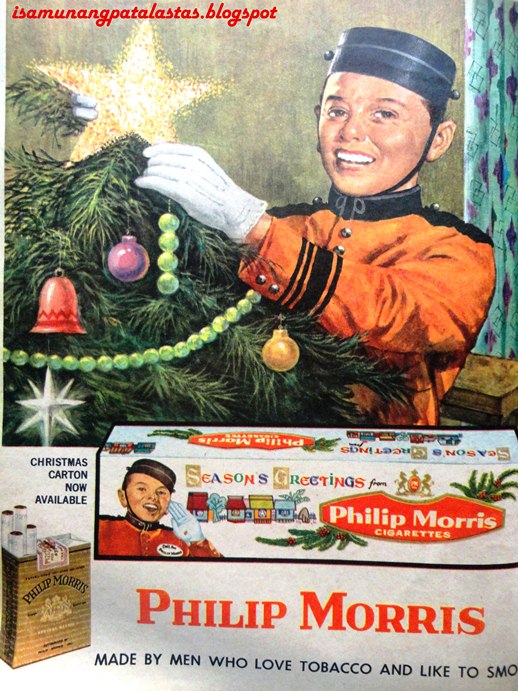
HAPPY HOLIDAYS, from Philip Morris' Johnny Bellhop, ca.1965
The products of PHILIP MORRIS International Inc. became
known to the Philippines only in 1955, when a licensing agreement was reached
with La Suerte Cigar and Cigarette Factory to manufacture and sell PHILIP MORRIS branded-cigarettes in the country. It was PHILIP MORRIS’ first exclusive
agreement outside of the U.S.
SEASON'S GREETINGS from Philip Morris, 1966
La Suerte Cigar & Cigarette Factory (La Suerte),44
Fortune Tobacco Corporation (Fortune),45 and Sterling Tobacco Corporation
(Sterling)46 are domestic corporations engaged in the production and
manufacture of cigars and cigarettes. These companies import leaf tobacco from
foreign sources and purchase locally produced leaf tobacco to be used in the
manufacture of cigars and cigarettes
MALIGAYANG PASKO, Call for Philip Morris, 1970
For over 40 years, La Suerte produced and sold PHILIP MORRIS, until Fortune Tobacco Corp. was established in 1965, which then took
over the manufacturing and marketing of the brand, including another American
favorite, Marlboro.
************
JOHNNY ROVENTINI soource; wikipedia
PHILIP MORRIS advertising featured the iconic bellhop
trade character which was conceived back in the Word War I years. Hotel lobbies then were used as meeting
places to meet people, talk business—and smoke. Initially, an illustration of a
bellhop was used in early ads, and part of his duties was to page people, hence
the slogan “Call for Philip Morris”.
Milton Biow, head of New York Biow Agency that handled the account, had the idea of‘humanizing’ the
illustrated bellhop on PHILIP MORRIS ads. He found him in the person of a 23
year-old, a shade under 4 feet, 59-pounder Johnny Roventini (b. Aug. 15, 1910/d. Nov. 30,
1998) who was a real-life bellboy working at the New Yorker Hotel. He was asked
to holler “Call for PHILIP MORRIS!”, which he did so in his high-pitched voice,
not knowing that he was paging a product, not a person.
Johnny Bellhop was finally found and became the most
successful spokesperson for PHILIP MORRIS. He appeared on TV and in print ads,
lent his distinctive voice to a PHILIP MORRIS radio show, and is credited with
spurring the growth of broadcast media.
LISTEN TO JOHNNY BELLHOP 's
"CALLFOR PHILIP MORRIS" HERE:
Source: The Mouldy Spud , Uploaded July 27, 2010
Johnny prefaced the highly-popular “I
Love Lucy” program of Lucille Ball and Desi Arnaz with his signature call--"Call
for Phil-ip Mor-rees"”—in perfect b-flat, and helped keep the ratings
soaring.
The iconic bellhop cigarette character was not unknown to
Filipinos, thanks to the popularity of the early PHILIP MORRIS ads that
featured him. In fact, the bellboy was ‘copied’
by La Insular Cigarettes, for its local print ads in 1929.
It was only in 1965
that the bellhop was used for PHILIP MORRIS magazine ads in the Philippines.
The Christmas ads shown here feature a faithful illustrated likeness of Johnny
Roventini, whose call for PHILIP MORRIS made him one of the most recognizable
faces on media.
At the prime of his career, Johnny was earning a hefty
$50,000 annual salary, thanks to his personal appearances that made him one of
the most recognizable faces on media. Considered a “living trademark”, Johnny’s
fame and success was enhanced by his ready smile and welcoming hands that won
the admiration of people who came to see him.
In the mid 1970s, Fortune Tobacco Corporation of Lucio
Tan, ruled the Philippine cigarette market led by brands like More, Westpoint,
Camel, Salem, Champion and HOPE INTERNATIONALLUXURY CIGARETTES, sold as
mentholated sticks. The company was founded in 1966, with a decrepit plant made
of GI sheets and scrap lumber in Marikina, equipped with second hand machines.
It would grow to become one of the five largest privately-held cigarette
manufacturers in the world.
The success of their brands were largely due to their
massive tri-media advertising and promotions, which was handled by their
agency, J. Romero and Associates. There was a deliberate decision to give the
Fortune cigarette line an imported image, and in fact, most of the brands in
their early advertising, featured Caucasian talents.
HOPE CIGARETTES were advertised on the basis of their “mentholated
freshness”. The TVCs showed foreign talents engaged in such exhilarating Western
leisure like sky-diving, sky wake-boarding and speed boat racing to drive home
the “freshness” story. Sure enough, HOPE CIGARETTES became the largest luxury cigarette
in the country.
But what made even HOPE CIGARETTES more popular was a
jingle that had a genuine American feel courtesy of the singer who sounded like
Karen Carpenter—then one of the leading voices of the airwaves.
“There’s a light of HOPE…when you light a HOPE…there’s a
light of HOPE for you…”, went the jingle, sang soulfully by the singer—Claire
de la Fuente, then 21, who was assigned by composer George Canseco to sing the
jingle. It accompanied a TVC which aired in late 1979, that featured
paragliders soaring on yonder blue skies.
WATCH HOPE CIGARETTE TVC here:
The song took HOPE CIGARETTES to an all-time high in
terms of awareness and popularity, but it also catapulted the singer to fame. As
the campaign evolved, the jingle was rearranged, and, in subsequent versions,
popular lines from the lyrics (“there’s a light of hope) as well as the melody
would be integrated in future incarnations of the jingle.
In 2010, Philip Morris Philippines Manufacturing Inc. and
Fortune Tobacco created a new corporation called Philip Morris Fortune Tobacco
Corporation (PMFTC). HOPE CIGARETTES would continue to be a prized part of the
product portfolio in the next decades. HOPE would have a period of highs and
lows—the recent blow was the implementation of the reformed sin tax in January
2013 that jacked up its prices. But, for a well-known and well-loved
brand, always “there’s a light of hope” for
its future!
Hope Luxury Cigarettes TV Commercial 1980 (Digitally
Restored and Remastered Version, by Lian Las Pinas, published 14April 2017. https://www.youtube.com/watch?v=43niYGJaE68