Showing posts with label Metro Laboratories. Show all posts

Tuesday, May 2, 2023

421. For a cleaner, neater, fresher look! VITALIS SOLID BRILLIANTINE, 1957

VITALIS SOLID BRILLIATINE PRINT AD, 1957

Old school barber shops are becoming trendier these days—specializing in timeless haircuts styles done in the old fashioned way: pompadours, fades, tapers, bowl cut, crew cut, French crop, side part and slick backs. Suddenly, more male hair care products in vintage-style packaging are appearing in the market to appeal to this fresher, neater styles of the past.

 One such stuff men put on their hair as part of their grroming regimen during the Magsaysay years was VITALIS SOLID BRILLIANTINE., made by Metro Laboratories Inc., under license from Bristol-Myers Co., New York, U.S. VITALIS was originally a hair tonic brand that was produced in the 1940s, but since hair lotion was not popular in the local market, the VITALIS name was appended to a pomade brand that were more in use by Filipino menfolk. When launched, VITALIS was touted as the most exciting hair preparation since the ordinary pomade—holding hair better, thus keeping a man well-groomed all day.

Even the name VITALIS, however, could not hold the competitors at bay—like Vaseline and Brylcreem. Besides, there were cheaper pomades entrenched in the market—X-7 , Black Panther, Robin Hood, Three Flowers. The VITALIS brand still exists in the online market as VITALIS Hair Tonic, and is produced today by Idelle Labs in the U.S.

Thursday, September 17, 2020

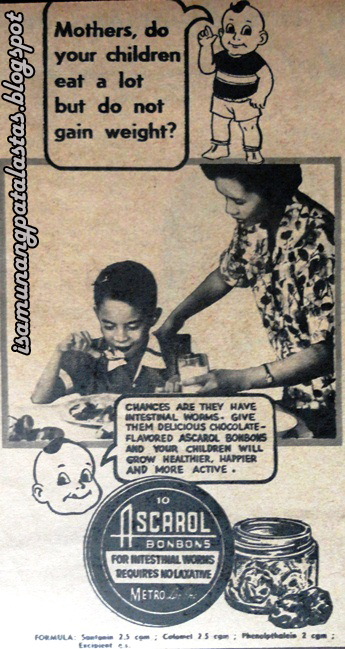
297. ASCAROL BONBONS, by Metro Laboratories, Inc. (1957-1969)

ASCAROL BONBONS, in chocolate flavor, 1957

One of the most popular deworming drugs in the 1950s, was ASCAROL brand, produced by Metro Laboratories, Inc. Metro was then a leading pharmaceutical company that made popular products as Dhobinol (skin ointment), Elixir Auri-Bromide and Metrotussin (cough medicine).

ASCAROL Print Ad, 1957

Ascariasis, or roundworm infestation, was a common children’s condition in the post-war 50s, and the most prevalent in agricultural Philippines. The soil-transmitted parasitic worms can cause severe abdominal pain, fatigue, vomiting, anemia, distended abdomen, itching, and malnutrition and weight loss in kids.

ASCAROL print ad, 1960 

 As liquid antihelminthic medicines tended to be distasteful for kids, Metro Laboratories made the product in chocolate-flavored candy forms---ASCAROL BONBONS. The albendazole-based bonbons, came individually-wrapped in a glass jar,, which children can enjoy like candy,  while being treated for their infestation. No laxatives were required.

 ASCAROL Print Ad, 1969

ASCAROL BONBONS were promoted in print ads, from the 50s to the 70s, becoming household names, and proven the most effective worm expellant for decades. The rise of new  and very affordable multi-worm products halted ASCAROL’s market success. Combantrin, for example, is Pyrantel-based, which required only one dose to eliminate all types of worms, and yet it is gentle on the stomach.

 The brand name Ascarol today, is used by Laboratorio NeoFarmaco of Ecuador, in their de-worming product that is just as popular as the Philippine brand of old.