Showing posts with label radio programs. Show all posts

Monday, February 17, 2020

266. Brand Stories: PURICO, Procter & Gamble PMC, 1917


The Philippine Manufacturing Co. is largely the history of modern vegetable shortening in the country.

ALWAYS PURE, ALWAYS RICH, PURICO! 1940 Ad

In 1917,  it employed a chemist whose assignment was to start production of shortening and other edible products.  Near the end of 1919, the first-ever vegetable shortening manufactured in the Philippines was launched. It was noted for its purity and richness that it was named PURICO—a term coined from combined words “puro” (pure) and “rico” (rich), as Spanish was still widely spoken then.


SO PURE, SO RICH...PURICO COOKS MORE! A pair of print ads, 1955

These qualities were underscored in slogans and headlines like “Always Pure. Always Rich,” and “So pure..so rich..Purico cooks more!”PURICO was sold in carton blocks with the familiar yellow label, and were widely available nationwide—from the tiniest sari-sari stores, to the biggest groceries in the islands.

EVERYDAY FOODS WITH PURICO, 1953 PRINT AD


PURICO MAKES IT PERFECT,a pair of PURICO Print Ads, 1954

The products of PMC were promoted over the radio, then the leading mass medium before the advent of television. PURICO sponsored "The PURICO Amateur Hour,

TOLINDOY, CONDE UBALDO, PURICO FAN PHOTOS, 1950S

The PURICO Amateur Hour featured the brightest stars of the radio, dishing out songs and skits and what-have you--from Tolinday and Chichay, announcers Ira Davis and Conde Ubaldo, actresses Rebecca Gonzales, Lily Miraflor and singing discoveries like Milagros Bernardo.

PURICO FAN PHOTOS OF CHICHAY, REBECCA GONZALES, ETC.

The radio program attracted bigtime stars (Rogelio de la Rosa, Rosa Rosal, among others) and gained a nationwide following. PURICO and other PMC brands are credited today for ushering in the golden age of Philippine broadcasting.

PURICO FREE XMAS FREE PROMO, 1955

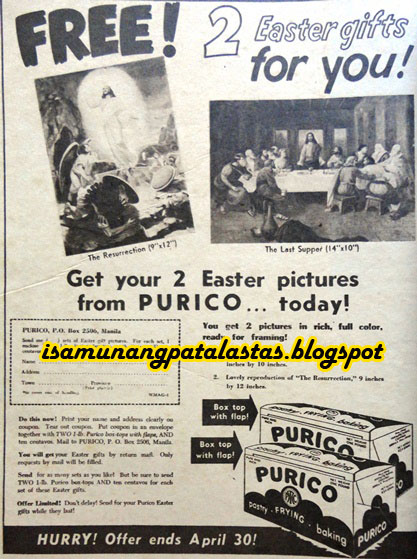
PURICO FREE EASTER GIFT PROMO, 1953

Fan photos of the performers and stars were issued for adoring fans to collect in albums. An example is shown above, made perhaps, by an ardent follower of the radio show.

TAWAG NG TANGHALAN TV PROGRAM, hosted by Lopito and Patsy, 1950s.

When PURICO Amaterur Hour was  renamed Tawag ng Tanghalan/Call of the Stage), it was staged for the new television medium,  for which the first TV advertising contract was  signed, after PMC was bought by Procter & Gamble. This further solidified the hold of PURICO on the shortening market. 

UPLIFTING THE PURICO IMAGE WITH A MANILA HOTEL AD,1960

The rise of liquid cooking oils eased out PURICO from the store shelves by the 1970s, until it totally disappeared altogether in the 1980s.

SOURCES:
PROGRESS Magazine 1956,
Radio Stars from Purico Radio Show, www.flyandfleablogspot.com

Tuesday, November 15, 2016

82. Brand Icon: PRISCILLA, THE KOLYNOS GIRL

PRISCILLA aka Presentacion "Esen" Bataclan, Kolynos Girl

 KOLYNOS DENTAL CREAM was an American-made toothpaste brand created by Newell Sill Jenkins in 1908.  It was already being advertised in Philippine magazines in the 1930s. Radio then, was already becoming a popular medium for entertainment and promotion then and many companies in the U.S. used it as a channel for marketing. Kolynos was one such product known for program sponsorships.

Kolynos print ad, 1936. Graphic Magazine.

 In 1936, KZRM held auditions for radio singers and one of those who tried out was a 14 year-old high school sophomore from Cavite—Presentacion Bataclan. So impressed were the executives that they gave her a program of her own—The Kolynos Hour. She made her singing debut in 1936 under the screen name Priscilla. Known on-air as “Priscilla, the Kolynos Girl”, she would become the No. 1 radio personality of the Commonwealth Era.

PRISCILLA, THE KOLYNOS GIRL, with pianist
Ariston Avelino and singer, Rafael Artigas.

 “The Kolynos Hour” ran for just fifteen minutes, every Mondays and Fridays—but it lasted for a good three years. Priscilla became a household name, and the radio station was besieged with fan mails (200 letters a week!) and requests for autographs. She earned the then incredible sum of Php 7.50 a show.


 The Kolynos Girl came to typify the toothpaste belle of radio at her likeable best, her toothsome smile and 14-karat crooning voice popularizing songs like Stardust, I’m in the Mood for Love, My Reverie, All the Things You Are, and When Your Love Has Gone. She recorded for RCA and later, Lebran, Bataan Excelsior and Villar Records.

KOLYNOS TOOTHPASTE AD, 1955. The Sunday Times Magazine

 In the next years to follow, until the outbreak of the War, Priscilla divided her time between the radio and the movies. During the Japanese Occupation, she performed at the Life Theater. It was while headlining a show at the Metropolitan Theater that she met her husband, musician-saxophonist Bernardo Aristorenas, whom she married in 1944.

PRISCILLA, as a professional singer, actress, 1951.

 After the war, Priscilla did camp shows for U.S. armed forces and became active again on-air when radio became a flourishing industry in the 1950s. She, along with the Mystery Singer (Cecil Lloyd), signed up with Station KZRH and got top billing in Philippine Refining Company-sponsored shows.


She free-lanced on “Pepsodent’s Hour (another toothpaste brand!), sang on “Vick’s Variety Show”in 1951 and was in the popular “Student Canteen”.

PRISCILLA, minding her gift shop "Eyeful" along Mabini St. 1966

 Overseas, Priscilla sang in Okinawa for a year at the Castle Terrace Club, then made the rounds of clubs in Taipei and Hong Kong. The Aristorenases returned to Manila in 1964 and put up a souvenir gift shop along Mabini St., called “Eyeful”.

LISTEN TO THE KOLYNOS GIRL
SINGING "TOMORROW NEVER COMES":

 Today, the Kolynos Girl is now an nonagenarian, who resides in relative anonymity and quiet in Alabang Hills. Little does one know that for almost 3 decades, she ruled the airwaves as a singing product ambassador , a broadcast icon, and a leading voice in the golden age of the Philippine radio industry.

 SOURCES:
Sunday Times Magazine, 23 Nov. 1966
Literary Movies Magazine, 1951