Showing posts with label 1960s. Show all posts

Monday, August 31, 2026

555. The 1st Potato Chips Made in the Philippines: CAROL-ANN’s, 1964

It’s ironic that the Philippines was one of the top producers of root crops in the world—from kamote (sweet potato), ube (purple yam), gabi (taro) and even potatoes—yet, the country relied on America for potato chips!

Thanks to the PX goods coming out surreptitiously from Clark beginning in the mid-60s, Filipinos finally had a taste of these crunchy potato chip snacks that were American pantry staples. Early ‘60s brands available from PX Clark included Laura Scudder’s, Granny Goose, Pik-Nik Shoestring Potatos and Lay’s. Pringles, made from molded dehydrated potatos, were popular with Filipinos in 1975.

It was only in 1964, that the first commercially made potato chip made their appearance on Philippine market shelves: CAROL-ANN’s Shoestring Potatoes and Potato Chips. The maker is not indicated on their plastic packaging, but identified itself as a member of the Potato Chip Institute International, later known as the Snack Food Association, a major trade organization founded in the 1930s.

CAROL-ANN’S come plain or salted, but it has other flavors worth tasting: Barbecue,  Salami, Onion, Garlic, Chinese Flavored. In single bags or bigger institutional sizes, CAROL-ANN’s were promoted as perfect for picnics, parties and other social gatherings. Being the only potato chip snacks available, CAROL-ANN’s gain enough following to merit it own modest advertising.

Two years after, the Universal Robina Corporation introduced its own line of snack foods in 1966, with flagship brand Chiz Curls, along with its Jack ‘n Jill branded Potato Chips. By 1968, URC was a major market player in the filed of snack foods. CAROL-ANN’s continued its potato chip business until the 1980s-1990s, until the brand just disappeared.

To this day though, the maker remains a mystery—who made CAROL-ANN’s? Who is CAROL-ANN? Whatever, people still remember CAROL-ANN’s Shoestring Potatoes and Chips in their classic, clear plastic packaging—thinly sliced, perfectly fried, full of crisp, potato goodness from the first bite to the last!

Tuesday, February 3, 2026

538. Those Adorable DARIGOLD KIDS of the ‘60s: Then and Now

When readers opened their magazines in 1963, they were treated to a spread of colored ads of DARIGOLD MILK featuring wide-eyed, happy-looking kids—perfect models of the milk’s promise of healthy goodness and tender love.

By that time, DARIGOLD was the No. 1 milk brand in the country, backed by its savvy marketing and well-crafted advertising, professionally made by its ad agency, Philprom, founded by Pete Teodoro in 1945. Not bad for the evaporated milk brand that had to be imported all the way from Seattle to be introduced in the Philippines in 1953.

The 1963-1964 campaign was launched first with a lead-off print ad featured 2 vignette shots of a young mom with her school-age daughter holding a glass of milk in one hand. In the foreground are two younger siblings with their toys, showing the boy giving her little sister a peck on her cheek.

A separate ad was spun off using the version with the two siblings being wowed as they are handed with a glass of DARIGOLD Milk.

The next in the print ad series showed a fair-haired girl holding a glass of DARIGOLD Milk with the headline:  “More, more, more…DARIGOLD gives you more!”. A jingle based on that line was created by the agency and became a national hit.

The last ad was a Black & White ad with 2 spot colors, touting the leadership position of DARIGOLD, which by then was the most preferred and best-selling brand. A curly-locked boy in a DARIGOLD shirt leading a trike race was the main visual, to drive home the point of the no. 1 milk in the market.

A quick search of the identities of the kiddie models yielded so many fascinating facts that are now inextricably linked with the milk brand’s history. In the 60s, the country head of DARIGOLD was Mr. Louie Benitez, a member of the prominent Benitez Family that included statesman and educator Dean Conrado Benitez and senator Helena Tirona Benitez.


Louie’s sister, Leila Benitez was known as the First Lady of Philippine TV, famous for hosting the first Student Canteen, and, what else—DARIGOLD Jamboree in 1965. Even DARIGOLD’s ad agency had a Benitez connection; Fred Benitez was a co-founder of Philprom.

It was no wonder then that the models in the aforementioned print ads were also Benitezes—Mr. Louie Benitez’s own wife and children.The kick-off ad that showed a Mom and her daughter, was no less than his wife Nena Mapa-Benitez and daughter Annie, on her lap. Annie now lives in Copenhagen, Denmark.

The two kissin’ kids with their toys on the floor are siblings Ricky and Pia Benitez. Ricky Benitez grew up and worked in his father’s trading company. He is now a Pastor who lives in Bacolod.

 Pia, now Mrs. Yupangco, is an artist and a freelance writer. In her college years, she became an intern at J. Walter Thompson where she bagged a 7-Up talent gig. Her father, however, thumbed down the idea of her out-of-town shooting, and thus ended her short modeling career.

 “We were nepo babies before it became uso 😆”, recalls Pia when asked how she became a DARIGOLD model. “My dad Louie Benitez was general manager of Darigold in the Philippines, that’s how!.  Even my grade school batch got to go to the Darigold manufacturing and repacking facility!” Pia also vaguely remembers shoting a DARIGOLD TV commercial at the Magallanes Park by the Philprom ad agency.

Soon, the original “nepo babies” were joined by more Benitezes—their cousins! In the 2nd print ad, the winsome child with her glass of DARIGOLD was portrayed by Mitos Benitez (now Yñiguez). She was the daughter of Mario Benitez—brother of Louie, more well-known as the founder of the classic MARIO’s, the hugely popular Italian Restaurant, located in Baguio. Today, Mitos  continues the family’s restaurant business tradition, by running the highly-rated Hill Station , a comfort food restaurant at Casa Vallejo in Baguio City.

Mitos’ brother—Anton Benitez, on the other hand, was the curly-haired trike rider  speeding ahead of other cartoon racers in the 3rd print ad. A La Salle graduate, Anton along with brothers Fil and Marlo now runs MARIO’s, which recently opened a branch in Clark Field, Pampanga.

 DARIGOLD’s  life cycle was cut short in 1976 when it ceased production due to contractual obligation problems. But for the Benitez kids, there was no crying over spilled milk. They have all moved on from being accidental commercial talents for an icon brand built by their father, to even more important matters like earning their education, acquiring skills and venturing into different careers, based on their passions—all pursued well, and successfully. DARIGOLD, in a special way, has proven to be “so good for the whole family”—as its longtime slogan says,

SOURCES:

FB Messenger interview with, Pia Benitez-Yupangco

Contributed photos from the Benitez children

Photo od the Benitezes as adults, from their FB groups. 

Photo of Mitos Benitez , by Wig Tysmans

Many thanks to Lisa Nepomuceno-Mapua for facilitating contact with the Benitez siblings.

Thursday, January 15, 2026

537. The Ad Model’s Model: BOOTS ANSON-ROA, various endorsements 1968-1978

BOOTS ANSON ROA (now Maria Elisa Cristobal Anson-Rodrigo, b. 30 Jan. 1945), may very well be one of the most versatile celebrities of the 60s thru the 70s—she was a sought-after TV and movie personality, actress, host and emcee, columnist, and diplomat. She also had an impeccable background as spotless and wholesome as the image she projected, that companies used her as a spokesperson and endorser of products.

The daughter of post-war actor Oscar Moreno and Belen Cristobal-Anson, a pharmacist-chemist, Boots was educated at the Assumption,  and the University of the Philippines (1960-64, Speech & Drama), where, as an ROTC campus beauty, appeared on a magazine cover.  Her studies were interrupted when she married Pete Roa in 1964, a popular TV host of Channel 5’s “Dance-o-Rama”.  Baby O’Brien originally co-hosted the show, and Boots stepped in when she left for her U.S. studies.

She went on to foray in movies beginning in 1968, ding over a hundred films, highlighted by a FAMAS Best Actress award in 1973 for the movie, “Tatay na si Erap” and a Lifetime Achievement Awardee,  also from the said body.

The well-respected Anson-Roa lent her credibility in various advertisements shown on this page. She promoted appliances, beauty products, food and beverages, all through the 60s and 80s. She was most visible with her then husband Pete Roa in the Blend 45 campaign series that ran in the late 70s.

Considered as a role model, Anson-Roa also had a successful professional career in the gvernment. She was the director of the U.P.-PGH Medical Foundation (1979- 81 and the Red Cross (1980-82) In 1982, she was appointed as Press/Cultural Attache at the Philippine Embassy in Washington. She was also a TOWNS (Ten Outstanding Women in the Nation's Service) Awardee.

After being widowed in 2007, she wed Atty. Francisco Rodrigo Jr., son of Sen. Francisco "Soc" Rodrigo in 2014. The multi-awarded Boots Anson-Rodrigo  is set to launch her biography book this Jan. 2026, entitled "Grateful ," chronicling her checkered life and times.

SOURCES:

Boots Anson Roa, https://en.wikipedia.org/wiki/Boots_Anson-Roa

Tuesday, January 6, 2026

536. And you thought Presto only made chocolates: PRESTO COFFEE, 1962

PRESTO COFFEE INTRO AD, "Magnifico!", 1962

“When you want-a good-o coffee, get PRESTO! It’s the very best-o!”

The local PRESTO brand of the Gokongwei-founded Consolidated Food Corp. (CFC)  is so well-associated with chocolate products-chocolate powder drink, cocoa, chocolate bars. Many have forgotten that its pioneer product was a coffee brand.

In 1961, after John Gokongwei Sr,  surveyed the local coffee landscape, decided that there was room more for new coffee brands. The market leader then was the post-war brand Café Puro of Commonwealth Foods Inc., which, by 1951, had become the no.1 selling coffee brand, a position it kept till the 1960s.

And so, New PRESTO COFFEE was launched in 1962—a 100% soluble coffee made from a unique blending process of choice coffee beans. Thus, PRESTO COFFEE claims to have a livelier aroma, and real perk-up flavor. An illustration of a distinctive bemoustached Italian coffee connoisseur accompanied the print ad.

The PRESTO Coffee brand, however was no match to Commonwealth Foods’ popular line of coffee brands that are so well-entrenched in the market. Nestle’s Nescafe, on the other hand, was gaining ground due its more premium image backed by a massive advertising budget.

So, Gokongwei looked at another more viable product venture—and saw SERG’s, which practically monopolized the chocolate market. In the second half of the 60s, CFC introduce a chocolate drink under the PRESTO Brand to test the market. Shortly after, it expanded to include chocolate products. The PRESTO chocolate line began to gain traction in the market, and the PRESTO coffee brand was discontinued. The rest is history for its successful chocolate line that came to include PRESTO ice cream, PRESTO Tivoli  and PRESTO fun fruit drinks.

CFC however, never forgot its coffee beginnings and launched Great Taste Coffee in the 70s. With its superior taste, product quality, and better, more sophisticated marketing support, Great Taste also became a huge better-late-than-never success for CFC.


Wednesday, November 26, 2025

532. Brand Stories: VICKS INHALER, Richardson-Vicks, 1941

Movie idol JAIME DELA ROSA for VICKS INHALER, 1959

Pharmacist Lunsford Richard founded  Richardson-Vicks out of a family emergency. His young son, Smith Richardson suffered from a serious case of croup. Lunsford combined unique ingredients into a salve that when heated by the body, would release soothing vapors.

The boy found relief and the homemade croup and pneumonia salve was soon being sold as a legitimate product in 1894, after Lunsford took over his brother-in-law Dr. John Vick’s drugstore business,  Thus began the Vicks Family Remedies Company (later, Vicks Chemical Company) in 1898.

In 1911, the salve was renamed as VapoRub by the now-grown up Smith,  the very boy who inspired its creation and now a the helm of the business. The soothing vapors became the unique advantage of the product, such that in 1941, that effective production action was used in the development of Vicks Cough Drops, that provided instant, portable relief. The cough drops were an immense success.

Matinee Idol LUIS GONZALES for VICKS INHALER, 1956

The Vicks “vapors” line was extended in 1941 with the launch of the VICKS INHALER. This unique products brings the soothing vapors of Vicks in your pocket, just by inhaling the vapors from a plastic tube which are released from an absorbent material (like a cotton wick) that has been saturated with a blend of ingredients formulated by the company. Again, the reception to this innovation was met with widespread approval.

Singer-actress JEAN LOPEZ for VICKS INHALER, 1960

By the 1950s, VICKS INHALER  was available in the Philippines, and its early local advertising in the late 1950s featured popular movie stars, shown on this page. Despite the rise of Thai and Chinese made inhalers, VICKS INHALER—now also available in the key chain type, continues to be a favorite among local users, as the brand is now owned and managed by Procter & Gamble, a trusted maker of products that make Filipino lives easier.

Thursday, November 6, 2025

530. DOLE Canned Pineapples and Fruit Drinks, 1968-1984

The brand that briefly gave icon brand Del Monte a run for its money was DOLE Philippines, which, with its array of canned pineapple and fruit drinks, was looked at as a threat to the former’s monopolistic pineapple business.

DOLE Philippines began operations in 1963 with Dolefil, a major producer of fresh and canned pineapples located in Polomolok, South Cotabato. The company's history in the Philippines is linked to the worldwide expansion of its parent company, which, in 1903 started the mass-production of canned pineapples in Hawaii. The pineapples were grown in the vast pineapple plantations that were processed in the company’s manufacturing facilities, which were canned to the highest standards,

By 1965, Dolefil made its first shipment of 30,000 cases of canned pineapple products to the US. At this time, DOLE products were being marketed and advertised in the Philippines, beginning with the canned pineapple products (chunks, crushed,  tidbits) and juices (pineapple, pineapple orange, pineapple strawberry).

DOLE products became popular options to Filipinos, as well as their mixed-fruit juices. To maintain quality control, Dolefil put up its own can manufacturing plant in 1968, and a packaging plant in 1976.

Things were going well for DOLE, until the more established Del Monte Phils.went all-out in advertising, featuring well-strategized and well-crafted TV commercials from the ad agency, McCann-Erickson, that were targeted at lower-middle classes. After all, pineapple juice was a staple drink in practically all-Filipino events, much like soda.

In 1990, Stanfilco, another Dole operation in the Philippines, merged with Dolefil. In 2013, Dole Phils. was  turned over to Itochu Corporation, and became the majority owner of DOLE plc, a global producer and marketer of fresh fruits and vegetables. This means that it has significant ownership of DOLE's Asian fresh produce and worldwide packaged foods businesses , and has also been expanding DOLE's pineapple production in the Philippines. 

Friday, October 31, 2025

529. KAMINOMOTO Hair Saver-Growth Accelerator, Print Ads, 1967

The world-famous brand of hair restorer was developed by Kaminomoto Co. Ltd.,  a company founded in Kobe, Japan in 1908. In 1932, it launched its KAMINOMOTO Hair Saver-Growth Accelerator tonic, that blends traditional knowledge of medicinal herbs with advanced technology, creating patented ingredients like Kamigen K and E. These have been validated for their effectiveness against alopecia.

With the joint-stock company Kaminomoto Hompo established in 1953, the product was launched in Southeast Asia beginning in 1959, and was introduced to the Philippine market in the mid 1960s.

KAMINOMOTO was advertised extensively on TV, magazines and newspapers, featuring a variety of hair tonics, and extending the line to KAMINOMOTO hair, scalp  and skin soap, shampoos, haiir strengthener, and hair lotion. Kaminomoto Co Ltd. received invention prizes for its products, winning the Japan Invention Award in 1961.

Early KAMINOMOTO advertising used Japanese materials and imagery, with a smattering of local illustrations. By the 70s, the KAMINOMOTO brand was using Filipino models in print ads. 

Even with the advent of Minoxidil that has more laboratory evidence to back its effective hair loss treatment, KAMINOMOTO continues to hold on to its market that patronizes general hair growth stimulants, combining high technology and the traditional power of natural medicinal herbs, roots and plants, that has come to be recognized and widely accepted, the world over.

Saturday, August 2, 2025

521. HELENE CURTIS SUAVE presents: "The Creation Series" 1961

“POUFF PARISIENNE” by Panching Servando of Ben Farrales Glamour House. The August creation puts a twist on the French pouff by flattening the hair on the sides and back exposing the ears. The model is Ines Villareal-Regala.

One of the earliest haircare brands to forge a strategic alliance with beauty institutions and the leading hairdressers in the country was HELENE CURTIS, In the early 1960s the company began to build on the success of its SUAVE brand, introducing shampoos, creme rinses, and wave sets. To promote it, SUAVE was promoted by beauty salon operators and the country’s leading hairstylists, in tie-up ads that bannered new hairstyles and the latest coiffure craze for them month, through a “creation series” launched in 1961 through 1962. The following 2-color ads which featured name models, were part of the series that ran in women’s magazines nationwide.

“PAPILLON” by Beny Baluyot of Beny’s Beauty Salon. A new creation for February that flaunts soft-looking hair for a chic, casual style that women will love.

“BOB PARISIENNE” by the Kayumanggi Styling Group, This shimmering hairstyle creation for December with lovely highlights features model Mrs. Caroline Manning. 

“THE BELL” by Moises Sia of Del Val’s Beauty Salon. Classically-designed  hair highlighted by sparkling gleams created by Suave for a radiant effect, without looking oily.

SUAVE, introduced in 1937 by Helene Curtis, is one of the most successful and enduring brand of the company and is still available to this day. Now with Unilever, SUAVE as a brand represents more than 100 products including shampoo, lotions, soaps and deodorant, used in United States, Argentina, Brazil, Mexico and Canada.

SOURCES:

Suave (the brand), https://en.wikipedia.org/wiki/Suave_(brand)

Helene Curtis Industries Inc. https://en.wikipedia.org/wiki/Helene_Curtis_Industries,_Inc.


Thursday, July 3, 2025

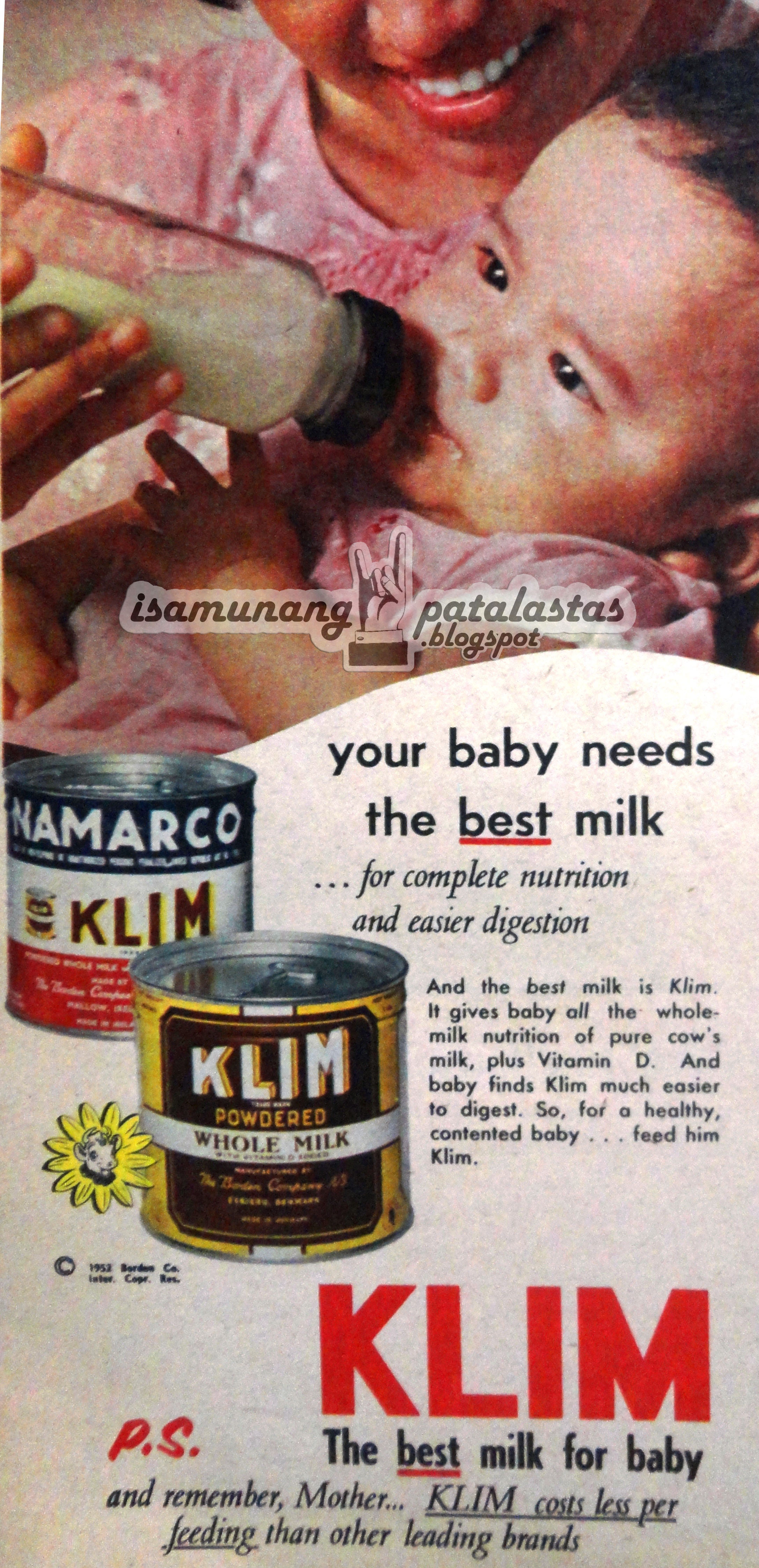
519. KLIM Powdered Whole Milk by Borden, 1935-1967 Print Ads

1965 KLIM AD "Best Milk for Baby"

KLIM Powdered Milk is one of the oldest milk brands available in the Philippines, but the product version sold here was made by Borden Co., a well-known U.S.-based dairy company that had its beginning in the 19th c. Early ads featured the slogan "Spell it backwards”.

EARLY 1935 PHILIPPINE KLIM AD

The brand KLIM had an even earlier history though, that began in 1920, when the Merrell-Soule Company of Syracuse, New York improved the spray-drying method patented by Robert Stauf in 1901, a process that dried milk into  powder. Merrell-Soule replaced regular milk with condensed milk, resulting in a dehydrated whole-milk powder that kept not only its nutrients, but also did not spoil quickly.

WORLD CHAMPION BOXER 'FLASH" ELORDE FOR KLIM,1957

KLIM Powdered Milk was sold in cans, and just a few spoonfuls mixed with water can give babies and kids the pure wholesome goodness and flavor of real cow’s milk. As KLIM can stay fresh without refrigeration, it was perfect for use in humid, tropical places. Hence, KLIM was brought to the Philippines as early as the 1930s, imported and distributed by the Getz Brothers.

KLIM achieved success in the Philippines, and its advertising played up on its completeness, value for money, and the convenience of no refrigeration. In the 1960s, NAMARCO-branded KLIM products were launched in support of the National Marketing Corp. which aimed to help Filipino retailers procure products at reasonable prices and promote economic welfare.

1966-67 KLIM AD
Over the years KLIM used tri-media advertising to push the product, using celebrity endorsers that included world champion boxer Gabriel “Flash” Elorde in the late 50s and a young Lea Salonga in the early 80s who popularized the jingle “I love KLIM…wow-..woww..woww.wow..I Love Klim!”.

1966-1967 KLIM AS
In 1998, Nestle acquired KLIM from Borden, which filed for bankruptcy in 2020. That same year, New Dairy Opco LLC won Borden's assets via an auction, becoming the company's new owner. KLIM Powdered Whole Milk is still being manufactured by Nestlé to this day, assuring us that this iconic brand will endure for more generations to come.

Friday, June 20, 2025

518. GOYA CHOCOLATE PRODUCTS, Print Ads, 1967-69

GOYA OMNIBUS CHOCOLATE DRINKS, 1968

One of the more popular brands of made-in-the-Philippines chocolate products is GOYA, a joint venture started in 1956 by the enterprising  Chua and Vilabrille families, under the company name GOYA Products, Inc. The first products were actually coffee and cocoa powder mixes.  The cocoa line proved to be more viable, so GOYA expanded to making instant chocolate mixes and chocolate-flavored beverages. Eventually, GOYA would extend its line to include chocolate bars and confections that proved to be successful, favored for its affordable price and chocolatey goodness.

FROM COCOA DRINKS..TO MILK CHOCOLATE TREATS, 1967

This led to Nestlé acquiring the local company in 1996, and was promoted actively through seasonals and regular advertising. Eight years later, in 2006, Petra Foods, a Singaporean food company —now known as Delfi Limited--- bought GOYA from Nestle, which continues to oversee its manufacture and marketing promotions in the Philippines, as well as in other Asian regions.

GOYA has had several relaunches, and is positioned to cater to the medium-end and lower-end brackets. But GOYA also has premium variety, a flanker product that is also part of the portfolio, and still affordably-priced.  

GOYA ALMOND CRUNCH with a Toblerone-type packaging,1969

From the plain cube-sized chocolates, GOYA now produces dark chocolates, dark mint chocolates, white chocolates, almonds dipped in chocolates, crunchy bite-size chocolates and even choco-covered biscuits. GOYA is into spreads, syrups and baking ingredients too—so long as it’s got chocolates.

The chocolate products are manufactured in a 3-hectare plant in Marikina City that has been globally-certified for its quality and taste. The iconic GOYA is now a heritage brand favored, recognized, and much-loved by generations of Filipino chocolate lovers. The GOYA brand continues to endure, providing chocolate enjoyment to Filipinos young and old alike, that is envisioned by Delfi Ltd. to prosper and grow even morem in the years to come.

Friday, May 30, 2025

515. CONTINENTAL NOODLE SOUP: The 1st Instant Noodle Soup in Packs, ca. 1950s-60, Print Ads

Before the advent of instant noodle soups in packs like Lucky Me, Maggi, Payless and Nissin’s, a noodle brand in foil packs has been satisfying Filipinos since the late 1950s: CONTINENTAL NOODLE SOUP, developed by Lipton, and distributed locally by the Philippine Refining Company (now Unilever).

When first sold, the brand was simply called Continental Noodle Soup, a dehydrated soup mix that cooked in 7 minutes. The first flavor was the classic Chicken Noodle Soup, made from noodles and chicken flavorings—a far cry from today’s noodles that cook in 2 minutes, available in a range of flavors from your basic chicken and beef to pancit canton, lomi, mami, even Thai and Korean spicy flavors.


Lipton's entry into the soup market is believed to have begun in the early 1950s with test campaigns for Continental Noodle Soup mix. The company also produced other dehydrated soup varieties, including onion soup mix, by the mid-1940s

At 45 centavos per pack, Continental Noodle Soups were expensive, but the copy claims that a pack is good for 4 servings. A sick child was usually served this soup treat, as chicken soup then, as now, a  it was sastisfying, warming, and comforting.

The first advertising were black and white print ads with clip art illustrations. By 1960, the ads, designed by PRC’s ad agency, were hand-illustrated and in full color. In 1964, Continental Noodle Soup was re-branded to the shorter ROYCO Noodle Soup (a coined term for ROYal + COntinental), and this brand name was used in other Asian and African countries. 

The new ROYCO name caught on with Filipino consumers and became a familiar household brand, until the late 70s when the more convenient plastic-packed oriental noodles were launched, displacing ROYCO.

Wednesday, April 23, 2025

511. The Milk Formula Trusted For Infants: PELARGON from Nestle, 1957-1971 Ads

PELARGON MODERN MILK, 1968 Print Ad

Before the advent of infant formula powdered milk like S-26 and NAN, there was PELARGON, a full-milk powder formula for babies, developed by Nestlé in 1934. It became a favored alternative to breastmilk as it was enriched with lactic acid bacteria for easier infant digestibility.  PELARGON gained popularity after World War II, as mothers made a switch from breastfeeding to bottle-feeding.

LACTOGEN ACIDIFIED POWDERED MILK, 1957 Print Ad

In fact, many mothers and children in the 60s and 70s recall PELARGON as their ideal firstborn formula. PELARGON was pure, full cream pasteurized cow’s milk, acidified with lactic acid for improved assimilation, then fortified by the addition of dextrins—maltose, sucrose, starch, vitamins A&D, thiamine, niacin, ascorbic acid and iron citrate.

PELARGON’s protein content and fat globules are similar to breastmilk. It forms soft, easily digestible gastric curds, and provides a formula adequate in all nutrients known to be essential for the regular feeding of normal, premature or weak infants.

IMPROVED FORMULA PELARGON, 1971 Print Ad

Filipro  Inc. introduced PELARGON to the Philippines only in the late 1950s after the war curtailed their importation activities, and things began to improve. The brand was promoted through advertising, using America-made ads featuring Caucasian babies and parents from the 60s thru the 70s.

PELARGON still exists today, no longer in the Philippines, but in South Africa, where it is known as NAN-PELARGON, as NAN and PELARGON were once individual brands owned by Nestle.