Showing posts with label liquor and spirits. Show all posts

Sunday, June 14, 2026

550. Scenic Spots in Philippine Ads: BANAWE RICE TERRACES, various ads 1962-65

TANDUAY RHUM "Banaue, World's 8th Wonder" Ad, 1965


Creating an eye-catching print ad doesn’t just entail casting the most attractive models, writing the most grabbing headline, and designing the most pleasing lay-out—it sometimes involves finding the right setting for the print ad narrative.  These three products—TANDUAY Rhum, FILPRIDE Gasoline and MARLBORO Cigarettes used the picturesque, age-old Banaue Rice Terraces as relevant backdrop for their product messages.

The first ad for TANDUAY Rhum immediately makes a strong association with the “8th wonder of the world” with the “matchless quality” of the product. Just as the Banaue Rice Terraces stand in the forefront of the country’s scenic wonders, so does the TANDUAY standard of quality which leads all others wherever rhum drinks are served. 

FILPRIDE Gasoline "GO PLACES' AD, 1962

The FILPRIDE GASOLINE ad of Fil-Oil, reminds the readers of the scenic wonders of the country, like the Banaue Rice Terraces, 351 kms. from Manila, then gently urges them to use power-packed Filpride gasoline when motoring to these places. If you are going to see the Philippine pride that is Banaue, wouldn’t it be fitting if you fill up your car with Filpride gasoline? That’s one smart connection!

MARLBORO COUNTRY "Banaue Country" Ad, 1965.

The last ad for MARLBORO Cigarettes went one step further by describing  the famed Banaue Rice Terraces as evoking the same Marlboro Country imagery-- rugged independence, adventure, self-reliance—an untamed place where men find flavor. Thus, the iconic, "Marlboro Man" cowboy scanning the vast grandness of the terraces—that seem to invite men of the same spirit to “Come to where the flavor is. Come to Marlboro Country”.

Today though, when one refers to the Marlboro Country of the Philippines—two sites are top-of-mind recalls: the Racuh Apayaman on Batan Island, Batanes which features rolling green hills, grazing cattle, and dramatic cliffs overlooking the Pacific Ocean; and the Marlboro Hills in Sagada, Mountain Province, famous for its pine-clad mountain trails , "sea of clouds" during sunrise and grand vistas of limestone peaks.

Sunday, May 15, 2022

372. BALINTAWAK BEER, ca. 1937

People in pre-war Philippines would surely remember BALINTAWAK BEER, a beer brand that came to be, thanks to Japanese investors who pooled in funds to establish a beer factory in Polo, Bulacan. This was the Balintawak Beer Brewery, founded in 1937, which launched its BALINTAWAK Pilsener Beer to the local market, bottled in amber bottles similar to San Miguel’s, with paper labels.

BALINTAWAK BEER was supported with print and radio advertising, and early ads focused on the beer’s relaxing, comforting qualities that’s perfect for social entertaining.  The KZRM airwaves was filled with songs and music from featured performers like Alicia Garong, pianist Rafael Artigas, and even a  BBB Mystery Singer.

In 1938, BALINTAWAK BEER  added its ‘Black Beer’ version, the counterpart of san Miguel’s Cerveza Negra. Like San Miguel, BALINTAWAK BLACK BEER was positioned as the drink ideal for women for its health-giving attributes.

World War II put an end to the operations of Balintawak Beer Brewery, as the plant was taken over by the Japanese forces, along with San Miguel beer plant. BALINTAWAK BEER, however, continued to be available to Filipinos.

In the 1950s, San Miguel Corporation bought the Polo plant and converted BBB into their primary brewery for their world-renowned San Miguel Beer.


 Vintage Bottle collectors are always looking for BALINTAWAK BEER bottles today for their rarity, as many of their identifying paper labels have been worn away by time.

 SOURCES:

Graphic Magazines, 1937-1939 issues

Kasaysayan, Vol. VII.  "Prewar Pesos for Japanese Goods," Yu Jose, Lydia.


Wednesday, April 20, 2022

369. MORE AMUSING BRAND NAMES YOU WON’T BELIEVE WERE USED IN THE PHILIPPINES (part IV)

Last of a 4-part series of some of the most amusing, unusual, and sometimes, weird-sounding names ever coined for real products, that were available in the Philippines –from the 1930s to the 1960s.

REUTER’S  SOAP. Brand Name For: Skin Soap

The early toilet soap designed to beautify a woman’s complexion is a trademark of Lanman & Kemp-Barclay & Co., Inc. The company, itself was founded in 1808 by Robert I. Murray and its business was conducted under the firm name Murray & Lanman in New York.  The brand name--REUTER’S SOAP-- has nothing to do with the world-famous news bureau. It was named after its creator, Dr. John Reuter. The classic bar soap was sold in the 1950s under its Spanish brand name, Jabon de Reuter, in the Philippines. The company still is in cooperation today with headquarters in Westwood, New Jersey, and continues to sell the soap.

SAKITALIS. Brand name for: Medical plaster

Now here’s another direct-to-the-point name for a pain-soothing medicated plaster—SAKITALIS (Aches away!).  The wordsmith had an easy time with this brand name, and even though it sounded like the aforementioned “Katialis”, it is still distinct in its category. SAKITALIS, which contains belladonna, was “the most effective plaster pan reliever”—in distinctive pink color! It was available in the late 1950s at all drugstores,  distributed by Colossal Drug Store. But the coming of made in Japan Salonpas, obliterated it, and by the 1970s, Salonpas became the dominant plaster brand, for its superior efficacy—not to mention its catchy, classy name that has become an everyday term for  a pain relieving plaster for all body parts.

SILENT NIGHT. A Brand Name for: Perfume and Lotion

Yes, Virginia, there is such a perfume brand called SILENT NIGHT, ‘ a perfume masterpiece made by Countess Maritza of New York, U.S.A.”. It was locally distributed in local stores in 1962. But wait,  there’s also a SILENT NIGHT Lotion to complement it. Like a line from the carol, was it also tender and mild,? With a name like that, how can you miss? As the ad suggests—“it’s best to give on Christmas!”. One wonders if it is inappropriate to give SILENT NIGHT on other occasions, say, like birthdays and Valentines,

TANSAN. A Brand Name for: Mineral Water

It’s okay to drink the TANSAN!!!The crown cap revolutionized the glass bottling industry when it was invented in 1897 by William Painter. The first drink that featured the crimped tin cap was called TANSAN, a bottled mineral water marketed by Clifford Wilkinson in the early 1900s. The brand name TANSAN–believed to be of Japanese origin–has now come to mean crown caps in Filipino. The product first came out in straight-sided bottles, and then in small, bulb-shaped green bottles with the name in relief.  In its 1920s ads, TANSAN was proclaimed as a 100% pure, sourced from “natural waters free from all earthly deposits.” Being “radium-active,” TANSAN possesses many medicinal qualities, proven against stomach disorders.

VIN DÉSILES. A Brand Name for: Tonic wine

The brand name of this revitalizing drink popular in the 1950s seem anachronistic as it sound like the name of contemporary Hollywood action star, Vin Diesel. But it was produced long before the action star of “XXX” and “The Fast and the Furious” was born.  VIN DÉSILES, a wine-based drink that claims to restore energy and appetite, and was distributed by Oceanic Commercial, Inc. in the Philippines. It may not have inspired the name of action star Vin Dieeel, but it sure is power-packed like him!

SOURCE: By the Author. Originally appeared on esquiremag.ph under the title: Funniest Filipino Brand Names in the 20th Century - Esquire , https://www.esquiremag.ph/culture/lifestyle/old-brands-philippines-a2289-20190211-lfrm4


Friday, May 21, 2021

324. Hollywood Actor JACK PALANCE for LA TONDEÑA NATURAL RUM, 1967

Hollywood star JACK PALANCE, for LA TONDEÑA NATURAL RUM, 1967

Jack Palance (born Volodymyr Palahniuk  18 bFe. 1919/ d. 10 Nov. 2006) was a famous American male star famous for his rugged look that made him perfect for tough guy and villain roles. His distinctive character face were allegedly due to a botched reconstructive surgery, which has since been disproven as nothing more than a PR stunt. 

JACK PALANCE, Source: wikimedia commons

Palance was nominated for three Best Actor in a Supporting Role at the Academy Awards: “Sudden Fear”(1952) and “Shane” (1953). His third nomination in 1991 for “City Slickers” finally won him the coveted Oscar statuette. 

JACK PALANCE says of  La Tondens'a Natural Rum: "One of the finest I ever tasted!

In 1997 though, after completing the production of the  action movie “Kill a Dragon” in Hong Kong and Macau with Fernando Lamas, Palance dropped by in the Philippines to promote the said movi--and to appear in a print ad for LA TONDEÑA Natural Rum, “I’m taking it back to the States with me!”, says the headline, in reference to the drink that he discovered and enjoyed in the Philippines. 

JACK PALANCE, Oscar's  Best Supporting Actor for 1992, "City Slickers"
Photo: pinterest

In the 1960s, commercial endorsements of Hollywood stars for Philippine products are few and far between—the actress Joan Page did a cosmetic ad, but then she was based here for 4 years. It would take close to 4 decades for another Hollywood action star to promote a Filipino brand—Steven Seagal for Tanduay Gold in the late 1990s created by Jimenez DMB&B.

 As for Jack Palance, he found greater fame in the 80s as the host of the television revival of Ripley's Believe It or Not!. On ABC. The series  ran from 1982 to 1986 and also starred Palance's daughter Holly Palance. This led to a renaissance in his career, capped by an Oscar-winning performance in the comedy “City Slickers”,  at age 73. His acceptance speech included Palance demonstrating a one-armed push-up, which the audience lapped up and loved.

Monday, September 23, 2019

242. ARMANDO GOYENA for RUM CAÑA by Tabacalera, 1953


Tabacalera (Compañía General de Tabacos de Filipinas) was established as a cigar and tobacco factory by Antonio Lopez y Lopez, the Marquis of Comillas way back in 1881. It was put up right after the end of the tobacco monopoly.


Cigar-smoking then was a time-honored recreation for many Filipinos, and puffers often paired smoking with sipping liquor to heighten their smoking pleasure. 

Hence, Tabacalera branched out into the manufacture of liquor, and by the mid-twentieth century, it had the largest distillery in the Philippines churning out 40,000 liters of alcohol daily.

RUM CAÑA was one such successful product that came from their factory. Rum was a very popular mass drink, as it was very affordable, and Tabacalera’s RUM CAÑA became the choice of the country, and, in the 1950 decade, enjoyed a reputation as the Philippines’ best-selling rum.

RUM CAÑA was advertised during the 50s with famous star Armando Goyena as an endorser.  In real life, he was Jose “Pinggoy” Teodoro Iruyetagoyena Revilla Jr. (b. 7 Dec. 1922 / d. 9 Mar. 2011), who came from a well-off family and was a student of La Salle when he was discovered by Dna. Sisang de Leon for the movies  

He was introduced in “Puting Bantayog” (1948), that would pair him with Tessie Quintana. Goyena would shoot to stardom in 1952 with the superhero film “Kapitan Kidlat”, opposite Evelyn Villar.  His status as a major film star was cemented with “Hawayana”, which also catapulted the Goyena-Quintana love team to showbiz fame.


The film “Hawayana” , a 15th anniversary offering of LVN Pictures, was shot in color, a rarity in the 50s, and was directed by Manuel Silos. The RUM CAÑA series capitalized on the huge following of Goyena, and the appearance of the print ads were timed to coincide with the movie’s national screening in June 1953. 

In 1958, Goyena married the prominent beauty Paquita Roces, herself a top commercial model known as the first Camay Girl. The couple had 8 children: Maritess, Tina, Johnny, Ces, Pita, Rossi, Malu, and Cita and 29 grandchildren, many of whom also joined showbiz.


He put behind his acting career after his marriage, reappearing only in 1995 as Don Eugenio López in Chito Roño’s “Eskapo”. Roño cast him again in 2001 for “Yamashita: The Tiger's Treasure”, for which he won that year’s FAMAS Best Supporting Actor award. His last appearance was in “Annie B.” in 2004, before his death age 88 in 2011.

As to the product Goyena endorsed, Tabacalera’s products were acquired by La Tondeña beginning in 1955, with Añejo Rum. The liquor giant had earlier bought Ayala Distillery in 1924. RUM CAÑA today, no longer exists, but La Tondeña continues to manufacture and sell a similar rum product with the brand name  “Flor De Caña Anejo Oro Rum”.

Thursday, March 14, 2019

212: Is That Who I Think He Is? ANTHONY N. VILLANUEVA for TONDEÑA RUM (1966) and TERYLENE (1967)

CELEBRATED BOXER ANTHONY VILLANUEVA. Highest-placed Filipino Olympian, 1964


BOY BOXER, Anthony Villanueva
The 19 year old boxer who became a household name in 1964 with his triumph at the Tokyo Olympics was born Anthony N. Villanueva (b. 18 March 1945)  to an Olympian father, Cely Villanueva, a bronze medallist at the 1932 Los Angeles Olympics.

His pugilist father influenced his interest in boxing, so much so that at an early age, he became an accomplished athlete. 

Boxing aficionado and businessman Eugenio Puyat saw his potential and supported him, such that by 1962, at age 17, the FEU teen became a national boxing titlist.

This qualified him to the 1964 Tokyo Olympics where he competed in the Featherweight Division, where he defeated boxers from Italy, Tunisia, Poland and the U.S. before facing the Russian  Stanislav Stepashkin in the finals. In the controversial Gold medal match, Villanueva lost 3 to 2.

Nevertheless, Villanueva came home to a hero’s welcome—the highest-placed athlete in Philippine Olympic history. Showbiz beckoned, and Villanueva starred in at least 5 action movies, including the boxing-inspired “Malakas, Kaliwa't Kanan” with Nida Blanca and the bio-flick, “The Pancho Villa Story”.
 
VILLANUEVA AND STEPASHKIN in the controversial finals.
As he lost his amateur status due to his lucrative acting career, Villanueva turned professional in 1965, debuting in a fund-raising event called “Fiesta Fistiana” at the Araneta Coliseum, matched against the Japanese, Shigeo Nirasawa. He would hang his boxing gloves after only 5 bouts.

Capitalizing on his Olympic fame, advertisers sought out the acclaimed boxer, who signed up with two clients.
 
VILLANUEVA FOR TONDENA RUM, 1966
For La Tondeña, Villanueva did an ad for TONDEÑA NATURAL RUM in 1966. The B&W print ad featured a close-up photo of the boxer, holding a glass of “smooth as velvet” TONDEÑA RUM.

Villanueva also appeared in a TERYLENE ad that was part of  a campaign series. TERYLENE, a fabric perfect for suits, was a revolutionary clothing material made of a combination of viscose rayon and terylene. The thematic ad series featured active men in heroic James Bond roles, coming to damsel in distress, unmasking enemies, delivering karate chops—that tests the fabric for durability, comfort and strength.  
 
VILLANUEVA POSING FOR A TERYLENE AD,1967
Villanueva’s version shows him as a travelling photographer, smartly dressed in a suit—“so neat, so masculine, so elegant”-- flitting to and fro to his shooting assignments.
When his boxing and acting days were over, Villanueva became a boxing coach, until 1976, when he decided to go find his future in the U.S.  


SOURCES:

Tuesday, September 18, 2018

183. Brand Icon: WHITE CASTLE WHISKY GIRL, 1974

CARMI MARTIN, WHITE CASTLE GIRL, 1984-1986

One of the most unforgettable brand ambassadors for a product beginning in the 1970s was not your usual prim and proper college girl type (like Miss Magnolia), or your  fashionable ladies from high society  (like the Rustan’s VIP Council)—but rather a woman in a red bikini.

To make for a dramatic entrance, the WHITE CASTLE GIRL galloped into our TV living room astride a white horse, hair blowing in the wind, as the image of a castle loomed in the background. TV audience—especially male viewers—could not help but stayed glued to the screen as the strains of the catchy jingle, “White Castle, White Castle Whisky, White Castle Whisky ang bilhin”, followed her 30 sec. ride into the hearts of the drinking class. 

MR. JULIUS LIMPE
CEO, Destiliria Limtuaco
WHITE CASTLE 5 Years Old Whisky had always been a national favorite for many years, the product of Destileria Limtuaco, the country’s oldest distillery. The business was founded by 36 year old Amoy immigrant Lim Tua Co, who put up the distillery within 2 years of his arrival in the Chinese enclave of Binondo.  One of his earliest successes  is the medicinal wine, Sioktong.

Unfortunately, Lim Tua Co—who adopted the Christan name Bonifacio—died in 1887. So too, did his only son, Carlos, his heir apparent. A nephew, Lim Chay Seng took over the business in 1926, and shifted the production from Chinese drinks to Western spirits. Thus--WHITE CASTLE WHISKY came to be. It would become one of the company’s flagship brand, blended and aged to perfection in oak barrels, to give the whisky smooth, full-bodied taste, aroma and golden color.

WHITE CASTLE GIRL, EVANGELINE PASCUAL (1974)
Picture courtesy of: JOSE BENIGNO SALVADOR

The business flourished when his son, American-educated James Limpe took over the helm in 1937, a position which was passed on in 1958 to son Julius Limpe, a business graduate the University of Indiana. Julius became an expert blender of all sorts of liquor and spirit, which he patented and produced,  while steering Distileria Limtuaco to its pre-eminent position in the industry.

WHITE CASTLE GIRLS, AGNES RUSTIA (1975) & PEACHY VENERACION (1978)
SOURCE: www.limtuaco.com

To him also goes the credit for creating the imagery of the WHITE CASTLE GIRL. After all,  Mr. Julius Limpe was also an artist, so he also put his creativity to work in WHITE CASTLE WHISKY marketing and advertising. He conceived of a narrative that was fairy-tale like—a princess in a red bikini chanced upon a group of men while on a bareback ride on the beach astride her white horse.


WATCH "WHITE CASTLE WHISKY" CLASSIC 1978 TVC HERE:
(Source: ADman 1909,  Jul. 19, 2007)

To distract the men who had taken fancy on her, she brings out a bottle of WHITE CASTLE and drops it on the sand, diverting the men’s attention to the drink. The ruse worked and the princess in the red bikini rides safely back to her castle with a red turret. Sylvia Licauco had the honor of being the first White Castle Girl

WHITE CASTLE GIRL, TETCHIE AGBAYANI (1982). SOURCE: www.limtuaco.com

Along the way, the “princess” element was dropped, which, in a way was alright, as the first WHITE CASTLE GIRL to appear in a promotional material—i.e. calendar-- was a beauty royalty—Evangeline Pascual, Miss Republic of the Philippines 1974 and Miss World runner-up. It would seem that Miss RP automatically became a WHITE CASTLE GIRL, as in the case of Agnes Rustia and Peachy Veneracion.

WHITE CASTLE GIRL, LORNA TOLENTINO, 1982.
SOURCE/ Photo Credit: Jose Benigno Salvador

Two years before her Playboy splash, Visitacion “Tetchie” Agbayani reigned as the 1980 WHITE CASTLE GIRL. Even former child star, actress Lorna Tolentino, rode the bandwagon in 1982, at age 21.
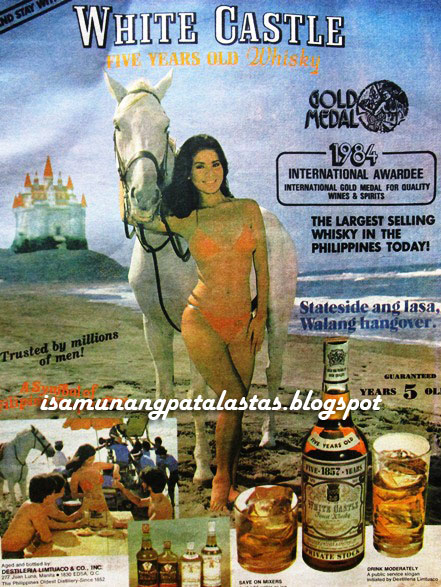
WHITE CASTLE GIRL, CARMI MARTIN, 1984

The WHITE CASTLE GIRL exuded a sexier air with the casting of voluptuous Carmi Martin from 1984-86. From thereon, that bombshell mold was used in the selection process.

WHITE CASTLE GIRL,LYKA UGARTE, 1986. SOURCE: www.limtuaco.com

The pouty beauty Lyka Ugarte, was a perfect follow-up to Martinl she held the for 2 years. Star of ST (Sex Trip) movies Cristina Gonzales snuggled with the white horse in the 1992 calendar.  Glydel Mercado’s topless appearance in 1996. At the turn of the new millennium, the WHITE CASTLE GIRL started to look more provocative with her come-hither poses, as seen from the calendars of Angela Velez, who did several versions from 1999 to the first half of 2000s. The horse became an afterthought.

WHITE CASTLE GIRLS Glydel Mercado (1996) & Angela Velez (1999)
SOURCE: www.limtuaco.com

To drum up excitement, a nationwide search for a new WHITE CASTLE GIRL for 2007 was launched, resulting in the victory of beauty queen Gemma Gatdula. Her reign went awry when she was dethroned; she was replaced by former Wowwowee dancer, RR Enriquez. Current WHITE CASTLE GIRL is actress Meg Imperial.

WATCH WHITE CASTLE GIRL "LORNA TOLENTINO" TVC HERE:
(Source: Liquor Express, posted May 20, 2018)

"If it ain't broke, don't fix it".--this saying might as well apply to WHITE CASTLE advertising. Apparently, the campaign with the WHITE CASTLE GIRL continues to work, and thus endures to this day, give or take a few refreshments. After 4 decades, the girl in the red bikini continues to charge on her white steed, past the white castle with a red turret—as fast as the galloping sales of WHITE CASTLE WHISKY!


SOURCES:
WHITE CASTLE WHISKY CLASSIC PHILIPPINE TVC (1978): https://www.youtube.com/watch?v=bQT4qU6mlT8, posted by ADman 1909,  Jul. 19, 2007.
LORNA TOLENTINO-WHITE CASTLE GIRL 1982, https://www.youtube.com/watch?v=us4DAWw8Mws, posted by Liquor Express, May 20, 2018.
MANY THANKS TO MR. JOSE BENIGNO SALVADOR FOR THE USE OF HIS WHITE CASTLE PICTURES (Evangeline Pascual,Lorna Tolentino, White Castle paper label), PEP.PH  and MR. BORJ MENESES (for Gemma Gatdula's photo)