Showing posts with label Inc.. Show all posts

Friday, June 20, 2025

518. GOYA CHOCOLATE PRODUCTS, Print Ads, 1967-69

GOYA OMNIBUS CHOCOLATE DRINKS, 1968

One of the more popular brands of made-in-the-Philippines chocolate products is GOYA, a joint venture started in 1956 by the enterprising  Chua and Vilabrille families, under the company name GOYA Products, Inc. The first products were actually coffee and cocoa powder mixes.  The cocoa line proved to be more viable, so GOYA expanded to making instant chocolate mixes and chocolate-flavored beverages. Eventually, GOYA would extend its line to include chocolate bars and confections that proved to be successful, favored for its affordable price and chocolatey goodness.

FROM COCOA DRINKS..TO MILK CHOCOLATE TREATS, 1967

This led to Nestlé acquiring the local company in 1996, and was promoted actively through seasonals and regular advertising. Eight years later, in 2006, Petra Foods, a Singaporean food company —now known as Delfi Limited--- bought GOYA from Nestle, which continues to oversee its manufacture and marketing promotions in the Philippines, as well as in other Asian regions.

GOYA has had several relaunches, and is positioned to cater to the medium-end and lower-end brackets. But GOYA also has premium variety, a flanker product that is also part of the portfolio, and still affordably-priced.  

GOYA ALMOND CRUNCH with a Toblerone-type packaging,1969

From the plain cube-sized chocolates, GOYA now produces dark chocolates, dark mint chocolates, white chocolates, almonds dipped in chocolates, crunchy bite-size chocolates and even choco-covered biscuits. GOYA is into spreads, syrups and baking ingredients too—so long as it’s got chocolates.

The chocolate products are manufactured in a 3-hectare plant in Marikina City that has been globally-certified for its quality and taste. The iconic GOYA is now a heritage brand favored, recognized, and much-loved by generations of Filipino chocolate lovers. The GOYA brand continues to endure, providing chocolate enjoyment to Filipinos young and old alike, that is envisioned by Delfi Ltd. to prosper and grow even morem in the years to come.

Tuesday, January 3, 2023

407. ZENCO FOOTSTEP: We Shoe The Philippines, 1983

ZENCO FOOTSTEP CORPORATE AD, 1983

The shoe store that boomed in the 80s and 90s selling such brands as Mighty Kid, Islander and Kaypee, started back in 1957 as Zenco Commercial (ZENCO) , a distributor of footwear founded by Yao Khapu. From a tiny store in Binondo, and later in Caloocan, Khapu moved to Divisoria to open his  first ZENCO FOOTSTEP on 26 May 1961. A strong marketing network propelled ZENCO FOOTSTEP’s business, pushing its diverse footwear and shoemaking products in major markets  nationwide.

 WATCH A 1991 ZENCO TVC HERE:
Courtesy: RoofDev Studios

When ZENCO partnered with Rubberworld Philippines in 1981, business grew even more, and soon ZENCO FOOTSTEP became the place to go for Rubberworld products that became hugely popular with the young and sport set, including Grosby, Adidas, Spartan sandals, Kaypee, Dockmaster, Mighty Kid shoes and fashions.

The closure of Rubberworld due to the financial crisis, the pull-out of Addias, and the renewed effort of SM stores to regain its foothold of the footwear business by building its giant malls  in 1990s, put a halt to ZENCO’s amazing run. Through all these, ZENCO FOOTSTEP remains in business today—more modest, but still viable-- in a few, but choice locations nationwide.

 SOURCES:

Zenco Footstep weebly: http://zfootsteps.weebly.com/about-us.html

 A short history of Zenco Footstep, https://www.esquiremag.ph/long-reads/features/zenco-footstep-history-a00289-20220615

 Zenco Footstep TVC (1991) (Effects and footages), https://www.youtube.com/watch?v=QNjf5jvpIrg, Uploaded by RoofDev Studios


Friday, December 9, 2022

403. SUN GOLD POMADE, by Peter & Co., 1962-1972 Ads

SUN GOLD PRODUCTS Omnibus Ad, 1962

During the 1960s, local cosmetic and perfumery companies began making their presence felt in the market, alongside foreign companies, mostly from Japan. One such company was Peter & Co., in Quezon City, which started out making cosmetics, perfumes and toiletry products.

AN OLD GLASS JAR OF SUN GOLD POMADE

Apparently, Peter & Co, enjoyed a measure of success in that period with their SUN GOLD brand of pomade, brilliantine, and perfume. The company regularly adevryised its SUN GOLD products in magazines from the 1960s-thru the 70s.

SUN GOLD POMADE AD, 1972

SUN GOLD Medicated Pomade turned out to be their flagship brand. Packaged in attractive  wide-mouth clear glass jars with signature ridges, the medicated pomade was known for its pleasing fragrance. In fact, SUN GOLD Medicated Pomade enjoyed a long stay in the market, adding irresistible sparkle to personalities” for decades. It allowed the company to stay in operations to this day

SUN GOLD POMADE, Then (1972) and Now (2022)

SUN GOLD Medicated Pomade is available on online sites today, like Lazada and Shopee Philippines in 25 g. plastic jars. It is described in the selling sites as “a perfumed pomade for our lolos”, that  is still used by loyal customers for their hair grooming needs.

PICTURE SOURCE: Sun Gold in plastic jar: Shopee Phils. 

Sunday, July 24, 2022

382. PANCHO PANTERA Instant Chocomilk, 1965

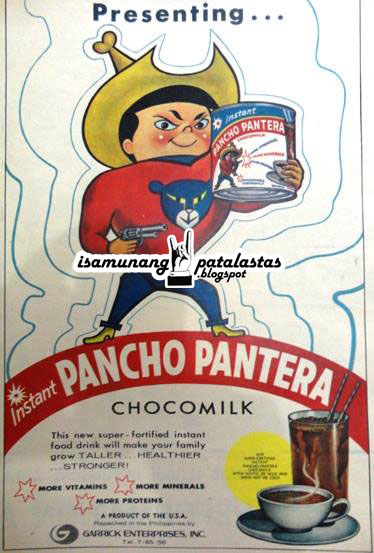
PANCHO PANTERA is an instant chocomilk powder drink that was widely popular in Mexico, introduced in the Philippines in 1965. Its product label claimed it is U.S. made and that the vitamins-and-minerals-fortified product was repacked in the Philippines by Garrick Enterprises Inc., owned and operated by Ricardo Quintos (father of Paul and Michael who were murdered by hired killers of his political opponent in Mindoro).

WATCH A MEXICAN TV AD OF PANCHO PANTERA CA. 1967

But PANCHO PANTERA is a heritage brand from Mexico, sold and enjoyed for over  90 years, before folding up in 2021. Along the way, the brand  was bought by a succession of blue-chip companies, from Procter & Gamble to Mead Johnson,

 PANCHO PANTERA had a brief shining moment in Philippine marketing, advertised in full color ads in magazines, and  TV, with an animated cartoon commercial featuring a cowboy mascot and a catchy jingle.

PANCHO PANTERA MASCOT, updated

In less than 2 years, PANCHO PANTERA would disappear from the local market, but Filipino children growing up in the 60s still vaguely remember the cowboy kid that ran through te TV screen, a picture of a healthier, stronger, taller kid, brought up with chocomilk that is PANCHO PANTERA!

SOURCE:

Choco Milk y Pancho Pantera en 1967, uploaded by Telenostalgia Nov. 20, 2011. https://www.youtube.com/watch?v=XAgUdUPJINA


Saturday, April 2, 2022

368. Creative Guild’s TV Ad of the Month for Jun. 1996: JAG ANTI-FIT “Merman”

JIMENEZ DMB&B's winning ad for Jag Anti-Fit, aired June 1996
Jeans ad featuring merman makes waves

(from a PR article published in the Philippine Star and Manila Bulletin, Sep. 1996)

The new JAG Anti-Fit commercial is making waves, literally, with its focus on a mythological sea creature. Titled “Merman”, the ad is catching the fancy of viewers. It features a man shown swimming with a fishtail, then removing it afterwards to put on a pair of JAG Anti-Fit Jeans.

Using a merman as model for denim jeans is indeed a fresh idea,

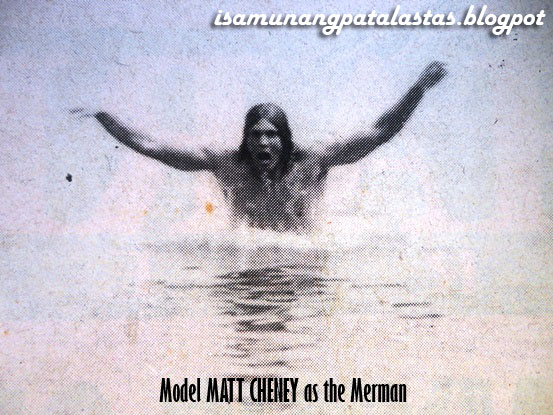
Australian model MATT CHENEY, a competitive swimmer, and did all the swimming scenes in the ad.

“We had to think Anti-Fit. I think this is synonymous to being rugged, daring, comfortable and even controversial”, says Jun Reyes, the commercial’s director.

“When we say jeans, it usually refers to tight-fitting denims, so the idea behind the commercial is to show how we can feel comfortable with jeans”, adds Alex Castro, who collaborated with Reyes on the JAG ad. “ We fitted a man with the tail of a fish to show how constricting denims can be. It shows the limitation of movement. It is not relaxed, not comfortable. Then we show JAG breaks out of the denim stereotype”.

 WATCH JAG ANTI-FIT "MERMAN" TVC HERE:
Source: JAGJeansPh

To make the commercial work, the team relied on realistic props and materials. Says Reyes, “it took hours to put the fish tail on the model. He had to wake up at 4 a.m. for the make-up artist to work on him. We really made sure that the tail would appear as though it was a part of him. We used prosthetics so that the tail would look real. And the tail was detailed for the model so that it would not make him uncomfortable. We had a another tail on reserve in case it got damage. The model had to be carried by 4 men to the beach.

JAG ANTI-FIT "MERMAN' TVC SHOOTING IN BOLINAO, PANGASINAN

Choosing the ideal site for the commercial was also crucial. The shoot was shot in 2 locations: Anilao, Batangas for the underwater scenes, and Bolinao, Panagsinan for the beach scenes.

Reyes and Castro said the commercial was easy to do. They shot the underwater scene for a day, and the scenes above the water overnight.

Since models count a lot in the success of a commercial, JAG made sure they had a perfect merman in its ad. “We had to look for a model who is rugged and suave at the same time. These qualities we found in Matt Cheney, who is a swimmers and a model from Australia. He was paired with Carol Dunbar to add appeal to the commercial. Together, they epitomize the image of JAG—young, spirited, adventurous”, Reyes explains.

The prosthetic fish tail was molded on the model's body

Mythological creatures, gorgeous bods, and a cool concept. With all these elements combined, the JAG Anti-Fit commercial is already making a big splash on TV screens.

NOTE: JAG ANTI-FIT ‘MERMAN’ TVC was adjudged by the Creative Guild of the Philippines for the month of September 1996.

CREDITS:

AGENCY: JIMENEZ DMB&B

Copywriter: ALEX R. CASTRO / Art Director: NIKKO CORNELIO

Producer: PAUL SUAREZ / Account: ANNA DOMINGO

PRODUCTION HOUSE: UNITEL

Director: JUN REYES

D.O.P. BOY YÑIGUEZ, LEE BRIONES / Editor: IKE VENERACION

Production Design: TOMMY NG / Executive Producer: Deet Castillo

ADVERTISER: FIL-PACIFIC APPAREL INC.

Marketing Manager: Veng Taningco / President: Angeline Siy

SOURCES: JAGJeansPh, youtube video /  Manila Buletin, The Phlippine STAR press releases.


Sunday, July 18, 2021

332. ISUAN SOFT DRINKS, of ISUAN Inc. 1935-1937

ISUAN SOFTDRINKS PRINT AD, 1937

One of the most popular line of softdrinks of the 1930s Philippines is the ISUAN brand (pronounced E-Swan), produced by ISUAN, Inc. The softdrinks were made from the famous ISUAN Mineral Water, sourced and bottled at Deep Hot Springs, Km. 66, Los Baños, Laguna. Aside from the all-purpose mixer , Soda Water, the flavors include Tru-Orange and Ginger Ale. Another sub-brand Dixo-Cola was added to the ISUAN line around 1935.

FORMULA FOR REFRESHMENT, ISUAN, 1935

ISUAN GINGER ALE & TRU-ORANGE, 1935

WHISKY-ISUAN, 1930s

DIXO-COLA, by ISUAN, 1930s


Sunday, June 27, 2021

329. UNI-CHARM NAPKINS : “Parang Wala, Kahit Meron” Campaign, 1983

UNI-CHARM WITH TCP* "PARANG WALA, KAHIT MERON", 1983

Sometime in the late 70s, Mondragon industries Industries was founded by Jose Antonio Gonzalez, who would become our Tourism Secretary in 1986. The company was initially engaged in the production women’s intimate fashions—from brassieres to panties and lingerie. The underwear products  became instant sensations in the 80s, and became Mondragon’s flagship brand. With this success, the company forayed into other women’s products, and the result was UNI-CHARM Sanitary Napkins.

TINA REVILLA for UNI-CHARM, 1983

UNI-CHARM was specially design with TCP—for Total Comfort and Protection.It has a special absorbent multi-layer system that absorbs faster to keep you drier than ordinary pads.Plus, it was the only napkin at that time that was individually wrapped. In 1983, UNI-CHARM was launched with a campaign using the theme line: “Parang wala, Kahit meron”. 

BONG DIMAYACYAC/ CITA CAPUYON for UNI-CHARM, 1984

The  brand had the endorsements of 3 celebrities: Pops Fernandez (a young entertainment personality), Tina Revilla (TV host and producer), and Gloria “Bong” Dimayacyac (Miss Asia 1973). There was also a TV commercial as part of the campaign component. 

POPS FERNANDEZ for UNI-CHARM, 1983

The campaign elevated awareness for UNI-CHARM and the brand enjoyed moderate success. With the diversification of Mondragon, UNI-CHARM was dropped from the product portfolio. Today, “Unicharm” name is owned by a Japanese firm that makes sanitary pads and chidren’s diapers.

Thursday, June 3, 2021

326. Everybody Loves COCOA RICOA by Philippine Food Industries Inc., 1962 Ads

COCOA RICOA was the pioneer product of the  Philippine Food Industries, Inc. when it bgena its operations in the chocolate processing and manufacturing plant along EDSA in Mandaluyong in 1956. The brand became a traditional favorite for chocolate lovers, using COCOA RICOA for the chocolate breakfast drinks, cakes, custards, ice cream, cookies and other chocolate-based goodies.

The product was advertised heavily in color ads that often carried recipes to promote its varied usages, although the chocolate powder was mostly used for hot and cold drinks. COCOA RICOA was also produced in blocks, and in sweetened powder and syrup form, for versatility of use. 

It attained such popularity that in 1962, a thematic campaign was launched to create a”bandwagon effect” for the brand. “Everybody Loves Cocoa Ricoa” featured every member of a Filipino family attesting to COCOA RICOA’s flavorsome, chocolatey appeal as used in their specific favorite choco treat: Lola for her “champorado”, Lolo for his “Chocolate Español”, Mama for her chocolate cake, and so on. 

Today, COCOA RICOA is still being produced, led by its  COCOA RICOA Breakfast Powder, still in its familiar, but modernized deep turquoise packaging by Commonwealth Foods, Inc, which  has owned the brand since 1968. COCOA RICOA is one of the few trailblazing, locally-produced chocolate product brand that has survived the test—and taste—of times, inspite of the  greater availability of imported brands in the Philippine market, proof that after all these years, “Everybody loves COCOA RICOA!”

Thursday, September 17, 2020

297. ASCAROL BONBONS, by Metro Laboratories, Inc. (1957-1969)

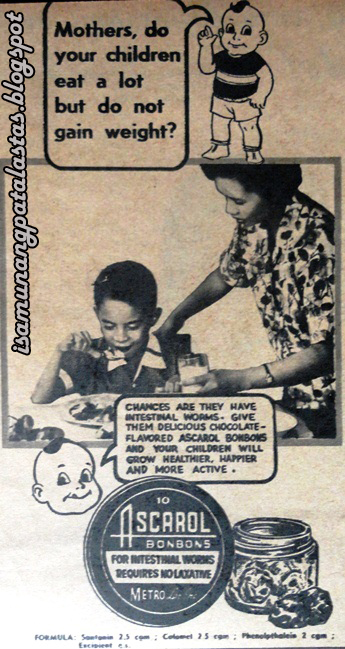
ASCAROL BONBONS, in chocolate flavor, 1957

One of the most popular deworming drugs in the 1950s, was ASCAROL brand, produced by Metro Laboratories, Inc. Metro was then a leading pharmaceutical company that made popular products as Dhobinol (skin ointment), Elixir Auri-Bromide and Metrotussin (cough medicine).

ASCAROL Print Ad, 1957

Ascariasis, or roundworm infestation, was a common children’s condition in the post-war 50s, and the most prevalent in agricultural Philippines. The soil-transmitted parasitic worms can cause severe abdominal pain, fatigue, vomiting, anemia, distended abdomen, itching, and malnutrition and weight loss in kids.

ASCAROL print ad, 1960 

 As liquid antihelminthic medicines tended to be distasteful for kids, Metro Laboratories made the product in chocolate-flavored candy forms---ASCAROL BONBONS. The albendazole-based bonbons, came individually-wrapped in a glass jar,, which children can enjoy like candy,  while being treated for their infestation. No laxatives were required.

 ASCAROL Print Ad, 1969

ASCAROL BONBONS were promoted in print ads, from the 50s to the 70s, becoming household names, and proven the most effective worm expellant for decades. The rise of new  and very affordable multi-worm products halted ASCAROL’s market success. Combantrin, for example, is Pyrantel-based, which required only one dose to eliminate all types of worms, and yet it is gentle on the stomach.

 The brand name Ascarol today, is used by Laboratorio NeoFarmaco of Ecuador, in their de-worming product that is just as popular as the Philippine brand of old.

Sunday, May 17, 2020

279. Draw-it-Yourself DUTCH BABY PRINT ADS, 1967-68


DUTCH BABY is a brand of canned milk that was manufactured and marketed in the Philippines as early as 1953. It was made by Milk Industries in Markina, reputedly under the supervision of Dutch scientists. By 1965, the company was known as Marikina Dairy Industries, Inc., and was allied with the Australian Dairy Produce board of Melbourne, Victoria.


DUTCH BABY EVAPORATED FILLED MILK, was the lead brand, and was extensively advertised in newspapers and magazines. It was one of the leading milk brands in the country, along with Darigold and Liberty.  As its marketing became more sophisticated, the company sought the help of J. Walter Thompson ad agency to help develop their advertising campaigns.


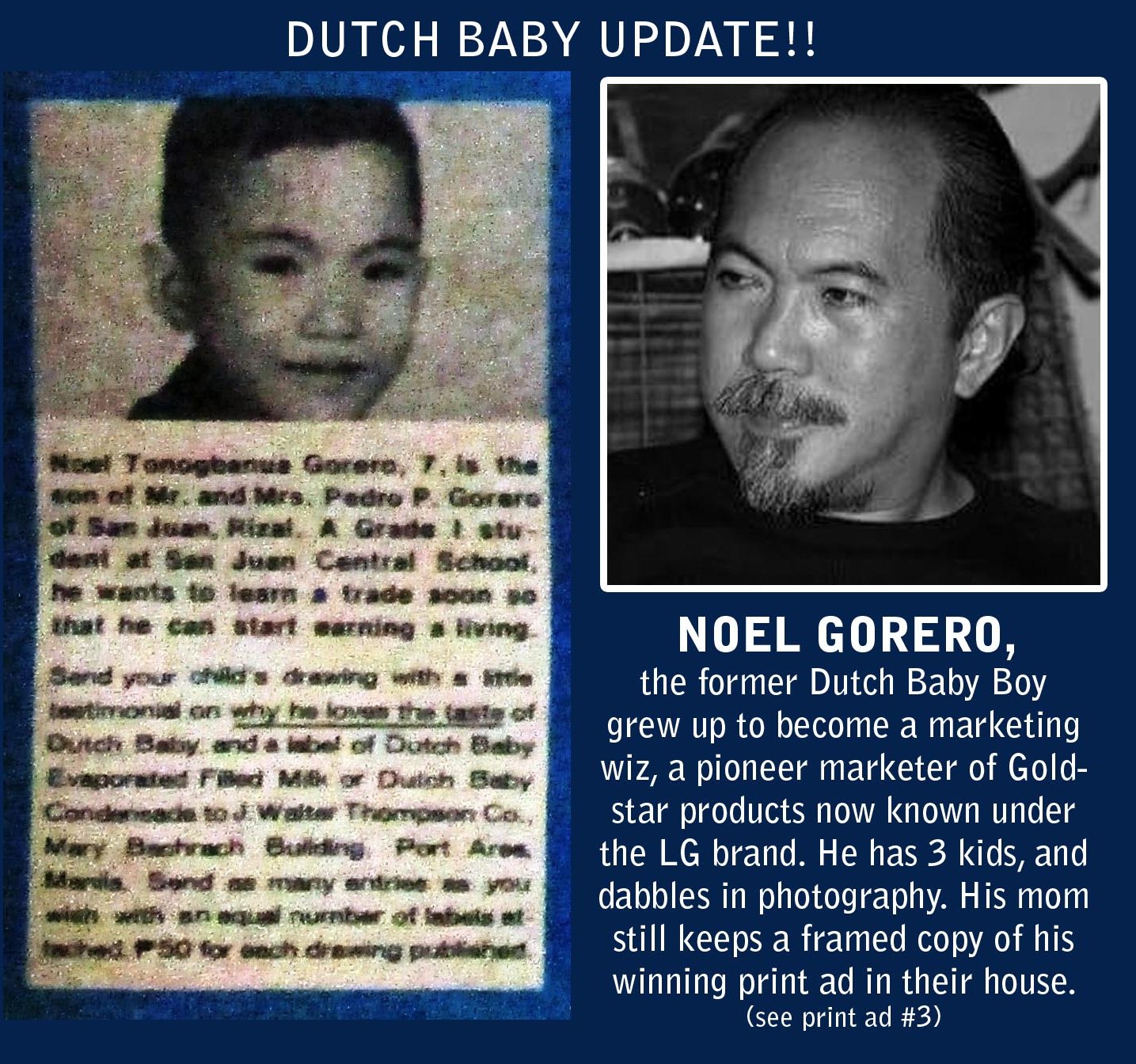
In 1967, J. Walter Thompson came out with one of the first content-contributed print ad series. It solicited the help of parents and children with a request to “Send your child’s drawing and a little testimonial on why he loves the taste of DUTCH BABY along with a label of DUTCH BABY Evaporated Filled Milk or DUTCH BABY Condensada to J. Walter Thompson, Mary Bachrach Bldg., Port Area, Manila”.


There was a cash prize of  50 Pesos for each drawing that was selected and published. Eventually, 3 DUTCH BABY ads were released, featuring the winning art works of 7-year old Noel Gorero (San Juan Central School), Michelle de Leon (St. Theresa’s College) and 11 year old Rommel Simpliciano (Manila High School) .

DUTCH BABY was available in the Philippines until the 70s, until it disappeared altogether . The brand name is now held by a Malaysian milk company, until1983, when milk products were renamed Dutch Lady.


Saturday, November 16, 2019

251. LION’S SODA CRACKERS by M.Y. San, Print Ads 1940-1987


Soda crackers or “saltines’ are thin, square cracker made from white flour, yeast, and baking soda, with surface perforations and with a distinctively dry and crisp texture. They were known as early as the mid 19th century.
 
A very early pre-war LION SODA CRACKERS Ad
One Philippine cracker classic  is the LION BRAND SODA CRACKERS, manufactured by M.Y. San Co., Inc. The  Mar family, whose patriarch Mar Yuck San had come to the Philippines from Guangdong in 1900, had established a soda fountain business. Like Clarke’s Ice Cream Parlor, they put up a bakery headed by Mar Chew, a relative who had learned baking in Hawaii.
 
LION'S SODA CRACKERS, Print Ad, 1966 
One of the first such products that were served in the restaurant were soda crackers known for their crispy quality that were perfect for eating with jams, butter, and marmalade. By the ate 1930s, they were so popular that they were sold commercially under the brand name LION BRAND SODA CRACKERS, with the familiar lion trade character. The earliest advertisements came out in 1940.
 
LION'S SODA CRACKRS, print ad, 1969
The brand name was eventually shortened to LION’S SODA CRACKERS in the 1960s, and the LION brand was also used for its mixed biscuits offerings. M.Y. San the produced another line of soda crackers named ‘SkyFlakes” in the 60s that proved to be a bigger hit than LION.

LION'S SODA CRACKERS, Print Ad, 1971
LION’S SODA CRACKERS though continued to be produced all the way thru the 1990s, metamorphosing as LION’S Cream Crackers.  Nissin Monde now owns M.Y. San, as its subsidiary Monde M.Y. San, which continues to produce its bestsellers like SkyFlakes, Fita, Graham Crackers—but LION brand of crackers and bsicuits have been discontinued with the phase-out of the LION’S Cream Cracker line.

OMNIBUS M.Y. SAN Ad, with LION'S SODA CRACKERS, 1987

Wednesday, October 16, 2019

246. Hunt for the Best: HUNT’S PORK & BEANS, 1958-1970 Ads

HUNT'S PORK & BEANS PRINT AD, 1970


HUNT’S, a name associated in the Philippines with Pork and Beans, began as the Hunt Bros. Fruit Packing Co., in Sebastopol, California, founded by brothers Joseph and William Hunt. It originally was a canning company that canned fruit and vegetables from California farms, but by 1941, it was into canned soups, fruits, vegetables and juices.

HUNT'S PORK & BEANS, CATSUP AND FRUIT COCKTAIL Omnibus Ad, 1958

In 1943, Norton Simon's Val Vita Food Products of Fullerton, California merged with the packing company, and the new business was incorporated as Hunt Food and Industries, Inc.  It also streamlined its operation by focusing on canned tomato products.

In fact, the first HUNT’S products that were distributed in the Philippines in the mid 1950s were HUNT’S Tomato Sauce, HUNT’S Tomato Catsup and HUNT’S Pork & Beans. HUNT’S Fruit Cocktail  was the only fruit-based canned product it sold here in the Philippines 1957. The print advertising carried the famous slogan “Hunt-- for the best”, which would be used for many years.
 
HUNT'S PORK & BEANS, PRINT AD, 1960
In 1956, a group of businessmen formed a company known as the Pure Foods Corporation, which manufactured processed meats and food products under the Pure Foods brand name. Ayala Corporation acquired substantial shares in the company in 1965. It also acquired the right to manufacture HUNT’S Pork & Beans, made from high quality Great Northern Beans and real pork bits covered in rich, thick, sweet tomato sauce. It was distributed by Atkins, Kroll & Co. Inc., along with HUNT’S Tomato Sauce and Catsup, but HUNT’S Pork & Beans would remain its best seller and flagship brand.
 
HUNT'S PORK & BANS, 1960
HUNT’S Pork & Beans became a sort of a favorite “emergency food”,  as it was affordable and could be eaten straight from the can. It had very little competition in its time, so it became the country’s largest-selling canned pork and beans for many years.

But the decades that followed saw major changes with the mother company, HUNT’S Food and Industries Inc. In 1960, it merged with Wesson Oil & Snowdrift Co. to become Hunt-Wesson Foods.  A series of mergers happened in through the 80s, until Hunt-Wesson, the company which included the Hunt's brands, was sold in 1990 to ConAgra Foods, a leading packaged food company of North America.
 
HUNT'S PORK & BEANS, 1960
Meanwhile, Pure Foods dropped HUNT’S as it began making its own brand of pork & beans in the early 1980s. Around 1984, Universal Robina Corp, came to an agreement with ConAgra Foods to manufacture and market HUNT’S Pork and Beans  in the Philippines under this 50-50 joint venture.
 
HUNT'S PORK & BEANS, PRINT AD 1969
More recently, in May 2017, Century Pacific Food, Inc., the country’s canned food-producing leader,  acquired the Philippine license  for HUNT’S Pork and Beans, from the URC group. The deal includes the right to manufacture, sell and distribute Hunt’s branded products in the Philippines from Hunt’s-URC. HUNT’S Pork & Beans continue to lord over the ready-to-eat canned beans product category, with a commanding 86% share of the market.

SOURCES: