S. C. Johnson (S. C. Johnson & Son, Inc.), previously
known as S. C. Johnson Wax (and earlier on, Johnson Wax), is a global
manufacturer of household cleaning supplies and other consumer chemicals based
in Racine, Wisconsin.
WATCH THIS U.S.-PRODUCED OFF! TV AD STOCK FOOTAGE
Other than wax, one of the earliest S.C. Johnson products
sold in the Philippines was OFF! Insect Repellent, first produced and sold in
1957. Just 5 years after, OFF! became available in the Philippines, in bottles
and aerosol spray. Its active ingredient is N, N-Diethyl-meta-toluamide, known
as DEET, which is the most common and safest ingredient in insect repellents, of which S.C.
Johnson is considered a pioneer.
OFF! "Your Invisible Mosquito Net", 1972
OFF! had the
endorsement of the U.S. Department of Agriculture, calling it “the most
effective product of its kind. OFF!
Insect Repellent was marketed via advertising and promotions, like during the
H-Fever months that happened in 1975. (Slogan: “Your invisible mosquito net”.)
It’s last advertising agency in the Philippines, was FCB.
OFF! Insect Repellent continues to manufactured by the same
company today, one of the more enduring brands of S.C. Johnson.
OFF! In 1960s liquid form and in the 1970s aerosol spray can.
SUAVE Print Ad, 1969, featuring Terry Aldeguer of the Aldeguer Sisters
Helene Curtis was a company formed from National Industries, which had originally produced personal care products, but which had to shift to making products for the war efforts. After World War II, National Industries resumed making personal care products and was renamed Helene Curtis, after the first names of partner Louis Stein's wife and son.
The first products to come out from the Helene Curtis plant was SUAVE Hairdressing, in Crème and Lotion, which was launched for general retail sale, and proved to be a sales success.
It went on to create more revolutionary products like hairsprays, with the brand name, Spraynet, spray-on deodorant Stopette, and a dandruff shampoo called Enden.
Hairdresser Nomer Pabilonia for SUAVE. Model: Conchitina Sevilla
But in the 1960s, Helene Curtis would eventually go back to build on the success of its SUAVE brand, introducing shampoos, creme rinses, and wave sets.
As early as the 1960, Helene Curtis SUAVE was marketed in the Philippines, and was actively pushed with regular advertising campaigns.
The earliest examples show SUAVE print ads featuring well-known fashion icons modeling the latest styles (“The Bob”, “The Bell”) created by leading hairdressers of the day, like Nomer Pabilonia and Moises Sia, who readily endorsed the product.
Hairdresser Moises Sia for SUAVE, 1960 Print Ad
SUAVE had a great run in the Philippines and in the 1980s, it was repackaged in cost-efficient plastic with caps, as hair control products became more popular. Today, the SUAVE brand is owned by Unilever, and has expanded to include hair grooming essentials for men and women, like gels, shampoos, mousse, aerosol anti-frizz and other hair-control products.
People in pre-war Philippines would surely remember BALINTAWAK BEER, a beer brand that
came to be, thanks to Japanese investors who pooled in funds to establish a
beer factory in Polo, Bulacan. This was the Balintawak Beer Brewery, founded in 1937, which launched its BALINTAWAK Pilsener Beer to the local
market, bottled in amber bottles similar to San Miguel’s, with paper labels.
BALINTAWAK BEER
was supported with print and radio advertising, and early ads focused on the beer’s
relaxing, comforting qualities that’s perfect for social entertaining. The KZRM airwaves was filled with songs and
music from featured performers like Alicia Garong, pianist Rafael Artigas, and
even a BBB Mystery Singer.
In 1938, BALINTAWAK
BEER added its ‘Black Beer’ version,
the counterpart of san Miguel’s Cerveza Negra. Like San Miguel, BALINTAWAK BLACK BEER was positioned as
the drink ideal for women for its health-giving attributes.
World War II put an end to the operations of Balintawak Beer Brewery, as the plant
was taken over by the Japanese forces, along with San Miguel beer plant. BALINTAWAK BEER, however, continued to
be available to Filipinos.
In the 1950s, San Miguel Corporation bought the Polo plant
and converted BBB into their primary brewery for their world-renowned San
Miguel Beer.
Vintage Bottle collectors are always looking for BALINTAWAK BEER bottles today for their
rarity, as many of their identifying paper labels have been worn away by time.
SOURCES:
Graphic Magazines, 1937-1939 issues
Kasaysayan, Vol. VII. "Prewar Pesos for Japanese Goods," Yu
Jose, Lydia.
JAG JEANS TVC featuring FatBoy Slim's "Gangster Tripping"
From the mid 1990s to 2000, JAG JEANS, a product of
Fil-Pacific Apparel Inc., invested in advertising to level-up its image in the
crowded jeans market that included known imported brands and rising local,
quality brands.
TWO JAG MODELS MEET
It was during this period that it churned out a slew of
commercials that began turning head—from the 1996 “Merman” TVC, that won a Creative
Guild Award, to the “Senses” TVC for it female jeans line that captured a
significant number of production/technical awards (best in cinematography, art
direction) at the Philippine Advertising
Congress in 1998.
In 1999, JAG JEANS took another risk by launching a campaign
that was shot in Sydney, Australia for 9 days, using Aussie talents and a
production house. In this casually cool
commercial, the city becomes the ramp on which our JAG JEANS strut their
fashion stuff.
We follow them around, walking and posing nonchalantly on
the graffiti-lined streets, inside a
train, a male’s shower room. The music of FatBoy Slim provided the track for
this commercial with his big beat, electronic new funk rock song. “ Gangster
Tripping”.
The 30 sec. JAG JEANS had even shorter 15 sec. versions, one
of which is featured here.
CLIENTS & AGENCY CREATIVES WITH SYDNEY PRODUCTION CREW
CREDITS:
AGENCY: JIMENEZ DMB&B
Copywriter: ALEX R. CASTRO / Art Director: DON SEVILLA III
CLICQUOT CLUB was
first produced in 1881 in Massachusetts, as a sparkling cider by LaCroix Fruit
Farm. It was named “Clicquot”,after the French champagne “Veuve Clicquot”. After
The Clicquot company was formed, the apple cider was dropped, in favor of a new
drink—the Clicquot Club Ginger Ale. Other flavors followed: Cream Soda,
Strawberry, Orange, Rootbeer, Lemon & Lime, and Grape. Its “Eskimo Boy”
mascot, became one of the most recognizable brand characters in the U.S.
It was
distributed internationally in the 1950s, that led to its Philippine launch. Rafael
Yabut‘s “Tayo’y Mag-aliw” radio program, aired over DZRH, promoted the product in
a segment called “Clicquot’s Tayo’y Uminom Program”. Clicquot Club was gone by
the early 1960s; the company was
eventually bought by the Cott Beverage Corporation of Connecticut in 1969.
Last of a 4-part series of some of the most amusing,
unusual, and sometimes, weird-sounding names ever coined for real products,
that were available in the Philippines –from the 1930s to the 1960s.
REUTER’S SOAP. Brand Name For: Skin
Soap
The early toilet soap designed to beautify a woman’s
complexion is a trademark of Lanman & Kemp-Barclay & Co., Inc. The
company, itself was founded in 1808 by Robert I. Murray and its business was
conducted under the firm name Murray & Lanman in New York. The brand name--REUTER’S SOAP-- has nothing
to do with the world-famous news bureau. It was named after its creator, Dr.
John Reuter. The classic bar soap was sold in the 1950s under its Spanish brand
name, Jabon de Reuter, in the Philippines. The company still is in cooperation
today with headquarters in Westwood, New Jersey, and continues to sell the
soap.
SAKITALIS. Brand name for:
Medical plaster
Now here’s another direct-to-the-point name for a pain-soothing
medicated plaster—SAKITALIS (Aches away!).The wordsmith had an easy time with this brand name, and even though it
sounded like the aforementioned “Katialis”, it is still distinct in its
category. SAKITALIS, which contains belladonna, was “the most effective plaster
pan reliever”—in distinctive pink color! It was available in the late 1950s at
all drugstores,distributed by Colossal
Drug Store. But the coming of made in Japan Salonpas, obliterated it, and by
the 1970s, Salonpas became the dominant plaster brand, for its superior
efficacy—not to mention its catchy, classy name that has become an everyday
term fora pain relieving plaster for
all body parts.
SILENT NIGHT. A Brand Name for:
Perfume and Lotion
Yes, Virginia, there is such a perfume brand called
SILENT NIGHT, ‘ a perfume masterpiece made by Countess Maritza of New York,
U.S.A.”. It was locally distributed in local stores in 1962. But wait,there’s also a SILENT NIGHT Lotion to
complement it. Like a line from the carol, was it also tender and mild,? With a
name like that, how can you miss? As the ad suggests—“it’s best to give on
Christmas!”. One wonders if it is inappropriate to give SILENT NIGHT on other
occasions, say, like birthdays and Valentines,
TANSAN. A Brand Name for:
Mineral Water
It’s okay to drink the TANSAN!!!The crown cap revolutionized the glass bottling industry
when it was invented in 1897 by William Painter. The first drink that featured
the crimped tin cap was called TANSAN, a bottled mineral water marketed by
Clifford Wilkinson in the early 1900s. The brand name TANSAN–believed to be of
Japanese origin–has now come to mean crown caps in Filipino. The product first
came out in straight-sided bottles, and then in small, bulb-shaped green
bottles with the name in relief. In its
1920s ads, TANSAN was proclaimed as a 100% pure, sourced from “natural waters
free from all earthly deposits.” Being “radium-active,” TANSAN possesses many
medicinal qualities, proven against stomach disorders.
VIN DÉSILES. A Brand Name for: Tonic
wine
The brand name of this revitalizing drink popular in the
1950s seem anachronistic as it sound like the name of contemporary Hollywood
action star, Vin Diesel. But it was produced long before the action star of
“XXX” and “The Fast and the Furious” was born. VIN DÉSILES, a wine-based drink that claims to
restore energy and appetite, and was distributed by Oceanic Commercial, Inc. in
the Philippines. It may not have inspired the name of action star Vin Dieeel,
but it sure is power-packed like him!
JIMENEZ DMB&B's winning ad for Jag Anti-Fit, aired June 1996
Jeans ad featuring
merman makes waves
(from a PR article published in the Philippine Star and Manila
Bulletin, Sep. 1996)
The new JAG Anti-Fit commercial is making waves, literally,
with its focus on a mythological sea creature. Titled “Merman”, the ad is
catching the fancy of viewers. It features a man shown swimming with a
fishtail, then removing it afterwards to put on a pair of JAG Anti-Fit Jeans.
Using a merman as model for denim jeans is indeed a fresh
idea,
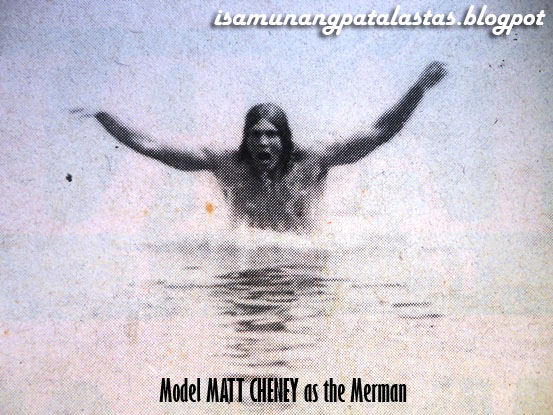
Australian model MATT CHENEY, a competitive swimmer, and did all the swimming scenes in the ad.
“We had to think Anti-Fit. I think this is synonymous to
being rugged, daring, comfortable and even controversial”, says Jun Reyes, the
commercial’s director.
“When we say jeans, it usually refers to tight-fitting
denims, so the idea behind the commercial is to show how we can feel
comfortable with jeans”, adds Alex Castro, who collaborated with Reyes on the
JAG ad. “ We fitted a man with the tail of a fish to show how constricting
denims can be. It shows the limitation of movement. It is not relaxed, not
comfortable. Then we show JAG breaks out of the denim stereotype”.
WATCH JAG ANTI-FIT "MERMAN" TVC HERE:
Source: JAGJeansPh
To make the commercial work, the team relied on realistic
props and materials. Says Reyes, “it took hours to put the fish tail on the
model. He had to wake up at 4 a.m. for the make-up artist to work on him. We
really made sure that the tail would appear as though it was a part of him. We
used prosthetics so that the tail would look real. And the tail was detailed
for the model so that it would not make him uncomfortable. We had a another
tail on reserve in case it got damage. The model had to be carried by 4 men to
the beach.
JAG ANTI-FIT "MERMAN' TVC SHOOTING IN BOLINAO, PANGASINAN
Choosing the ideal site for the commercial was also crucial.
The shoot was shot in 2 locations: Anilao, Batangas for the underwater scenes,
and Bolinao, Panagsinan for the beach scenes.
Reyes and Castro said the commercial was easy to do. They
shot the underwater scene for a day, and the scenes above the water overnight.
Since models count a lot in the success of a commercial, JAG
made sure they had a perfect merman in its ad. “We had to look for a model who
is rugged and suave at the same time. These qualities we found in Matt Cheney,
who is a swimmers and a model from Australia. He was paired with Carol Dunbar
to add appeal to the commercial. Together, they epitomize the image of JAG—young,
spirited, adventurous”, Reyes explains.
The prosthetic fish tail was molded on the model's body
Mythological creatures, gorgeous bods, and a cool concept.
With all these elements combined, the JAG Anti-Fit commercial is already making
a big splash on TV screens.
NOTE: JAG ANTI-FIT ‘MERMAN’
TVC was adjudged by the Creative Guild of the Philippines for the month of
September 1996.
CREDITS:
AGENCY: JIMENEZ DMB&B
Copywriter: ALEX R. CASTRO / Art Director: NIKKO CORNELIO
Producer: PAUL SUAREZ / Account: ANNA DOMINGO
PRODUCTION HOUSE: UNITEL
Director: JUN REYES
D.O.P. BOY YÑIGUEZ, LEE BRIONES / Editor: IKE VENERACION
Production Design: TOMMY NG / Executive Producer: Deet Castillo