Thursday, February 24, 2022

364. Sporty Fashion for Your Feet: SPARTAN FOOTWEAR, Print Ads 1960s

SPARTAN COMMANDER, THE MOST GUWAPO OF THEM ALL! 1963.


One of the most iconic athletic footwear brand from the 1960s-70s  is SPARTAN. It was so popular that the brand “Spartan” briefly became a generic name to refer to rubber shoes. SPARTAN was the rubber shoes of choice of many basketball teams and sports leagues, with many styles to choose from.

SPARTAN CHIRSTMAS AD, 1964

For example, there was the ‘Commander’ style, touted as “the most guwapo of them all”, with its colorful ankle patch and blue and red stripes. There was also a SPARTAN Speed Star, made for hardcourt action and agility. It eventually venture dinto other footwear like children and ladies’ shoes and sandals.

SPARTAN was made by KP Rubber Corporation located along Francisco St., in Caloocan City, but not much is known about the company. It folded up I the 1970s. The SPARTAN name is being used today as a brand for rain boots, and also by Reebok, for its line of all-terrain rubber shoes.

SOURCES:
Spartan Speed Star Ad: Pinterest.ph via Eduardo de Leon


Monday, February 21, 2022

363. Brand Stories: ASTRING-O-SOL Mouthwash, Print Ads 1929-1980

ASTRING-O-SOL, "JEANNE YOUNG", 1968 Print Ad

Mouth rinses were not unknown among ancient Chinese, Greeks, Romans and Egyptians. One early mouth was human urine (Romans imported bottled Portuguese urine!), which contains ammonia, believed to disinfect mouth and whiten teeth. Other ptions include the use of tortoise blood, salt-alum-vinegar mis, and pure, cold water to ward of tartar and plaque.


ASTRING O SOL, "MORNING MOUTH", 1929 Print Ads

In 1865 that English surgeon Joseph Lister used an antiseptic to sterilize hs operating room. Inspired by this, Dr. Joseph Lawrence, one of the founders of Johnson & Johnson, developed a mouthwash for cleaning mouths and sterilizing wounds in 18979, naming it Listerine, in honor of Dr. Lister.  Listerine became the first prescription mouthwash in 1914  to be sold over the counter in the United States.

ASTRING O SOL, "MORNING MOUTH", 1929 Print Ad

Not to be outdone, the American pharmaceutical manufacturing giant,  Frederick Stearns & Company (est. 1887, Detroit Michigan) , created ASTRING-O-SOL, the concentrated antiseptic that became part of their dental care line.

ASTRING O SOL COMIC STRIP AD, "ARMANDO" 1956

ASTRING O SOL COMIC STRIP AD, "MYRNA", 1957

ASTRING O SOL COMIC STRIP AD, "LYDIA", 1957

ASTRING-O-SOL contained Myrrh oil (which helps relieve mouth sores and gum inflammation), oil of wintegreesn (which provides germ protection as well as cooling effect), and Zinc chloride (for  pleasant-tasting sensation, hence the “Breath Sweetener” descriptor). Zinc can also limit tartar build up.

ASTRING O SOL "Caressing Sweet", 1960 Strip Ad

The powerful Astringent, Antiseptic and Prophylactic Mouth Wash, which needed t be diluted with water,  was internationally sold by the 1920s, and competed successfully against Listerine. ASTRING-O-SOL’s earliest campaign “Morning Mouth”, gained much popularity among consumers, appearing for the first time on Philippine publications in 1929.

ASTRING O SOL, "Against Bad Breath:, 1969 Color Print Ad

Today, ASTRING-O-SOL  is a registered trademark of the GlaxoSmithKline group of companies, under its GSK Consumer Healthcare Division. With its own manufacturing facility in Cainta, Rizal. GSK continues to bring dental health products and over-the-counter medicines to millions of Filipinos. Other than ASTRING-O-SOL, the company alsmo makes Sensodyne, Aquafresh, Calpol and Dequadin. Advertising is handled locally by Campaigns & Grey. 

ASTRING O SOL, 1980 Print

SOURCES:

Mouthwash, Wikipedia: https://en.wikipedia.org/wiki/Mouthwash

GSK Product Portfolio: https://www.gsk.com/media/2508/gsk-consumer-healthcare-brands-portfolio.pdf

 Astring-O-Sol | National Museum of American History: https://americanhistory.si.edu/collections/search/object/nmah_1218695

Tuesday, February 8, 2022

362. MORE AMUSING BRAND NAMES YOU WON'T BELIEVE WERE USED IN THE PHILIPPINES, Part II

Part II of some of the most amusing, unusual, and sometimes, weird-sounding names ever coined for real products, that were available in the Philippines –from the 1930s to the 1960s.

***********

BARRY’S TRICOPHEROUS, Brand name for:  Hair Tonic against baldness, thinning hair and dandruff

BARRY’S TRICOPHEROUS was introduced in the late 1840s by "professor" and former New York wig-maker, Alexander C. Barry. The term “tricopherous” alone  conjures many images—either a serious, incurable disease or the name of an extinct dinosaur. But despite its name, the product did surprisingly well.  Barry exhorted his customers: “Stimulate the skin to healthful action with the Tricopherous, and the torpid vessels, recovering their activity, will annihilate the disease.” Apparently, that worked for many satisfied men. The product contains 97% alcohol, 1.5% castor oil, and 1% tincture of cantharides (Spanish fly), which supposedly help stimulate the scalp’s blood supply.  BARRY’S TRICOPHEROUS is still being produced and sold today by Lanman & Kemp-Barclay & Co.

GALISATUMBrand Name for: Skin Ointment

GALISATUM Lunas Galis was a skin ointment developed by Dr. Carlos Jahrling of Botica Sta. Cruz in the 1930s. Dr. Jahrling was a German pharmacist from Offenbach who opened his own business in Manila.“Galis” was an all-encompassing local  term for any skin conditions. “-Atum” was a suffix that was  commonly used in pharmaceutical products  like “mentholatum”and “petrolatum”.  GALISATUM with Lunas Galis sounds more like an incantation or a Latin spell to improve skin condition, especially when you say it thrice.  But it does relieves prickly heat, chafing, pimples, mange, eczema, dandruff and  maladies with mysterious names like Dhobie’s Itch (another term for Jock’s Itch) and Hongkong Foot (a slang for athlete’s foot), as this ad from 1936 claims.

GAYTOP: Brand Name for: Concentrated Hairdressing and Conditioner

Before gay language became more elaborate, it was okay to for Helene Curtis to dub its latest hair conditioner product.  GAYTOP. Nothing wrong with that--in the late 1950s. Today, GAYTOP sounds so suggestive with its homo-erotic undertones;  it seems to reveal  one’s orientation and preferred sexual role—especially when talked about in a beauty parlor! Indeed, if this product were around today, it will be a “brand that dares not speak its name”.

JAGGING JAGGINGBrand Name for:  Face Powder and Pomade

There really is no reason why a  cosmetic product guaranteed to make you “lovely to look at” be named JAGGING JAGGING. It is nonsensical, unfeminine and the sound is far from mellifluous. But  Chun Huat Pomade Factory, the manufacturer, did just that, making it hard to believe that Jagging Jagging  is indeed,  a “girls’ favorite”. Ad from 1934. 

KULSO-ALIS: Brand Name For:  Anti-diarrhea, anti-dysentery

Another product coming from Dr. Jahrling’s Botica St. Cruz is  KULSO-ALIS, a concoction with a brand name that comes from “Kulso” (diarrhea, loose bowel movement) and “Alis” (to be free from, begone). It was a common way to coin brand names for products this way, bewildering the Pilipino name may be to a foreigner. Perhaps this anti-LBM medicine was really meant to target local market only.It is interesting that Kulso-Alis lists  opium as one of its ingredients. Ad from 1937

 (This article originally appeared in the online magazine Esquire Philippines www.esquiremag.ph, on 11 Feb. 2019, under the title "Funniest Filipino Brand names in the 20th Century", commissioned from the author, Alex del Rosario-Castro)

Friday, January 28, 2022

361. Before the Movie, there was the Pomade: : BLACK PANTHER, 1940s-50 Ads

BLACK PANTHER , 1957 Print Ad

Nope, this cosmetic brand was not inspired by Stan Lee’s character, BLACK PANTHER, who first appeared in comic books in 1966 as ruler of the kingdom of Wakanda. It was subsequently made into a blockbuster superhero film in 2018, starring Chadwick Boseman as T'Challa / Black Panther.

BLACK PANTHER, 1953 Ad

The cosmetic products BLACK PANTHER Hair Pomade predates Stan’s superhero by almost 2 decades, first appearing in post-war 1948. Heart throb Pancho Magalona was tapped to endorse the product in 1948 before he became a Glo-Co hair tonic model too). Subsequent ads featured line drawings.

PANCHO MAGALONA for BLACK PANTHER, 1948 Ad

BLACK PANTHER was manufactured by Lander New York, and sold in the Philippines by Peter & Co., in Manila. The came in attractive dark cobalt blue bottles. “The slumbering fire of BLACK PANTHER…attacks a man’s heart…attack a woman’s heart…until they merge in a flame of ecstacy”—so goes a line from its print ad, worthy of an Oscar. T’Challa would have approved.

Monday, January 24, 2022

360. Brand Stories: HENO DE PRAVIA Soap, Print Ads 1960s-80

HENO DE PRAVIA, Print Ad, 1974

One of the more prized soaps in the world are those made in Spain, and some brands like Maja enjoyed worldwide success, like Maja by Myrurgia , a favorite soap brand in 1930s Philippines.

In the late 60s, another Spanish made soap made its appearance in the Philippines and had a long, successful run as a beauty soap with “fragrance that leaves a little bit of you behind”: HENO DE PRAVIA.

The green soap in the familiar yellow and white package was a product of Perfumeria Gal, which produced the soap in 1905. The soap came into existence when one of the company's founders, Salvador Echeandia, traveled to Pravia in 1903, a northern Spanish village, where he went to sell his company's products. He arrived while farmers were busy cutting “heno”, a grass used as fodder for livestock, and its aroma captivated him. 

HENO DE PRAVIA, Print Ad, 1968

Upon his return to Madrid he reproduced the fragrance of the “heno” grass and blended it with geranium, lavender and a hint of sandalwood. He marketed the soap as HENO DE PRAVIA, and in tribute to its derivation, made the bar mossy green, and wrapped it in yellow, the color of “heno” when it dries.  HENO DE PRAVIA became  Spain's best-selling soap, and its name has become a household word there.
HENO DE PRAVIA, Family 1, Print Ad, 1980

In the 1960s, HENO DE PRAVIA made its appearance in the Philippine market, and was promoted on the basis of its fragrance and credentials, having won awards in London, Paris and Madrid. Its first advertising print ad featured Filipina models, butw hen the agency, J.Romero & Associates took over, the ads featured Hispanic beauties and Castilian-type models, in keeping with the soap’s origin.

HENO DE PRAVIA, Print Ad, 1974

HENO DE PRAVIA, which caims to be still the no.1 beauty soap in the world, manufactured by Perfumeria Española Corp., a joint venture of  Perfumeria Gal with CIP. The brand is still available in the Philippines today, distributed by JDH Zuellig Inchcape Inc. It is also sold on online stores like Lazada and Shopee.

HENO DE PRAVIA, Family 2, Print Ad, 1980

SOURCE: Spanish Shop Online: https://www.spanishoponline.com/heno-de-pravia.html

Saturday, January 15, 2022

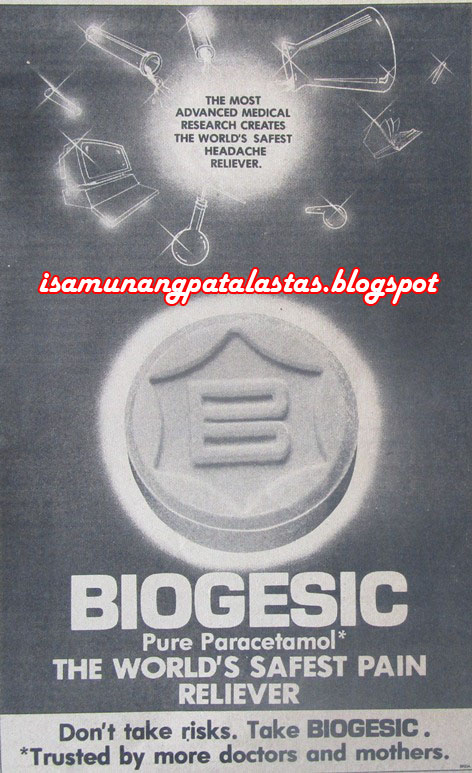
359. Out-of-Stock, but Never Out-of-Mind: BIOGESIC, Print Ads 1987

DON'T TAKE RISKS, TAKE BIOGESIC, Print Ad, 1987 

BIOGESIC  has been in the news lately, as the popular paracetamol brand has suddenly gone out of stock—along with analgesic, anti-pyretic, cold and cough medicine brands-- in the midst of the ongoing covid surge. The supply situation was so bad that even one netizen asked John Lloyd, current BIOGESIC endorser, for the much-needed tablets.   

A Biogesic out-of-stock  meme circulated during the covid surge, CTTO

BIOGESIC has been in the market for over 50 years, a product of the pharmaceutical firm, United Laboratories, Inc. (UNILAB). For decades, anti-fever and pain brands available  locally were paracetamol and aspirin-based, like Cortal, Cortapen, Medicol, Bayer’s Aspirin. The introduction of acetaminophen products expanded the market, and by the late 1970s, Tylenol, the widely-used American brand from McNeilab of Johnson & Johnson, was launched in the Philippines, along with its cold medicine counterpart, CoTylenol.

Tylenol became a huge threat to BIOGESIC and other local brands, as it was sold on the basis of safety—it does not cause stomach upset like aspirin does, which can irritate the stomach lining. Tylenol was also sold on its American leadership (America’s #1 Pain reliever), to capitalize on the so-called colonial mentality of Filipinos. 

CHILDREN'S BIOGESIC SYRUP PARACETAMOL, 1987

All that changed when Tylenol products in the U.S. were laced with cyanide in 1982 by still-unknown criminals, resulting in 7 cyanide deaths in Chicago. The product was pulled out of the Philippine market, and by 1986, BIOGESIC took over the safety theme with the absolute claim: “The World’s Safest Pain Reliever”—in reference to its pure paracetamol ingredient, not the brand. In 1987, a children’s syrup version was even introduced.

BIOGESIC never let go of this safety positioning, and has served the brand well, especially when the “Ingat” campaign, featuring celebrity actor John Lloyd Cruz, was launched in 2007. Marketing pundits believe that the consistent brand messaging of BIOGESIC  paved the way for Filipino consumers to continue trusting the product for aches, fever, and pain, as it continues to be the leading choice for paracetamol in the market—if people can only find it in drugstores today!

SOURCE: John Lloyd and 9 Years of “Ingat”. The Manila Times: https://www.manilatimes.net/2015/05/23/lifestyle-entertainment/show-times/john-lloyd-and-nine-years-of-ingat/185906, 23 May 2015

Saturday, January 8, 2022

358. AMUSING BRAND NAMES YOU WON’T BELIEVE WERE USED IN THE PHILIPPINES, Part 1

(This article originally appeared in the online magazine Esquire Philippines www.esquiremag.ph, on 11 Feb. 2019, under the title "Funniest Filipino Brand names in the 20th Century", commissioned from the author, Alex del Rosario-Castro)

What’s in a brand name? A brand name defines and differentiates a product from its competitors in the eyes of the customer. So important are brand names that they can make or break a product—an urban legend has it that a car maker once named its new vehicle “Nova”, not knowing that “no va” meant “not going” in Spanish.

Would you go to a coffee house called “Cargo House” or “Pequod”? Those names by the way, were considered for your now favorite Starbucks. Then, there’s Lithiated Lemon, a lemon-lime drink introduced in 1929. But when renamed 7-Up, sales increased six-fold. On the other hand, there are perfect brand names like “Jollibee”, “Hapee” and “Mr.Clean” that evoke positive images of joy, clean living and fun.

Before marketing experts offered their brand-naming services, many makers of products just coined their own brand names, resulting in amusing, unusual and sometimes, weird-sounding names.

***********

ANALGINA: Brand Name for a Medicine Syrup for rheumatism and headaches.

ANALGINA is the name of this cure-all also indicated for diarrhea, neuralgia, cramp, breastache, backache, indigestion and cough. At first impression, it has a name seemingly coined from two delicate parts of the human female anatomy—well, at least that’s how it reads.  But the first part of the brand name is derived from ‘analgesia” , which means “relief from pain”.  With the  suffix added however, ANALGINA, as a brand name, doesn’t evoke anything medicine-y; rather it sounds like a disease!  In 1929, you can buy ANALGINA over-the- counter at Botica Insular along Quesada St. in Manila. Just don’t say the name out loud.

ASEMBLEA FILIPINA: Brand Name for : Local cigarettes

Why would someone name a cigarette brand after the Philippine Assembly (ASEMBLEA FILIPINA) ? Well, Simeon Roque y Compania,  maker of these “cigarillos” in Betis, Pampanga, just did. In fairness, the inauguration of the Philippine Assembly in 1907 was a major event, as that gave a glimmer of hope to Filipinos for self-rule. To the local cigarette maker maybe, that historic milestone is worth celebrating with a puff of a “cigarillo” stick. The cigarette label of ASEMBLEA FILIPINA” cigarettes even contain a short poem in the vernacular, exhorting customers Philippine-made products, not imported ones—and exhortation to nationalism, at a time we needed it most.

ATOMIC / ATOMI-CHLOR: Brand Name for :  Pomade / Pesticide

The atomic age began when the first nuclear bomb was detonated in 1945 that led to the bombing of Hiroshima and Nagasaki  which ended World War II. It also started our fascination with atomic designs and organic forms,  inspired by atoms, missiles and rockets, that found their way in product designs and even in brand names. Such is the case with two different products sold and manufactured locally in the 50s .The first is ATOMIC Solid Brilliantine, a men’s pomade brand available in glass jars. What can this pomade do? Will it split the atoms in your hair?  Will you be positively charged? We may never know as this product had a short shelf life.

Another is ATOMI-CHLOR, a liquid product formulated to rid pet dogs and your lawn of  fleas, ticks and insects. This Chlordane-based product came out in 1951. One is wont to wonder if ATOMI-CHLOR had radioactive properties that killed these pests. But we now know that Chlordane is a chemical compound classified as an organic pollutants hazardous to animals, and even human health. Oops.

BAGONG LITAO: Brand Name for Local cigarettes

Another strange name for a cigarette brand is “BAGONG LITAO” (Newly-Appeared), locally made and rolled in Pampanga by a certain Martin Torres. Even the front panel illustration is rather odd: it shows 3 Filipina women in baro’t saya—and they are not even smoking.  For cure, BAGONG LITAO is a reference to the new arrival of the product. But wouldn’t the name become obsolete in a year or so? Because by then, it will no longer be new. It will no longer be BAGONG LITAO, right? Hmmm, I need a smoke. 

BALATKINIS: Brand Name for a Skin Ointment

Katialis is the most successful and most popular local skin ointment in history, with a formula developed by Dr. Lorenzo C. Reyes. Its name was derived from Kati+ Alis (Itch Away) . But the actual concoction was done by his chemist brother, Manuel, who mixed the ointment at the Locre Laboratorio in San Lazaro, Manila. After a decade, Manuel struck it on his own and developed his own product in  that, like Katialis, promised to eradicate: “galis, buni, pigsa, tagihawa, butlig, anan,pekas alipunga at sugat na maliliit”.  Manuel also named it like Katialis—combining Balat + Kinis to come up with the brand name BALATKINIS  (Smooth Skin).  Launched in 1947, BALATKINIS, the copycat product with a copycat name proved to be short-lived.