Tuesday, June 28, 2022

378. Carnation COFFEE-MATE NON-DAIRY CREAMER, "Perfect Harmony" Campaign, 1989

CARNATION COFFEE-MATE Perfect Harmony AD, Piano, 1989

CARNATION is an evaporated milk product company  created in 1899, and its Carnation Evaporated Milk first made its presence in the Philippines in the early 1960s. Evaporated milk were favored in the country then, but Carnation made product extensions, including condensed milk, instant powdered filled milk, and a liquid coffee creamer---first introduced in 1974—Carnation COFFEE-MATE in cans.

 But Philippine households believed in cost-efficiency; since evaporated milk was already available at home, coffee-drinkers in the family used the same milk as coffee creamer. As expected, Carnation COFFEE-MATE Liquid Creamer didn’t quite succeed in the market. 

LIQUID COFFEE-MATE AD, 1974

It was only in the early 1980s, that a Carnation COFFEE-MATE Non-Dairy Coffee Creamer in powdered form, was re-introduced to the Philippine market. The non-dairy creamer was already popular in the U.S. since the mid to late 1960s, clearly positioned as a coffee partner. The new Carnation COFFEE-MATE had a better level of acceptance, despite it being perceived as a premium product.

In 1985, Nestlé acquired the Carnation Company, and the Carnation name was removed from the brand name. In 1989, its ad agency, Advertising and Marketing Associates (AMA) relaunched COFFEE-MATE with a new campaign entitled “Perfect Harmony”. The campaign echoed the perfect-for-coffee message of the older U.S. campaign. It made sense as Nestlé also produced the best-selling Nescafe Coffee brand

CARNATION Omnibus Ad, 1984

The brand embraced its premium image, and that was translated in classy, sophisticated  ads that were mostly in black and white tones, and printed on the glossy pages of magazines. A jar of COFFFEE-MATE was featured alongside cups of coffee, with black-and-white piano keys and chessboard as backdrops. The poster-like ads had little copy—jut “Perfect Harmony” in glowing white fonts.

The TV commercial was memorable for its mellow jazz-laced  jingle with a sexy  saxophone solo as the singers sing-- “COFFEE-MATE and your coffee..go together in perfect harmony..”. The “Perfect Harmony” campaign was rather unexpected in coffee advertising, as most commercials of the time featured situations and vignettes, lasting for over 2 years. 

CARNATION COFFEE-MATE Perfect Harmony AD, "Chess", 1989

Now branded Nestl COFFEE-MATE, the product continues to be available in the market and is available in stand-up packs. Flavored COFFEE-MATE (Hazelnut, Vanilla, Caramel) were launched in  2007-2013. The new liquid form was re-introduced in 2018. Its advertising presence continues to be active, with commercials produced on a regular basis. 


Sunday, June 19, 2022

377, Celebrity Model: HILDA KORONEL for LUX (1981), TUSSY (1974), and CASHMILON (1970) Ads

LUX LADY, HILDA KORONEL, Print Ad, 1981

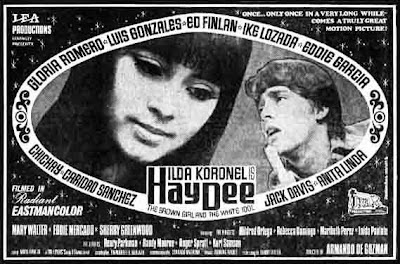
When she came into the showbiz scene via the movie “Haydee” in 1970, Hilda Koronel was just 13 years  old, but her performance in the film as the Filipino fan and her American boy band crush, as well as her refreshing beauty captured the fancy of Philippine fandom,

HAYDEE, with Ed Finlan, LEA Productions, 1970. Credit: Video48

The Angeles- born Susan Reid (b.17 Jan. 1957) , a prized discovery of LEA Productions,  had previously debuted in “Leslie” a year before. But if “Haydee” catapulted her to national fame, it was “Santiago” that earned her acting honors with a FAMAS supporting actress trophy.  Soon, she was making other critically acclaimed movies like “Stardoom”, “Tubog sa Ginto”, “Kung Mangarap ka’t Magising”, “Angela Markado”, “Tinimbang Ka Nguni’t Kulang”, “Maynila, Sa Kuko ng Liwanag”,  and “Insiang”—an iconic role that cause a sensation in Cannes. 

TUSSY LOTION with Vitamin A, Print Ad, 1974

Hilda was not only sought by producers and magazine editors, but also by advertising agencies, who squired her no end for her elegant beauty and influence. It is indeed surprising that she only appeared in a handful of ads, the most prominent being LUX Beauty Soap, where she appeared with an equally young Edu Manzano as her escort, in a commercial produced by J.Walter Thompson.

Her previous appearance had been in a “Tussy” skin lotion ad in 1974, and “Cashmilon” fashions (with Tirso Cruz III), in 1970, perhaps her first endorsement. She had always shied away from publicity, even as local media keeps wanting to pry on her private life, especially her relationships with actor Jay Ilagan and a string of others: Bambi del Castillo, Spanky Monserrat, and Dr. Victor Lopez. 


CASHMILON, with Tirso Cruz III, Print Ad. 1970

Hilda has even become more reclusive when she moved to the U.S. with Fil-Am husband Ralph Moore Jr. in 2000. She may have distanced herself away from the entertainment circuit, but her luminous beauty and rare talent will always be remembered and celebrated by her fans who first saw her on the silver screen 50 years ago. 

CREDITS:
Photo of "Haydee" movie ad, courtesy of Video 48 blogspot
wikipedia.com: Hilda Koronel


Saturday, June 11, 2022

376. THE NEW PHILIPPINE REPUBLIC, Inauguration Ads, 1946

COMPLIMENTS OF GREG FALLESGON ADVERTISING

On the occasion of the 124th anniversary of the PHILIPPINE INDEPENDENCE DAY first proclaimed on June 12, 1898, we bring to you a special selection of commemorative print ads from July 4, 1946--the day the country's independence day was formally inaugurated after the 2nd World War. These 76 year old advertisements, from a special 1946 newspaper supplement,  capture the joy and pride of a new republic, as it takes its place among the nations of the world. Long live the Philippines! 
 
FROM RENEE THORNTON COSMETICS

FROM SAN MIGUEL BREWERY

FROM LA ESTRELLA DEL NORTE

FROM PHIL. PRESS WIRELESS, INC.

FROM SISON GROUP OF BUSINESS

FROM GLO-CO HOLLYWOOD PRODUCTS

FROM CRISPULO ZAMORA SILVERSMITH

FROM LUIS ZAMORA ENGRAVERS

FROM CHINA BANKING CORP.

FROM PEDRO CRUZ JEWELRY STORE

FROM FAR EASTERN AIR TRANSPORT, INC.


Sunday, June 5, 2022

375. Great New Laundry Soap Discovery! PMC's OSO, 1957

As one knows Philippine Manufacturing Company (PMC) started as early as 1908, under the name Manila Refining Co. It capitalized on the rich coconut industry of the country, to give us edible products like “Purico”, an early vegetable oil-based shortening. When Procter and Gamble acquired it in 1935, the company beefed up its coconut oil-based product portfolio to include laundry detergent bars, with the introduction of PERLA  in 1949.

The next decade saw PMC expanding its detergent line. In 1951, it came up with dirt-fighting “Luto”, and in  1957, it launched OSO.

OSO was heralded as “a great new soap discovery”, with a promise that it “washes better than any other soap”—a bold superlative claim, at that time. It was a product of a “new process” that made the soap purer and brighter. Thus, OSO had a 3-way advantage: longer-lasting suds, greater economy, and more fragrant clothes.

 Subsequent ads positioned it as “the whitest soap, for the whitest wash”. Even with this, OSO did not last the 50s decade.  After all, P&G already had 3 detergent bars at that time, and the differentiation was not delineated at that time. The best performer was PERLA, and consumers have also began discovering that it was also ideal for white clothes, as it was not only effective, but gentle. OSO was eased out towards the end of the 50s decade; LUTO would also be dropped. PMC decided put its marketing resources behind PERLA, a move that proved to be wise, as the iconic soap bar continue to exist to this day.

Monday, May 30, 2022

374. OFF! INSECT REPELLENT, by SC Johnson, Print Ads 1962-1975

OFF! Insect Repellent Print Ad, 1962

S. C. Johnson (S. C. Johnson & Son, Inc.), previously known as S. C. Johnson Wax (and earlier on, Johnson Wax), is a global manufacturer of household cleaning supplies and other consumer chemicals based in Racine, Wisconsin.

WATCH THIS U.S.-PRODUCED OFF! TV AD STOCK FOOTAGE

Other than wax, one of the earliest S.C. Johnson products sold in the Philippines was OFF! Insect Repellent, first produced and sold in 1957. Just 5 years after, OFF! became available in the Philippines, in bottles and aerosol spray. Its active ingredient is N, N-Diethyl-meta-toluamide, known as DEET, which is the most common and safest  ingredient in insect repellents, of which S.C. Johnson is considered a pioneer.

OFF! "Your Invisible Mosquito Net", 1972

OFF! had the endorsement of the U.S. Department of Agriculture, calling it “the most effective product of its kind.  OFF! Insect Repellent was marketed via advertising and promotions, like during the H-Fever months that happened in 1975. (Slogan: “Your invisible mosquito net”.) It’s last advertising agency in the Philippines, was FCB. 

OFF! Insect Repellent continues to manufactured by the same company today, one of the more enduring brands of S.C. Johnson.

OFF! In 1960s liquid form and in the 1970s aerosol spray can.

SOURCE:youtube, OFF!Insect Repellent Commercial , https://www.youtube.com/watch?v=5WVxG4zZ_OQ, uploaded by FilmArchivesNYC, July 24, 2013.

Sunday, May 22, 2022

373. Helene Curtis SUAVE Hairdressing Crème and Lotion, Print Ads 1960-1969

SUAVE Print Ad, 1969, featuring Terry Aldeguer of the Aldeguer Sisters

Helene Curtis was a company formed from National Industries, which had originally produced personal care products, but which had to shift to making products for the war efforts. After World War II, National Industries resumed making personal care products and was renamed Helene Curtis, after the first names of partner Louis Stein's wife and son. 
The first products to come out from the Helene Curtis plant was SUAVE Hairdressing, in Crème and Lotion, which was launched for general retail sale, and proved to be a sales success. It went on to create more revolutionary products like hairsprays, with the brand name, Spraynet, spray-on deodorant Stopette, and a dandruff shampoo called Enden. 

Hairdresser Nomer Pabilonia for SUAVE. Model: Conchitina Sevilla 

But in the 1960s, Helene Curtis would eventually go back to build on the success of its SUAVE brand, introducing shampoos, creme rinses, and wave sets. As early as the 1960, Helene Curtis SUAVE was marketed in the Philippines, and was actively pushed with regular advertising campaigns. 

The earliest examples show SUAVE print ads featuring well-known fashion icons modeling the latest styles (“The Bob”, “The Bell”) created by leading hairdressers of the day, like Nomer Pabilonia and Moises Sia, who readily endorsed the product. 

Hairdresser Moises Sia for SUAVE, 1960 Print Ad

SUAVE had a great run in the Philippines and in the 1980s, it was repackaged in cost-efficient plastic with caps, as hair control products became more popular. Today, the SUAVE brand is owned by Unilever, and has expanded to include hair grooming essentials for men and women, like gels, shampoos, mousse, aerosol anti-frizz and other hair-control products.

Sunday, May 15, 2022

372. BALINTAWAK BEER, ca. 1937

People in pre-war Philippines would surely remember BALINTAWAK BEER, a beer brand that came to be, thanks to Japanese investors who pooled in funds to establish a beer factory in Polo, Bulacan. This was the Balintawak Beer Brewery, founded in 1937, which launched its BALINTAWAK Pilsener Beer to the local market, bottled in amber bottles similar to San Miguel’s, with paper labels.

BALINTAWAK BEER was supported with print and radio advertising, and early ads focused on the beer’s relaxing, comforting qualities that’s perfect for social entertaining.  The KZRM airwaves was filled with songs and music from featured performers like Alicia Garong, pianist Rafael Artigas, and even a  BBB Mystery Singer.

In 1938, BALINTAWAK BEER  added its ‘Black Beer’ version, the counterpart of san Miguel’s Cerveza Negra. Like San Miguel, BALINTAWAK BLACK BEER was positioned as the drink ideal for women for its health-giving attributes.

World War II put an end to the operations of Balintawak Beer Brewery, as the plant was taken over by the Japanese forces, along with San Miguel beer plant. BALINTAWAK BEER, however, continued to be available to Filipinos.

In the 1950s, San Miguel Corporation bought the Polo plant and converted BBB into their primary brewery for their world-renowned San Miguel Beer.


 Vintage Bottle collectors are always looking for BALINTAWAK BEER bottles today for their rarity, as many of their identifying paper labels have been worn away by time.

 SOURCES:

Graphic Magazines, 1937-1939 issues

Kasaysayan, Vol. VII.  "Prewar Pesos for Japanese Goods," Yu Jose, Lydia.