Thursday, August 12, 2021

337. 7-UP, “WHERE THERE’S ACTION” U.S.-Adapted Campaign, 1966-67


7-UP 'WHERE THERE'S ACTION', Campaign, Philippines (Top, 1966), U.S. (Bottom, 1965)

The 7-UP  “Where There’s Action” campaign  was launched in 1965, by J. Walter Thompson,  bannering the message that the drink has a “taste that’s fresh and frisky….with a quick-quenching action to make thirst quit!” The print ads featured young, active groups engaged in all kinds of fun, sporty and leisurely activities.

 LISTEN TO 7-UP'S 1965
'WHERE THERE'S ACTION' JINGLE:

In 1966, the U.S. campaign was adapted in the Philippines using local talents , but keeping the global design template including the typeface, copy, and visual vignettes. The Philippine version however, emphasize more on the bright, exhilarating feeling that comes with the refreshment that 7-UP brings in these action-packed social events.

7-UP PHILIPPINES, 'SKATING', PRINT, 1966

7-UP PHILIPPINES, 'JERKING', PRINT, 1966

7-UP PHILIPPINES, 'DRUMMING', PRINT, 1966

7-UP PHILIPPINES, 'TUG-OF-WAR', PRINT, 1966

“Where There’s Action” campaign was used until 1967, and the last few ads made use of American models possibly also provided for by the U.S. mother agency. The 7-UP campaign was later replaced by the world-fampus “UnCOLA” campaign that became a blockbuster success for many years.

7-UP AD FEATURING A FOREIGN TALENT, PRINT, 1967

SOURCES:

U.S. 7-Up Ads: www.ebay.com

7-Up “Where thre’s Action” jingle: https://www.youtube.com/watch?v=eUuHR5dlfV4

Tuesday, August 10, 2021

336. MINA ARAGON for CASHMERE BOUQUET, 1961

CASHMERE BOUQUET is a line of toiletry and personal care products with a long history that stretches back to the 19th century. It is a product of Colgate (later, Colgate-Palmolive)  which introduced the first milled perfumed toilet soap in 1872. The Palmolive Co. in the Philippines was set up in 1926 in a small Binondo office, becoming Colgate-Palmolive after merging with Colgate in 1928.

 As Colgate-Palmolive, the merged company launched Colgate Dental Cream, and CASHMERE BOUQUET products. The first products under this brand were all introduced in the mid 50s, that included CASHMERE BOUQUET Pomade, Beauty Soap and Talcum Powder.

 One of the earliest celebrity endorsers employed by CASHMERE BOUQUET was the young actress MINA ARAGON, who was contracted to appear in prints ads for CASHMERE BOUQUET Soap and Talcum Powder.

MINA ARAGON in CASHMERE BOUQUET SOAP AD, 1961

MINA ARAGON was a teen actress in the early 60s, with a hallowed showbiz pedigree. She was the daughter of Luis (Lou) Salvador Sr., the progeny of other celebrities like Lou Jr., Leroy Salvador, Philip Salvador, Alona Alegre, Ross Rival, among others. Mina was launched as “the discovery of the year” of People's Pictures Inc, in the 1961 Zaldy Zshornack starrer, “I Believe”.

 That same year, she was teamed up with rising superstar Fernando Poe Jr., in at least 5 movies: “Sakristan Mayor”, “Apollo Robles”,  “Hinahamon Kita”,  “Masikip ang Daigdig” (1962) and “Mandong Mandurukot” (1963). She would be partnered with a host of other leading men thereafter, from Romeo Vasquez, Bernard Bonnin and Bob Soler. But it was to another Poe that Mina eventually fell for and married in real life—Andy Poe, FPJ’s brother, but their relationship was short-lived.

MINA ARAGON in CASHMERE BOUQUET TALCUM POWDER AD, 1961

She would eventually marry Vicente del Rosario, who would go on to found the giant Philippine media and entertainment company, Viva Entertainment Inc. in 1981. Mina had a direct hand in the success if Sharon Cuneta and Vina Morales.Tragedy befell,MINA ARAGON when 6 people, including Mina's family members, died in an arson that  was started by Dolphy Jr. in 1981. She passed away in 1996.

 But way back in 1961, MINA ARAGON was at the cusp of national fame, with a stellar film career that had just started to peak, wanted by fans, producers, and advertisers alike—including the makers of CASHMERE BOUQUET, which she graciously, and effectively pushed as a commercial model on national print ads.

SOURCES:

Mina Aragon, geni,com: https://www.geni.com/people/Mina-Aragon/6000000015984865124

Mina Aragon, imdb, movie list

10 Most Shocking Showbz Crimes, on spot.ph: https://www.spot.ph/entertainment/44500/10-most-shocking-showbiz-crimes

Tuesday, August 3, 2021

335. Brand Stories: JULEP BEVERAGE SYRUP, 1964

FROM THE MAKERS OF OVALTINE---JULEP! Intro Ad, 1964

The fruit juice syrup that took the coutnry by storm was introduced in 1963, as JULEP Beverage Syrup, touted as coming from “the  makers of Ovaltine”, which by then was an established brand. Associated British Foods plc (ABF) was a leading British multinational food processing and retailing company that specialized in sugar products and ingredients. Through the years, its subsidiaries in the Philippines included Novartis, Wander AG and currently, ABF Group.

COOL RELAXATION WITH JULEP, 1964

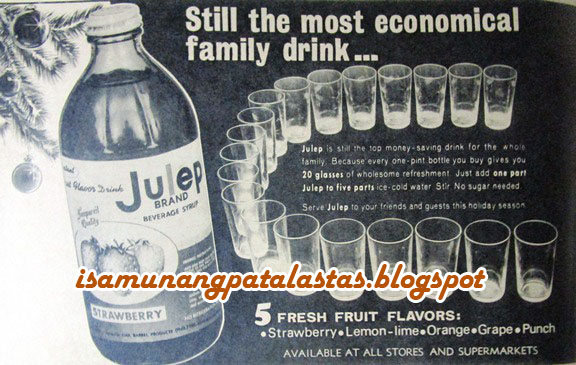
JULEP found a ready market in the Philippines as it was a pioneer liquid concentrate brand—long before Sunquick and Sunny Orange Drink. It was available in 5 refreshing flavors: Grape, Lemon-Lime, Orange, Punch and  Strawberry. All one had to do was add 1 part JULEP to 5 parts water, and you’re ready to enjoy its fruity goodness. One pint of JULEP makes from 20-22 glasses, so it was economical too.

SO REFRESHINGLY DELICIOUS--JULEP! 1967 Ad

The black and white launch ads of JULEP came out in 1964, and soon, Filipino consumers couldn’t get enough of the new fruit juice; never mind if it left colored stains on the mouth. The brand became the most popular juice drink in the Philippines, and the name JULEP became a byword. Its advertising became even more sophisticated with full-blown campaigns rolled out in 1967—all featuring photographic ads in color.

ZESTY, FLAVORFUL JULEP, 1969 Ad

ZESTY, ECONOMICAL JULEP, 1969 Ad

JULEP had a good run, driven primarily by its economical price, but by the late 60s and early 70s, there were newer brands that competed for attention. All of a sudden, JULEP was looked at as on old-fashioned brand, not “in” with the young set which was looking for more innovation and appealing flavors. Mothers, too, were more discerning, and were ready to invest more in better quality drinks.  Competitors like Sunquick, took to TV advertising with commercials featuring pop jingle, hipper-looking teens, in fun-filled vignettes. SUNKIST, on the other hand, was driven mainly by its made-in-America image, a tack that TANG would later adapt in its Philippine launch. It also didn’t help that the company that originally made JULEP underwent a series of mergers and acquisitions that led to the dropping of the brand in the product portfolio. In the 80s, Sunny Orange took over as the more popular orange brand in the mass market.

THE MOST ECONOMICAL FAMILY DRINK, 1966 Ad


Thursday, July 29, 2021

334. “Little Car on 2 Wheels”: VESPA SCOOTERS, 1964

VESPA SCOOTER, Philippine ad, 1964

VESPA SCOOTERS are considered prized classic scooters, what with their sleek, streamlined midcentury design. The Piaggo family of Italy started the business after World War II,  manufacturing their first vehicle in 1946 using spare aircraft parts from Benito Mussolini’s airplanes.

VESPA SCOOTER, Philippine ad, 1964

Piaggio & Co. Inc., the family company,  eventually ventured into scooters to boost mass transportation in the country, naming the line VESPA--Italian for ‘wasp’--as the unique handle bars and the roundish body reminded them of the insect. 

VESPA IN ROMAN HOLIDAY FILM, 1953
Photo: allposters.com

The new VESPA SCOOTER was such a hit in Europe and by 1956, 1 million VESPA units had been sold. In 1964, VESPA SCOOTERS made their first appearance in the Philippines when units wereimported by East Asiatic Co., Ltd. with business offices in Buendia Avenue, Makati. VESPA was distributed nationally by Olympia International Inc. with dealers in Baguio, Angeles, Bacolod, Cagayan de Oro, Zamboanga and Davao City.

VESPA PHILIPPINE DEALER

Italy’s “little car on two wheels” was perfect for Philippine roads, and rides smoothly with astonishing economy—45 kilometers to a meter. The iconic style icon—VESPA was featured being driven by Audrey Hepburn in her 1953 film, “Roman Holiday”---is still in production today—available through Vespa Philippines Motoitalia, along Ortigas in San Juan.


SOURCES:

History of the Vespa: https://vespapizzeria.com/history-of-the-vespa/

Vespa Philippines: https://www.vespa.com/ph_EN.html

Saturday, July 24, 2021

333. WHITE KING FLOUR AND MIXES, Republic Flour Mills, 1960S Ads

AN EARLY WHITE KING FLOUR AD, check out the king mascot, 1962

Republic Flour Mills (now known as RFM Corporation), was the country’s first flour mill, established all the way back in August 16, 1957—even though wheat wasn;t really grown locally. It introduced Filipinos to a brand of all-purpose flour named WHITE KING, which, through appealing advertising and strong sales promotions, became very popular in the Philippines. By 1962, WHITE KING was an established flour brand, bolstered by a new Cake Flour line.

WHITE KING OMNIBUS AD, 1964

But much as Filipinos craved for cakes, the baked confections were just too inconvenient to common families who only had wood-fed or gas stoves in their kitchens; even with cake flour mixes, they were just too cumbersome to create. Thus, things took a turn for the better with the introduction of the WHITE KING Hotcake, Waffle,  Doughnut  and Bibingka Mixes—all-time Filipino favorites that didn’t require baking, frosting, and much fuss.

WHITE KING HOTCAKE MIX & DOUGHNUT MIX AD, 1962

WHITE KING Hotcake and Waffle Mix became the company’s bestseller through the years, and today, it continues to be produced by RFM,  in the Creamy Classic and Complete varieties (just add one egg, maple syrup comes free!). The original WHITE KING All-Purpose Flour, Bibingka and Chocolate Cake are still very much around too, but Brownies, Crinkles, and Puto are also now part of the current offerings of  this  heritage brand that has been around for over 60 years. 

 .

Sunday, July 18, 2021

332. ISUAN SOFT DRINKS, of ISUAN Inc. 1935-1937

ISUAN SOFTDRINKS PRINT AD, 1937

One of the most popular line of softdrinks of the 1930s Philippines is the ISUAN brand (pronounced E-Swan), produced by ISUAN, Inc. The softdrinks were made from the famous ISUAN Mineral Water, sourced and bottled at Deep Hot Springs, Km. 66, Los Baños, Laguna. Aside from the all-purpose mixer , Soda Water, the flavors include Tru-Orange and Ginger Ale. Another sub-brand Dixo-Cola was added to the ISUAN line around 1935.

FORMULA FOR REFRESHMENT, ISUAN, 1935

ISUAN GINGER ALE & TRU-ORANGE, 1935

WHISKY-ISUAN, 1930s

DIXO-COLA, by ISUAN, 1930s


Tuesday, July 13, 2021

331. Just Add Ice and Milk! JUDY’S HALO-HALO IN CANS, 1963

JUDY'S HALO-HALO, print ad 1963

 Now here’s a product innovation that’s theoretically brilliant—a canned halo-halo! Imagine, your favorite refreshing Filipino dessert, yours to enjoy straight from the can—just add shaved ice and milk!  JUDY’S HALO-HALO, which came out in the early 1960s, packed a halo-halo mix of sweet beans, preserved kamote, banana, langka bits and sakobi (tapioca pearls) in a tin can. By adding shaved ice, evaporated milk, and a scoop of leche flan or ube haleya, you can easily make your own halo-halo creation. But the idea, however clever, did not take off. It’s probably because halo-halo was readily available in any neighborhood, and can be made using fresher, more natural ingredients—no preservatives needed.  At a cheaper price too, since in those days, you had the option of bringing your own glass. JUDY’S HALO-HALO even had the budget to advertise in national weekly magazine, using strip ads, but no amount of marketing push could help the product.  You could say that the reception to JUDY’s HALO-HALO was cold, its sale, well, frozen.