Wednesday, June 24, 2020

284. Served in the Philippines’ Finest Restaurants: CHASE & SANBORN COFFEE, Print Ad Series, 1956

CHASE & SANBORN, "Exclusively Served in the Finest Restaurants", Print Series, 1956

One of the early American coffee roasting companies was started in 1862 in Boston by Caleb Chase and James Solomon Sanborn. Initially engaged in tea and coffee importation, the company soon launched an American coffee brand bearing their name—CHASE & SANBORN COFFEE, the first coffee company to pack and ship roasted coffee in sealed tins.

CHASE & SANBORN was available in the Philippines beginning in the mid1930s. Imported all the way from the U.S.A., CHASE & SANBORN became a pre-war coffee favorite, advertised on leading magazines of the Commonwealth er and supported by msales gimmicks (premiums like how-to dance booklets were given away). The classic brnd was actively advertised through the 50s and 60s decade.

In 1956, CHASE & SANBORN came up with a pint ad series touting the brand as the exclusive coffee choice of the country’s finest restaurants and coffee shops. The strategic alliance with the renown establishments boosted the quality image of the coffee  brand.


The Philippines’ premier MANILA HOTEL was built in 1909  and was opened on the commemoration of American Independence on July 4, 1912. The historic hotel was the home of Gen. Douglas Macarthur and his family when he served as a military adviser to Pres. Manuel Quezon in 1935.  For “the finest hotel in the Far East”, only CHASE & SANBORN will do.


The well-air conditioned  NEW EUROPE RESTAURANT,  was a favorite dining olacein Manila, especially with the Ermita crowd. Located along Isaac Peral (now Herran  St.), “the home of good food”, was put up by Heinz Wielke.


 Known as “the grand old dame of Baguio”, PINES HOTEL was one of the earliest structures in the city, erected in 1909 on Gov. Pack Rd. It was destroyed during the War, but was rebuilt on Luneta Hill with the same name. The Pines Lobby was a popular coffee place, plus the Bontoc Bar, in the 1950s. It was gutted by fire in 1984.


Time was when pharmacies also had coffee shops appended to their business, and Botica Boie was a large drugstore chain that also operated BOIE COFFEE SHOP, along Escolta. While young people got their ice cream soda from the shop, the oldies delighted in their cups of CHASE & SANBORN COFFEE.

As the ad copy goes: “the finest restaurants the world over serve CHASE & SANBORN”.  But---you’ll enjoy its rich aroma and delicious flavor—at home too!”


Thursday, June 18, 2020

283. Brand Stories: VASELINE HAIR TONIC, 1960-1965


One of the best-selling hair tonics in the world is VASELINE HAIR TONIC for Men, manufactured by Chesebrough Manufacturing Co. The product had its start in 1859, when Robert Chesebrough visited Penssylvania oil fields and saw residue called “rod wax” that accumulated on oil rigs. Workers used the waxy substance to heal cuts and wounds. Chesebrough managed to extract petroleum jelly from the rod wax and created a medical product out of it which he called VASELINE.


The brand name was coined from the German word for water “wasser” and the Greek word “elaion” or olive oil.  From VASELINE Jelly, the company began expanding to personal line products using the same ingredient as base. In the 1920s, Chesebrough launched its VASELINE HAIR TONIC, a liquid hair groomer.  It was heavily promoted in print ads on the popular Life Magazine  from the late 1920s-1940s,  promising to ‘stimulate circulation, helped to relieve excessive dryness, and keep hir “manageable and handsome”.


In 1955, Pond’s and the Chesebrough Manufacturing Company merged to become Chesebrough-Pond’s.  By then, a Philippine affiliate company had been set up, marketing products such as Pond’s and Angel Face. It ws in 1960 that  Chesebrough-Ponds introduced VASELINE HAIR TONIC in the Philippines through a series of print ad. At that time GLO-CO, a local cosmetic company, dominated the men’s hair grooming market with its  Glo-Co Hair Tonix, endorsed by movies stars as early as the 50s.


To ensure wider usage, VASELINE HAIR TONIC was positioned as a unisex hair grooming product—good for both men and women.  Its quarter-page ads featured young men and women in various social situations. In 1967, rising young star of sampaguita Pictures--Lito Legaspi—endorsed the brand as its commercial model.


Vaseline was made by the Chesebrough Manufacturing Company until the company was purchased by Unilever in 1987.The product VASELINE HAIR TONIC with scalp Conditioner is still available today.

Friday, June 12, 2020

282. Brand Stories: GRASSLAND PURE COW’S MILK, 1962


 GRASSLAND FARMS INC., a 100% Filipino dairy enterprise, was founded in Nov. 1961 and began operations in June 1962. The promising modern milk processing plant gets its supply of raw milk from its own dairy farm of over 1000 cows.

The  plant was just operating 25% of its capacity with the bulk of the farm’s raw milk sold to disitributors of pasteurized milk. The lead products was GRASSLAND PURE COW’S MILK, which was processed from the raw product by heating the milk to a higher temperature than the pasteurised product killing all bacteria.


GRASSLAND PURE COW’S MILK was packaged in softdrink bottles, with metal caps and marketed by its offices with address at 1202 E. De los Santos Avenue. By 1962, the company was putting out print ads of GRASSLAND PURE COW’S MILK –“unequalled in food values because it’s rich in body-building proteins, vitamins and minerals”. And, to drive home the point that it’s good for young and old alike, the ads featured teens, oldies, kids and young adults.


In 1966, GRASSLAND FARMS INC, sounded a call for other companies interested in a joint venture arrangement primarily to provide working capital---  U.S. investors preferred. There is no information if such a co-op arrangement happened, but one thing for certain, GRASSLAND PURE COW’S MILK disappeared from supermarket shelves, even before the new 70s decade rolled in.

SOURCE:
International Commerce, A U.S. Dept.of Comerce weekly. 4 Jul. 1966

Friday, June 5, 2020

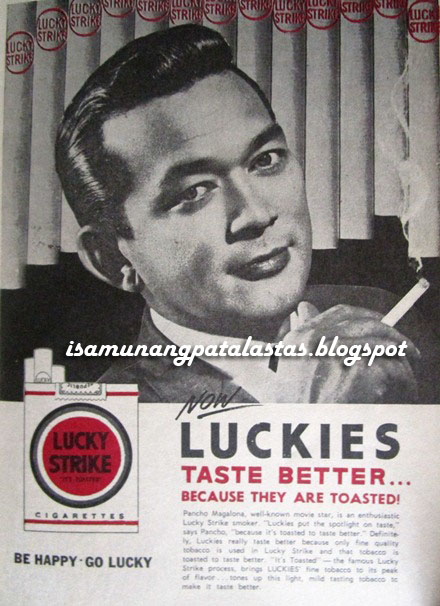
281. Celebrity Endorsers: THE MAGALONA FAMILY, various ads 1953-1980s


The MAGALONAS are a very popular showbiz family,  thanks largely to the love team of reel-and-real life sweethearts PANCHO MAGALONA and TITA DURAN, who captivated Filipino movie fans with their many hit movies.
 
PANCHO MAGALONA, FOR GLO-CO TONIX, 1953


PANCHO MAGALONA (Enrique Gayoso Magalona Jr., b. 22 Jan. 1923/d. Apr. 1998), was born with a silver spoon in his mouth, the son of former senator Enrique Magalona Sr. of Negros Occidental. His sister, Susan Magalona (who married Joaquin Elizalde) was a legendary beauty in her time. He began his film career in 1947, when he was cast in “Prima Donna”, backed by a recommendation from Dna. Aurora Quezon, no less. The film was headlined by  opera singer Jovita Fuentes
 
PANCHO MAGALONA FOR SAN MIGUEL BEER, 1957
His dashing mestizo looks sent many fans swooning, but his star shone brighter when, the next year, he was teamed up with a former child actress TITA DURAN. Their formidable love team was one of the most well-loved in showbiz, beginning in 1948, with the movie “Dahil Sa Iyo”.

PANCHO MAGALONA FOR LUCKY STRIKE CIGARETTES, 1965

The apex of  Pancho’s career was  a FAMAS Best Actor trophy for his 1958 film, “Hanggang sa Dulo ng Daigdig”. He even went on to bag Hollywood roles lin the Jeff Chandler starrer “Merrills’ Marauders” and “The Hook”, with no less than Kirk Douglas. His iconic role, however, was that of Simon, in the 1962 Jose Rizal movie,”El Filbusterismo”.
 
TITA DURAN FOR MENNEN BABY POWDER, 1959
Pancho’s other half, TITA DURAN (aka Tita Durango, b. 14 Jun,1929/ d. 2 Dec. 1991) started as a child actress,who as an 8-year old, was cast as an abandoned child in the  1936 melodrama, “ Awit ng mga Ulila”. Sampaguita Pictures signed her up in 1938, and put her in another tear-jerker film, “Inang Mahal”. The war intervened but she returned as a young woman to her former studio, Sampaguita Pictures, to support Carmen Rosales in “Gerilyera”, which led to light musical roles—and a durable partnership with PANCHO MAGALONA.
 
TITA DURAN FOR SCOTT'S EMULSION, 1970
The tandem were acclaimed for romance-musicals like “Always, Kay Ganda Mo” (1949), “Umaga Na Giliw,” “Kay Ganda Mo Neneng,” (1950)  “Sa Isang Sulyap Mo Tita,” and “Vod-A-Vil ”(1953) and  Sa Isang Halik Mo, Pancho” (1954). So wildly popular was their love team that PANCHO and TITA were sought after as commercial models, even  after they had married and had started a family. Their children would include Francis, Susan, Vicky, Victor, Henry, Popeye , Malot, Maricar and Martin.  
WATCH FRANCIS MAGALONA
"Royal Tru Orange" TVC "Ito Ang Gusto Ko"here:

The MAGALONA legacy was continued by son FRANCIS MAGALONA (b. 4 Oct. 1964/6 Mar. 2009), who, as Francis M,  is recognized as the best and the most successful all-time Filipino rapper. He had monster hit songs like “Mga Kababayan Ko”, “Kaleidoscope World”, ”3 Stars and a Sun”,  and “Ito ang Gusto Ko”, which became the track of his well-remembered ROYAL TRU-ORANGE Commercials.  

WATCH FRANCIS MAGALONA RTO TVC HERE: 

On March 18, 2009, FRANCIS MAGALONA was recognized by the Philippine government with a posthumous Presidential Medal of Merit award, "for his musical and artistic brilliance, his deep faith in the Filipino and his sense of national pride that continue to inspire us."

SOURCES:
Pancho Magalona, Tita Duran, Francis Magalona:
Videos:
Francis Magalona Royal Tru Orange 2 Commercial Royal https://www.youtube.com/watch?v=GHi6Zg_io6g, uploaded by
Francis Magalona, 22 May 2016
Francis Magalona RTO Commercial, https://www.youtube.com/watch?v=tipPV_45gkw, uploaded by ninjacool 69, 3 Mar. 2011

Monday, May 25, 2020

280. Need A Haircut? Get the TRIM JIM Cut, by Union Carbide, 1971


In this age of the great COVIC pandemic, the world desperately needs a cure, a vaccine to put our fears to rest—and end this agonizing, extended community quarantine, that  continues to leave us isolated, hungry, pennyless—and in need of haircuts. Back in the early 1970s though, when long hair ruled supreme, there was a handy plastic contraption that one could carry in one’s jeans' pocket for quickly trimming and styling hair—without going to the barber shop.


In 1971, UNION CARBIDE introduced the TRIM JIM Safety Haircutter. It is a handy two-bladed do-it-yourseld plastic  hair trimmer that you use to trim your locks, simply by running the TRIM JIM through your hair, much like comb.

You can cut your hair longish—to achieve the HARE KRISHNA Look. Or thin it to get that EXECUTIVE Look. 


The TRIM JIM was so convenient when launched in the Martial Law years as long-haired boys opted to cut their own hair personally, than have it cut by scissors-wielding military people who were then hot on the trails of these long-haired nonconformists. ROTC cadets, too, brought a TRIM JIM along, in case their crew cut was still deemed to lush and thick.  A quick TRIM JIM cut will do it—for just 4 pesos!

Despite its much-heralded convenience, the results of using a TRIM JIM were unpredictable.  Unsteady hand pressure can cause uneven cutting. Sometimes, a single run of TRIM JIM with new, sharp blades can result in instant bald patches.Contouring hair like sideburns was difficult.

But then again, it’s true what TRIM JIM claims. The TRIM JIM cut is your own personal signature-- you get truly a different breed of cut!

Sunday, May 17, 2020

279. Draw-it-Yourself DUTCH BABY PRINT ADS, 1967-68


DUTCH BABY is a brand of canned milk that was manufactured and marketed in the Philippines as early as 1953. It was made by Milk Industries in Markina, reputedly under the supervision of Dutch scientists. By 1965, the company was known as Marikina Dairy Industries, Inc., and was allied with the Australian Dairy Produce board of Melbourne, Victoria.


DUTCH BABY EVAPORATED FILLED MILK, was the lead brand, and was extensively advertised in newspapers and magazines. It was one of the leading milk brands in the country, along with Darigold and Liberty.  As its marketing became more sophisticated, the company sought the help of J. Walter Thompson ad agency to help develop their advertising campaigns.


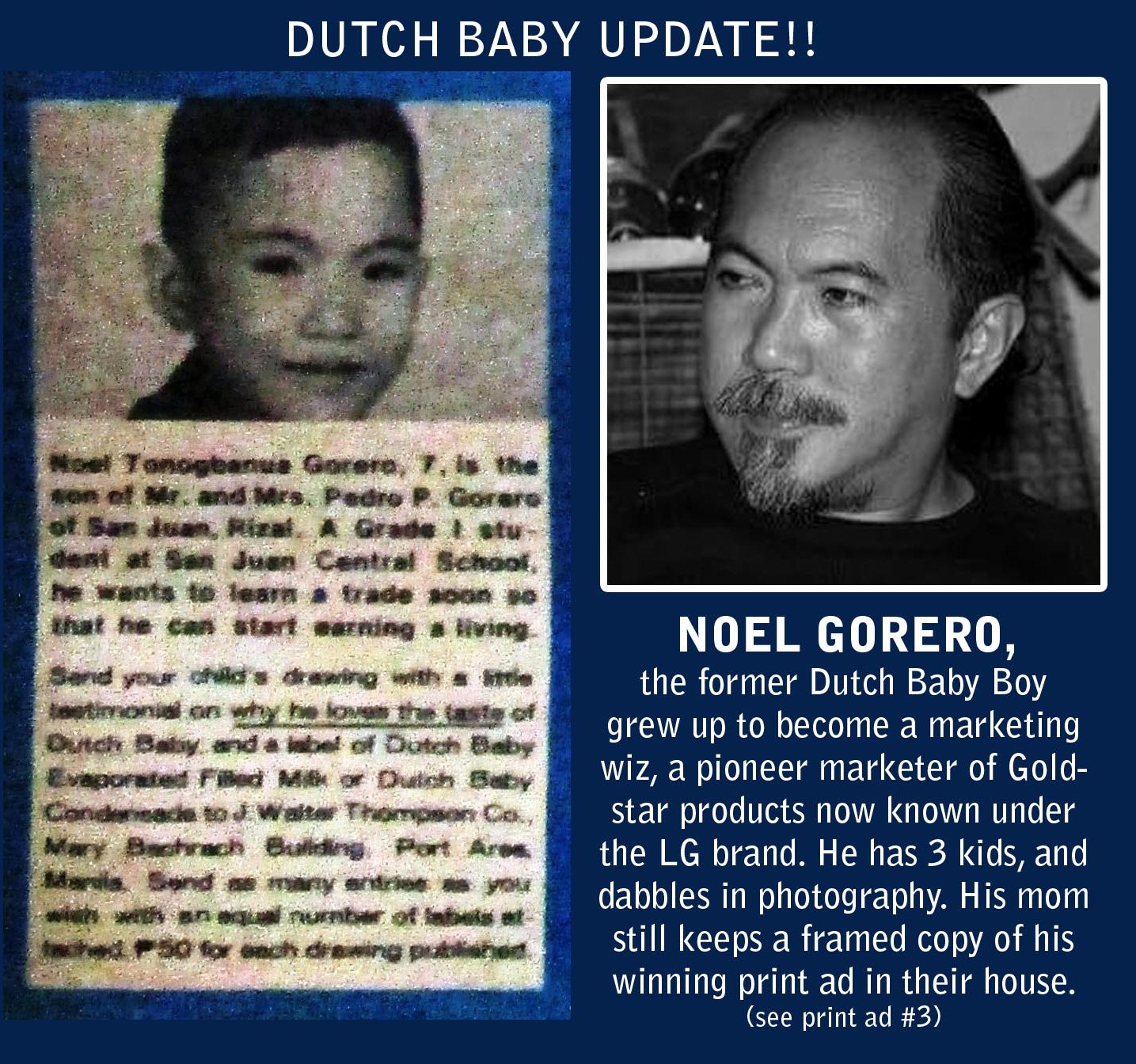
In 1967, J. Walter Thompson came out with one of the first content-contributed print ad series. It solicited the help of parents and children with a request to “Send your child’s drawing and a little testimonial on why he loves the taste of DUTCH BABY along with a label of DUTCH BABY Evaporated Filled Milk or DUTCH BABY Condensada to J. Walter Thompson, Mary Bachrach Bldg., Port Area, Manila”.


There was a cash prize of  50 Pesos for each drawing that was selected and published. Eventually, 3 DUTCH BABY ads were released, featuring the winning art works of 7-year old Noel Gorero (San Juan Central School), Michelle de Leon (St. Theresa’s College) and 11 year old Rommel Simpliciano (Manila High School) .

DUTCH BABY was available in the Philippines until the 70s, until it disappeared altogether . The brand name is now held by a Malaysian milk company, until1983, when milk products were renamed Dutch Lady.


Friday, May 8, 2020

278. Creative Guild’s 1986 Print Ad of the Year, P&G Phils., IVORY “Purity”

IVORY "PURITY" PRINT AD,  1986 Creative Guild Print Ad of the Year

ISA MUNANG PATALASTAS CONTINUES  ITS  TRIBUTE TO MR. RAMON R. JIMENEZ JR. (14 Jul. 1955/d. 27 Apr. 2020),, or simply MONJ to his colleagues, whose passing at the age of 64 is mourned the Philippine advertising industry that he inspired. After his illustrious career, he was named as the Secretary of the Department of Tourism, promoting the country via his well-received and hugely successful campaign “It’s More Fun in the Philippines” . Before he left Ace-Saatchi & Saatchi in 1988 to join wife Abby in their agency, Jimenez &Partners, MonJ was a VP-Creative and Executive Creative Director at Ace-Saatchi & Saatchi. One of his blue chip P&G accounts was IVORY Soap. Here is the story behind the print ad he helped create with his concept team, and which went on to bag the 1986 Creative Guild of the Philippines Print Ad of the Year.


**********
In 1986, clients and agencies wth a prevailing fear of white space were thrown off their swivel chairs by what appeared (or, in this case, didn’t appear) in several major newspapers. The full page was prited in special white paper and bore the headline, “You are looking at IVORY PURITY”. The text was printed, in an appropriately delicate  type, and the visual was simply a blank space framed by thin black border.

Ivory Phil. Ad, 1930s
The ad, “Purity”, was Ace Compton’s second winner, and was made possible by the fact that “ we were feeling a lot braver,” says Jimmy Santago. The client was global manufacturing giant Procter & Gamble, a Compton client for some 38 years  at the time the revolutionary ad was run, and this was the company’s third attempt at launching IVORY SOAP. “After two failures, it was no longer that sensitive a product.” Recalls Santiago. “The market was tired of it.” Santiago credits the brilliance of "repositioning” with reviving public interest in IVORY and taking its Philippine sales figures to unprecedented new heights.

The first two times it was launched , IVORY had been marketetd first as a soap for teenagers, and then as a family bar. The provincial teen markets, accustomed to heavily perfumed toiletries, also didn’t take too well to IVORY’s non-existent scent. Plus, the agency had to reckon with Filipnos’ completely different—and for the product, potentially damaging –-concept of “purity” at that time. “Pure was understood to be harsh, or concentrated, like a detergent,” Santiago recalls. The description was giving everybody the wrong idea.”

The time came to launch IVORY anew as a baby soap and an exceptionally pure product. The creative team was likewise in a fix about presenting a baby soap wthout unleashing the babes. Baby-filled ads were already the specialty of main competitor Teneder Care—“and we certainly  didn’t want Tender Care to sell any more soap!”Santiago says.

All of Compton’s creative teams were thus invted to pitch ideas for the xciting new projects, and art directors instinctively began by doodling babies—until Santiago declared it was time to leave the babies to someone else. He suggested a blank piece of paper, whiter than standard ash-colored newsprint, whose dirty color simply wouldn’t get the message across. Art director Melvin Mangada, then a fresh college graduate, framed the page n the simple black border, and writer Isabel Gamboa provded the straightforward copy highlighted by the brand logo. “The PUREST SOAP there is,” the copy reads, key words were capitalized for effect, and readers looking down at the white expanse couldn’t help but agree that, yes, this was as spotless as you could possibly get.

BACK TO BABIES. Ivory Ad, late 1986
The ad was a complete surprise. It broke several rules, not the least of whch was the tried and tested procedure of sung a baby to sell a baby product. The absence of a cute face seemed like a sure step towards marketing disaster. Also, client Procter & Gamble was an advertiser traditionally averse to wasting space or departing from bestselling formulas. “Cases like these are exceptions,” Santiago says, because you’re out there to jolt the market. Procter & Gamble’s  General Manager was pleasantly jolted himself, enough to call the ad “brilliant” and refreshingly “discontinuous”.After a time, however, client “got worried,” Santiago recalls, and eventually succumbed to convention by running more baby ads. “But after ;etting us come up wth the ad we wanted, it was alright,” Santiago laughs—especially after “Purity” won a Clio citation.

CREDITS:
AGENCY: Acre Compton Advertising, Inc.
ADVERTISER: Procter & Gamble, Philippines
PRODUCT: Ivory Soap
CREATIVE DIRECTOR: Mon Jimenez Jr.
COPYWRITER: Isabel Gamboa
ART DIRECTOR: Malvin Mangada