Sunday, February 4, 2018

149. Boxers or Briefs?: MEN’S UNDERWEAR ADS, 1950s-1970s.


Before BENCH underwear introduced the Filipino males to skimpy underwear fit for cavorting on the fashion runway, our ancestors wore loin clothes or g-string to cover their modesty, over 7,000 years ago.  In fact we have local terms for those early undies—“bahag” in Pilipino,  “pinang” in Kapampangan, “kuval” in Ibaloy, “wanes” in Bontoc, and “ba-ag” in Kalinga.

As Filipinos were already wearing shorts before the Spaniards arrived , they took to wearing the Western ‘calzonsillos’ --drawstring shorts-- which were often hand-sewn. These evolved into buttoned-up,  commercially-produced white drawers, with opening in front. They were to become  staple underwear,  found in every man’s aparador from the pre-war American-occupied Philippines all the way through the 60s.

Modern briefs were introduced only in 1935, sold first by Cooper’s Inc. in Chicago. They were the invention of hosiery designer, Arthur Kneibler, who was inspired after seeing a leg-less male swimsuit. He made a fitted underwear, with an overlapping Y-front fly—and thus the Jockey shorts was born.

Boxer shorts in the U.S. found favor only after the war, adapted from pugilist’s shorts that came with elastic waistband introduced by Everlast in 1925 (Pinoys would take to them only in the '90s). Meanwhile, local Chinese undershirt and pants manufacturers cashed in on the growing demand for modern underwear that provided support and style, by branching out into underwear. Classic briefs were made of cotton, but in the 1970s, nylon briefs came into vogue.

On this page are early Philippine ads that show the evolution of the modern briefs and shorts over 3 decades.


DE LUXE STETSON SHORTS (1955,1957). “Once Tried, Always Used”. LEFT, Stetson Shirt and Pants factory was a leading manufacturer of shorts, pants and later, briefs, in the 1950s.  The  popular brand was available at all leading bazaars and department stores and it regularly advertised in major dailies, like this magazine ad, 1955. RIGHT. De Luxe Stetson Shorts, 1958.


YANKEE SHORTS (1955). “The Perfect Cut”, Shift to Tankee Shorts yourself, and feel real fine! A generic pair of white, snap-buttoned shorts popular during the post-war era, 1955.


HANFORD BRIEFS (1957). The brand HANFORD began in 1954, in the business district of Juan Luna, started by the Te family. HANFORD has become a well-loved tradition that has been passed from one generation to the next an continues to operate to this day. Currently, its signature model is Mikhail Daza who appears in their advertising, a far cry from this illustrated ad from 1957.


GUARD BRIEFS (1961). This “comfort brief” has all the elements of a modern brief—elastic waistband supported by 20 bands of rubber;  fine, duraknit fabric that will not shrink, and  a snug fit that will not chafe inner thighs. The manufacturer is not named. 1961.


LEFT: DERBY MEN’S BRIEFS (1961). DERBY is cut along the body line to allow for freedom of movement and a conforming pouch for gentle, ample support. Uncle Sam Associated manufactured this underwear, along with undershirts. RIGHT: MAYFLOWER (1961).A popular shirts that is the only one in  the market with a bar-tack reinforcement to prevent tear on the crotch area,


CRISPA BRIEFS (1963). Named after the department store chain & textile company owned by the Floro Family, led by Valeriano “Danny” Floro in 1956. The fabrics are ‘redmanized’, a process which pre-shrinks them, so the products are guaranteed to stay snug and fit. One of the most successful garments factory in the 60s thru the 80s, CRISPA even fielded a basketball team (‘Crispa Redmanizers’) in the games Philippine Basketbal Association (PBA) and won 13 championships. 1963.


VERTEX BRIEFS (1963). One of the earliest printed bikini briefs (without a front opening), is Vertex Briefs, that is made from cool, absorbent fabric yarn.


LEFT: WALKER (1963). WALKER brand was distributed nationally by Sehwani Marketing Corp. in Mandaluyong. It became a market leader in shirt and briefs manufacturing in the 60s decade. It s Gold Line briefs featured innovations like the superior elastic Lactron 37 and Permalex leg openings to ensure no irritation. RIGHT: DMC (1971). DMC was one of the first to introduce lightweight, nylon briefs in the market.


WARREN BRIEFS (1971). WARREN BRIEFS popularized the use of 100% nylon in underwear, which were lighter, softer, and easier-to-dry than cotton. The only problem was that they felt hotter, despite being thin,  and absorbed less. Thus, WARREN also had cotton, terry-towel and de-hilo briefs. WARREN also introduced the first unisex briefs in the market. It reached its peak in the mid 1980s, with full color advertising on TV and print.


MONSIEUR NYLON BRIEFS (1973). MONSIEUR was another briefs brand that jumped into the nylon briefs bandwagon. It enjoyed a measure of success, as it was looked at as a premium underwear, right down to its innovative cylindrical packaging.


FALCON BRIEFS (1975). A product of Veindra Garments Industries, Falcon Briefs was a short-lived brand in the mid 1970s, but the company still exists to this day but as a textile merchant firm.


LEFT: MONTAGUT (1975). MONTAGUT is a clothing company with origins in France, which, in 1925 sold lingerie and silk stockings. In the 60s, Montagut expanded to include clothing and polo shirts manufactured with Fil Lumière which became international brands. Its Philippine partner, French Fashion Philippines, Inc., launched the premium MONTAGUT brand of classic and fashion briefs, which featured a variety of prints. RIGHT: PURITAN (1978). PURITAN Quality Mens Underwear is manufactured and exclusively distributed in the Philippines by General Garments Corporation. Launched in the Philippines over 40 years ago, it is currently one of the leading brands in the market, with 3  main product categories: Briefs, T-shirts and Undershirts.

Thursday, January 25, 2018

148. Brand Stories: LIWAYWAY GAWGAW, 1948

LIWAYWAY GAWGAW ANG GAMITIN. The classic package of the  oldest and
leading cornstarch brand in the country, Source: www.pictame.com

One of the most successful Filipino brand that is still in existence today is a cornstarch product called LIWAYWAY GAWGAW. It found favor in Filipino homes not just for cooking, but also for keeping clothes in shape, and giving them that clean, crisp look while the garment is pressed.

The Chinese-Filipino couple, Chan Lib and See Ying, are credited with launching LIWAYWAY GAWGAW to the Philippine market way back in 1948. They actually began bulk-buying cornstarch from wholesale markets, and re-packaged these in their Pasay home, in consumer-size paper packs for resale and distribution to sari-sari stores.

They gave it the brand name—“LIWAYWAY”—which was in keeping with using native brand names as a wave of Filipino nationalism swept post-war Philippines

LIWAYWAY means “dawn”, an appropriate name that presaged the future of a newly independent country, free at last from American rule. Even the package graphics reflected this hopeful optimism. It carried simple, comics-like illustration (sunrise behind mountains with swaying coconut trees on the front, a Filipina in native dress  pressing clothes at the back), the package copy  was composed in pure Pilipino, almost lyrical in style: "Sa minsang gamit ay di ninyo malilimot ang linis, puti at puro na pinanagutan namin" (at first use, you will not forget the clean, the whiteness and purity that we are liable for). Even the instructions for use were written  Pilipino, with words rarely use today: "Ginagawang maaluan at mabilis ang pagplantsa ng damit", 

LIWAYWAY GAWGAW was distributed all over the city in sari-sari stores and became an instant hit with Filipino housewives. The practice of treating fabrics with starch—“almirol”—was still popular then.

Women still wore baro’t saya which had sleeves and panuelos that required starching so they stay straight when worn.  On the other hand, menfolk still donned white Americana cerrada with white pants that had to look crisply white all day long.

Most students and young professionals too, too, wore white shirts to school or to their offices  (polo shirts for students, U.S. trubenized shirts for male office workers) , necessitating the use of ‘gawgaw” to give fabrics a clean finish, free from creases and wrinkles the whole day. LIWAYWAY GAWGAW, when applied to fabrics delivered unsurpassed results, to the great satisfaction of Filipino homemakers.

LISTEN TO "LIWAYWAY GAWGAW' 
RADIO JINGLE HERE:

No wonder, LIWAYWAY GAWGAW became an established Philippine brand, especially when it was promoted in the 60s and 70s using a highly memorable radio jingle, now an icon of our times. The success of the brand enabled the Chinese-Flipino couple to venture into other commodities—from candles, snack goods, coffee to hair products.  Today, their humble business has grown into an Asian empire, thanks to LIWAYWAY GAWGAW, and to the efforts of their visionary son, BENCH founder, Mr. Ben Chan.

SOURCES:
Liwayway Gawgaw (radio ad and jingle with photos), uploaded by Oishi Philippines, March 18, 2012, https://www.youtube.com/watch?v=Z-d_Vg2gsjY
Photo of Liwayway gawgaw: FASHIONABLE FILIPINAS: An Evolution of the Philippine Dress in Photographs, 1860-1960, by Gino Gnzales and Mark Lewis Higgins,
Liwayway Gawgaw product packs, front & back: https://makadto.com/tag/liwayway-gawgaw/
http://www.pictame.com/tag/LiwaywayGawgawAngGamitin

Friday, January 19, 2018

147. MISS CALTEX 1962-1970: A Corporate Beauty-Personality Contest of Caltex Philippines

MISS CALTEX was one of the most successful corporate event mounted by Caltex, producing 
winners who were all acclaimed for their beauty, personality and achievements. This 1963 batch 
of finalists include the eventual winner, Elsa Payumo,

One of the most prestigious and successful corporate events of the ‘60s decade is the search for MISS CALTEX PHILIPPINES, the brand ambassador of one of the leading oil and gas companies of the Philippines. It was designed primarily to promote Caltex Philippines and make it more accessible and familiar with the general public, by giving the company a beautiful face, and an amiable, articulate voice.

Running for eight long years, the MISS CALTEX quest was looked at as among the prestigious beauty searches in the country, known for attracting ladies of good standing in society, student achievers, career professionals and daughters of de buena familia.

Eligible to join are single women over 21 years of age,  5’2” or more, Filipino citizens with at least 2 years of college education, and of upstanding character. They should also not be related to any Caltex dealer, and free to travel and participate in all Caltex-sponsored activities.

The premium image of the contest was also due to its array of fabulous prizes, which includes foreign and local trips aboard American President Lines,  and via intrenail airlines like Air France, and Thai Airways. Semi-finalists were flown in free, courtesy of Philippine Airlines.

Cash prizes were much bigger than other pageants, for the winners also received savings accounts from Philippine Banking Corp.  For example, the first MISS CALTEX winner romped off with a cash price of Php 5,000 in 1962, a tidy sum at that time. The finalists were given free wardrobe, a monthly allowance of Php 500, travel insurance, appliances and jewelry pieces.

1965 MISS CALTEX SEARCH AD,
The Coronation Night was televised from the ABS Studios along Dewy Boulevard, and later at Makati’s Rizal Theater was conducted with class,  pageantry and with musical extravaganza. The winner was determined by  public voting through the use of newspaper coupons—which pre-dated today’s audience text voting. The last two editions had a distinguished panel of judges which picked the winner. It was no wonder then that MISS CALTEX rivaled the mainstream pageants of their time, including the premiere Bb. Pilipinas Pageant that began in 1964.
 
FIRST MISS CALTEX 1962, Mila Amunategui,
The very first MISS CALTEX 1962 search yielded 5 finalists: Esther Zuluaga, Mila Amunategui, Tessie Lizaso, Shirley Cuyugan and Maggie dela Riva. First Lady Luz Magsaysay crowned the eventual winner-Mila Amunategui (now Abad, she would have a long career as a top Philippine Airlines executive).
 
1963 MISS CALTEX, Elsa Payumo, center.
Elsa Payumo was crowned MISS CALTEX 1963, singled out from co-finalists Lina Iñigo (now, Winebrenner, former Bayanihan dancer and PR girl), Vicky Trinidad, Amparito Llamas (now Lhuiller) and Henrietta Silos (now Mendez, former MTRCB chair). Payumo would work for many years in the travel industry; she is now involved with a religious/healing ministry.
 
1964 MISS CALTEX, Amelia Reyes.
MISS CALTEX 1964, was U.P. Foreign Service graduate Amelia “Ammy” Reyes, who won over Cecile Espiritu, Leticia Gonzales, Carmen Araneta and Hortencia Cacho.

1965 MISS CALTEX, Susan Suarez, with finalists.
 MISS CALTEX 1965 was Susan Suarez, who polled close to 600 million points, a contest record. Other finalists included Elnora Conanan, Wilhelmina Dulla, Maria Victoria Pamintuan (now Celdran, mother of David and Carlos Celdran)  and Gladys Baban. The finales were held at the posh Rizal Theater in Makati.
 
1966 MISS CALTEX, Cecilia Borja, 3rd from left.
Cagayan de Oro’s Cecilia Borja (now Chiongbian, won the MISS CALTEX 1966 title, ahead of Lourdes Ledesma, Maria Cristina del Gallego, Rosky Balahadia (a Bayanihan dancer soloist) and Marilyn Recio (who would become a successful PR executive).
 
1966 MISS CALTEX FINALISTS, in a Lady's Choice ad.
Barbara Cervantes of faraway Surigao del Norte emerged as MISS CALTEX 1967, outpointing Clavel Asas, Fenny Cantero (now Mrs. Kit Tatad), Mary Lou Kessel and Medalla Macariola.
 
1968 MISS CALTEX, Aurora Patricio
MISS CALTEX 1968 was the statuesque Aurora Patricio, a U.S.T cum laude graduate,  who competed alongside Rosario Cervantes, Elizabeth Dinglasan, Ma. Elena Domingo and Mary Ann Ojeda.
 
1969 MISS CALTEX, Amy Gustilo
For the first time, a jury that included former Miss International Gemma Cruz MISS CALTEX 1969, won by Amy Gustilo (now Lopez,  a Christian music composer).  Other finalists were Mary Ellen Rutherford, Marilyn Tan, Maria Carmen Lopez and Corito Rivera. Gustilo donated all her cash prize and everything she earned from her one-year reign for the education of  poor Ifugao children in Bontoc.
 
THE LAST MISS CALTEX 1970, Zenaida Benedicto, foreground, with Igorot headband.
Zenaida Benedicto (now congresswoman, wife of Harry Angping, former Philippine Sports Commission chair) has the distinction of becoming the last MISS CALTEX 1970. Other finalists were Nina Lim, Yasmin Kiram (a Muslim princess) , Emilie Tiongson and Ma. Luisa Matti (mother of actress Amanda Page.

By then, the novelty of using pageants was wearing off. All sorts of beauty contests—including corporate titles--proliferated, which followed the beauty-cum-personality formula. The cost of mounting the annual promotional events was also staggering. Also, the victories of Gloria Diaz and Aurora Pijuan in international pageantry overshadowed that of MISS CALTEX. The contest was discontinued, but the image that MISS CALTEX left behind—that of being the most prestigious, most highly-regarded pageant based on the quality of contestants alone—remain as its best legacy. 

SOURCES:
AMY GUSTILO PHOTO (Miss Caltex 1969): https://ichoosehappynow.wordpress.com/tag/amy-gustilo-lopez/
Sunday Times Magazine, Nov. 14, 1969

Tuesday, January 9, 2018

146. Is That Who I Think He Is? LITO LEGASPI for COKE, VASELINE (1966) & DURACRON (1965)

LITO LEGASPI , REFRESHED WITH COKE. With actress Shirley Moreno. print ad, 1966.

Movie and TV actor LITO LEGASPI (b. 25 Jan. 1942) was only 17 when he was included in the 1959 ribtickler “Ipinagbili Kami ng Aming Tatay”, topbilled by Dolphy. He would be signed up by Sampaguita Pictures (Vera-Perez productions) in supporting roles in the drama, “Halik sa Lupa, (1961, with Carmen Rosales), and the action pic,  Kapitan Lolita Limbas (1961).

He would find his groove when Sampaguita Pictures built him up as one of their “pretty boys”, which included the likes of Pepito Rodriguez, Bert Leroy, Dinod Fernando, and Romeo Rivera. LEGASPI was cast in light romance-musical-comedies like “Joey, Eddie and Lito” (1961), where he was teamed up with Liberty Ilagan. 

He was finally launched that same year in the movie, “Lab na Lab Kita”, with no less than Susan Roces, and for awhile, they were promoted as a love team.

It was Susan’s partnership with Eddie Gutierrez, however, that fans clamored for, but LEGASPI would always appear alongside the popular love duo in such movies as “Susan, Susay, Susie” (1962), “Sabina” ( 1963), “Sa Libis ng Baryo” (1964).
 
LITO LEGASPI WITH HAIR VITALISED! Print ad,1965
With his clean, well-groomed looks, LEGASPI snagged print a assignments from softdrink giant, COCA-COLA (with reel partner, Libery Ilagan), Chesebrough-Pond’s VITALIS Hair Tonic, and DURACRON fabrics, a product of the country’s leading textile mills, Gentex.

The so-called “bomba” craze—sexy skin flicks—started with the 1970 movie, “Uhaw”, starring Merle Fernandez. LITO LEGASPI was caught up in a maelstrom as he was one of the featured male stars (Tito Gala was the other) in the controversial movie that was considered pornographic by many, the case was even debated in the Congress.
 
LITO LEGASPI, strikes a Duracron Pose. 1966.
Shedding off his wholesome matinee idol image, he went on to do another follow-up “bomba” movie—“Hayok” (1971) –again with Merle, Tito, and a newcomer bombshell, Rosanna Ortiz. With the government hot on the heels of  “bomba’ movies, LEGASPI made “Sinong Kapiling? Sinong Kasiping” (1977) where he won critical acclaim and was awarded an Urian trophy for Best  Supporting Actor. (1977). LITO LEGASPI is best known for playing Rodrigo Duterte in 1992 film Pugoy Hostage: Davao.


PICTURE CREDITS:

Wednesday, January 3, 2018

145. Happy Three Kings! PHILIPPINE CHARITY SWEEPSTAKES OFFICE (PCSO) ADS

LEFT, PCSO, the Blessedness of Giving", with a 1 Million Pesos First Pirze. Print ad. 1965.

“Loterias” were revenue-generating activities employed during the Spanish colonial times; in fact. Dr. Jose Rizal won a Php 6,200 windfall in 1892.  But it was only in 1932 that the first Sweepstakes draw was conducted by the government to finance various sports projects. 

So successful was the venture that a similar sweepstakes draw was held for the benefit of the Philippine Anti-Tuberculosis Society, held by a group called National Charity Sweepstakes.

This led eventually to the institutionalization of  the Sweepstakes as an official funds-raising events to promote public health and welfare.  Thus, in 1935, the PHILIPPINE CHARITY SWEEPSTAKES OFFICE was created with pres. Manuel L. Quezon’s approval of Act 4130. 

The new agency held the first Sweepstakes draw on Sept. 8, 1935. Backed by Filipinos for its humanitarian and charitable  missions, the PCSO has not stopped holding Sweepstakes draw ever since,

PCSO embarked on regular advertising to drum up interest for its Sweepstakes draws, and the biggest prizes were often reserved for the holidays season—when people had more disposable income. The print ads had seasonal themes—for example, Summer draws featured Maytime festivals, and the Christmas draws had ads that featured local holiday traditions.

Draws in January predictably had a New Year’s theme, and another favorite then was the Feast of 3 Kings, which had more significance to Filipinos until the late 1960s. 

In fact, it extended the Yuletide season by a good week, with a fixed date of January 6. Today, of course, vacations end after January 1.

These two ads, from 1956 and 1965 respectively, celebrate the Feast of three wise and generous men, and the blessedness of giving—which was what the PCSO is all about. 

Like the Three Kings, the ads say, the PCSO is driven by the same spirit—“to help many a hapless soul in charitable institutions not only on Christmas day, but the whole year round.

Thursday, December 28, 2017

144. TASTE THE HOLIDAY SPIRIT! Liquor Christmas Ads, 1936-1966

ENJOY THE HOLIDAY SEASON THE TRADITIONAL TANDUAY WAY! 1966 Christmas ad.

The long Christmas season in the Philippines, is indeed, the time to eat, drink and be merry….for tomorrow, we drink some more! Then, as now, when the holidays arrive, spirits and liquor products vie for  consumer’s attention by launching special Christmas ads in the hope of being included in his shopping list. Here are a few of them:

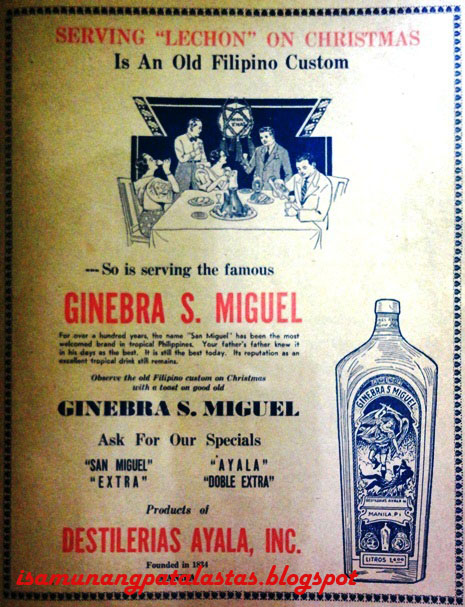
GINEBRA SAN MIGUEL, Old Filipino Custom, 1936

GINEBRA SAN MIGUEL,the world's no. 1 selling gin, has a heritage of excellence spanning more than 180 years. It was originally a product of Destilerias Ayala, Ic., founded in 1834. Its distinctive “marca demonio” label was designed by then-student Fernando Amorsolo, now a Philippine national artist. This Graphic ad from 1936, situates  GINEBRA SAN MIGUEL as part of  old Filipino Christmas customs, that also include serving noche buena lechon.

SAN MIGUEL BEER, Real Pleasure for the Holidays, 1957

SAN MIGUEL BEER  is the Philippines’ best known, and larget-selling  pale lager produced by San Miguel Brewery. It is a beer rich in history, as its parent company was established back in 1890. This midcentury Christmas ad of SAN MIGUEL BEER features two popular showbiz personalities at that time—the lovely Paquita Roces (the original Camay Girl) and the debonaire Fil-Danish actor, Ric Rodrigo.  Paquita was married to screen star Armando Goyena; while Rodrigo, husband of Rita Gomez, would win Asia’s Best Actor award in 1969, for the movie “Igorota”.

SUNTORY, Perfect for Christmas, 1963

SUNTORY Whiskey has its beginning s way back in 1899, when Shinjiro Torii began experimenting with the production of western-style whiskey in Japan. He managed to do that—and more—for in 1937, he created SUNTORY, a truly Japanese whiskey with a distinctive Japanese character—a masterpiece of Eastern artistry. La Fuerza Inc., of the Lim Family, became he local partner of SUNTORY in the 1960s, and this 1963 print ad was part of the product push for the Christmas season.

VOS BRANDY, Keep their Spirits High! 1964

La Fuerza Inc. was a distillery, incorporated in the 1950s  by the Lim family. Its local output were the Siu Hoc Tong energy liquor, C-88 and VOS Brandy, (Very Old Special brandy) which would gain prominence in the Philippine market in the 70s and 80s. Its commercials, known for being campy and sexist, introduced viewers to its most well-known slogan—“Pang romansa…espesyal!”, mouthed by a starlet holding a VOS Brandy bottle. But back in 1964, this VOS Brandy & Gin Christmas ad was pretty standard, safe and direct to the point.

TANDUAY RHUM, say 'Mabuhay'! 1966

TANDUAY RHUM,  by Tanduay Distillers, Inc., is an iconic brand of liquor with origins in a distillery in Hagonoy, Bulacan, acquired in 1856, by Ynchausti and Compania. A plant was built in Isla de Tanduay, near Quiapo and became the Tanduay Distillery. By the 1930s, its rum products were branded as TANDUAY RHUM. In 1934,  Elizalde & Company, Inc.  acquired  thedistillery and  operated it under the  name Tanduay Distillery, Inc. It became a leading producer of rums, liquor brands and other spirits. This 1966 ad capitalizes on TANDUAY RHUM as part of Philippine holiday drinking tradition, a drink hat "adds lilt and luster to the festive air".

Thursday, December 21, 2017

143. Call for Philip Morris! SEASON'S GREETINGS! 1965-1970

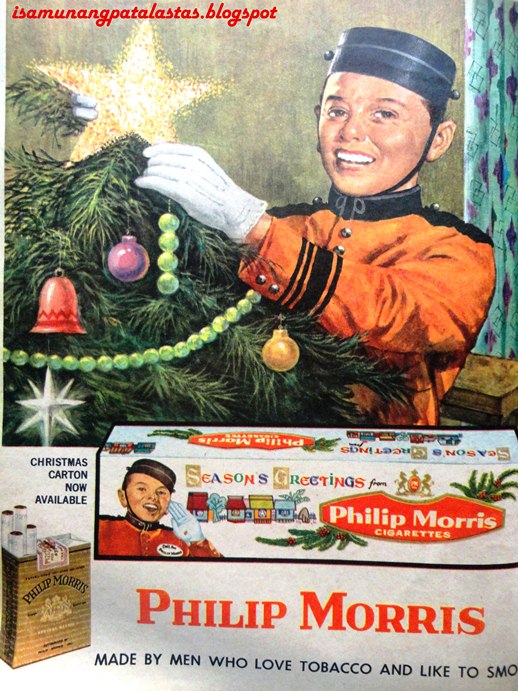
HAPPY HOLIDAYS, from Philip Morris' Johnny Bellhop, ca.1965

The products of PHILIP MORRIS International Inc. became known to the Philippines only in 1955, when a licensing agreement was reached with La Suerte Cigar and Cigarette Factory to manufacture and sell PHILIP MORRIS branded-cigarettes in the country. It was PHILIP MORRIS’ first exclusive agreement outside of the U.S.
 
SEASON'S GREETINGS from Philip Morris, 1966
La Suerte Cigar & Cigarette Factory (La Suerte),44 Fortune Tobacco Corporation (Fortune),45 and Sterling Tobacco Corporation (Sterling)46 are domestic corporations engaged in the production and manufacture of cigars and cigarettes. These companies import leaf tobacco from foreign sources and purchase locally produced leaf tobacco to be used in the manufacture of cigars and cigarettes
 
MALIGAYANG PASKO, Call for Philip Morris, 1970
For over 40 years, La Suerte produced and sold PHILIP MORRIS, until Fortune Tobacco Corp. was established in 1965, which then took over the manufacturing and marketing of the brand, including another American favorite, Marlboro.
************
 
JOHNNY ROVENTINI
soource; wikipedia
PHILIP MORRIS advertising featured the iconic bellhop trade character which was conceived back in the Word War I years.  Hotel lobbies then were used as meeting places to meet people, talk business—and smoke. Initially, an illustration of a bellhop was used in early ads, and part of his duties was to page people, hence the slogan “Call for Philip Morris”.

Milton Biow, head of New York Biow Agency that handled the account, had the idea of‘humanizing’  the illustrated bellhop on PHILIP MORRIS ads. He found him in the person of a 23 year-old, a shade under 4 feet, 59-pounder Johnny Roventini (b. Aug. 15, 1910/d. Nov. 30, 1998) who was a real-life bellboy working at the New Yorker Hotel. He was asked to holler “Call for PHILIP MORRIS!”, which he did so in his high-pitched voice, not knowing that he was paging a product, not a person.

Johnny Bellhop was finally found and became the most successful spokesperson for PHILIP MORRIS. He appeared on TV and in print ads, lent his distinctive voice to a PHILIP MORRIS radio show, and is credited with spurring the growth of broadcast media.

LISTEN TO JOHNNY BELLHOP 's
"CALLFOR PHILIP MORRIS" HERE:
Source: The Mouldy Spud , Uploaded July 27, 2010

Johnny prefaced the highly-popular “I Love Lucy” program of Lucille Ball and Desi Arnaz with his signature call--"Call for Phil-ip Mor-rees"”—in perfect b-flat, and helped keep the ratings soaring.

The iconic bellhop cigarette character was not unknown to Filipinos, thanks to the popularity of the early PHILIP MORRIS ads that featured him. In fact, the bellboy  was ‘copied’ by La Insular Cigarettes, for its local print ads in 1929. 

It was only in 1965 that the bellhop was used for PHILIP MORRIS magazine ads in the Philippines. The Christmas ads shown here feature a faithful illustrated likeness of Johnny Roventini, whose call for PHILIP MORRIS made him one of the most recognizable faces on media.

At the prime of his career, Johnny was earning a hefty $50,000 annual salary, thanks to his personal appearances that made him one of the most recognizable faces on media. Considered a “living trademark”, Johnny’s fame and success was enhanced by his ready smile and welcoming hands that won the admiration of people who came to see him.


  MALIGAYANG PASKO SA INYONG LAHAT!
from Isa Munang Patalastas