One of the most popular soy sauce brands in the country—MARCA PIÑA Soy Sauce—began as a
backyard business employing 10 people in
Marulas, Bulacan back in the late 1940s.
The soy sauce product was first sold in the small neighborhood, but demand for MARCA PIÑA increased simply through
word-of-mouth, that National Soy Factory, the name of the small enterprise, had
to step up their production to answer the growing clamor for the product.
MARCA PIÑA Soy Sauce
was noted not only for its taste, but also its rich color, texture and aroma.
After all, the company used only high quality soy beans and manufactured the
soy sauce using advance food technology. Moreover, MARCA PIÑA was priced
affordably.
Incidentally, the PIÑA or pineapple is asymbol of welcome and hospitality. It is also
a symbol of royal privilege, and the pineapple name and icon was used by other
successful brands of food companies like Marca Piña Quezo and Marca Piña Hams.
By
the 1960s, the soy sauce was known nationwide, advertising actively in
magazines and leading publications.
WATCH THE 2006 VERSION OF THE
MARCA PIÑA SOY SAUCE "PIÑARAP BOY" TVC 30S
Government legalities mandated that the word “National”
should not be used for company names, so in 1973, National Soy Co., was
rebranded as Balanced Food Corporation.
MARCA PINA SOY SAUCE Ad, 1961
It was in the 1970s that MARCA PIÑA Convey Advertising produce the now-classic “Piñakamasarap”
TV ad that featured a young boy mouthing “Piñarap!”
(who happened to be the son of the owner, Mr. Tian Sy) at the end of the commercial.
MARCA PINA SOY SAUCE "PINAKAMASARAP Ad, 1965
The
line caught on, and soon, everybody could recall and replay it—one of the most
memorable advertising catchphrases to this day. To immortalize the
unforgettable line that catapulted MARCA
PIÑA to greater prominence,Balanced
Food Corporation adopted the name Piñakamasarap Corporation in 1978.
MARCA PINA SOY SAUCE "PINAKAMASARAP Ad, 1968
Today, Piñakamasarap Corporation produces not just soy
sauce but other condiments and dips like MARCA
PIÑA Vinegar, Patis, Sukang Puti, Oyster Sauce and Kubo Sukang Paombong. Many
of these are exported the world over, enjoying the patronage of expatriate
Filipinos who, then, as now, still call the MARCA PIÑA super brand-“Piñarap!”.
As to the little boy who uttered the line in that classic as, he now sits as
the chief executive of the renown food manufacturing corporation.
Ace-Saatchi & Saatchi Creative Director Jimmy F.
Santiago recalls the birth of the 1990 Print Ad of the Year, “Wet Page”, as substantially
a bloody process. The client was,once again. Old friend procter & Gamble,
and the product was PAMPERS, a disposable diaper. Since PAMPERS spent more
money on television, the print ad was meant to be no more than a sustaining
effort.
As I turned out,the oncept took forever to be born. The
selling was simple enough, that PAMPERS kept babies drier, and TV had
consistently followed the formula of showing smiling, contentedly dry babies. For print,
however, client had already trashed dozens of ideas; moving the account to a
different account group only resulted in more casualties.
One day, Santiago found himself sifting through piles of
disapproved print ads when he came across a study of a bleeding page by art
director Mario Monteagudo. “It was the same idea as drinking scotch while
writing a love letter”, Santiago explains. “The more drunk you get, mas
pumapangit ang writing mo---and the page would even get wet”.
Santiago wrote some copy with a pentel pn, wet it with
water and his won saliva, and matched that “problem” page with a complementary “solution”
ay-out minus the water damage but beaing the product logp and a few lines of
descriptive copy. That became the ad that was presented and eventualy approved by client. “We just
recycled an old idea that had been missed by everybody.”
The “wet page” itself is a strikingly sloppy image. “A baby
wearing cloth diaper sat on this page.’ Reads the copy, printed in grey text
with the letters precariously dissolving. The word “baby” suffers the biggest damage,
an almost indecipherable blob of smeared , “and he still didn’t like it”.ink.
Which better ord to victimize indeed, than the ne closest to the target
consumer mommy’s heart!
The ad appeared as a half-spread in newpapers,
award-winning proof that it doesn’t pay to second-guess clients. “That’s what
took us so long”, Santiago explains. “Everyone was expecting to be approved when
they were disapproved.” Still, “Wet Page” did not quite win the battle; when
the Procetr & Gamble general manager saw the ad, he instantly disliked it. “After
it won a Clio citation, we brought the ad back to him”, Santiago recalls
CREDITS:
ADVERTISER:
Procter & Gamble Philippines
PRODUCT: Pampers
Disposable Diapers
AGENCY:
Ace-Saatchi & Saatchi Advertising
CREATIVE DIRECTOR:
Jimmy F. Santiago
COPYWRITERS:
Finina Gatchalian/Bingo Bautista
ART DIRECTORS:
Bingo Bautista/ Mario Monteagudo
PRINT PRODUCER:
Pirio Tatlongmaria
PRINT SUPPLIER:
Micrographics, Inc.
STUDIO MANAGER:
Ray del Rosario
ILLUSTRATOR:
Elaine Lopez
Source:
Hnasa, Alya, ed. Uy, Butch. Perfect 10: A Decade of
Creativity in Philippine Advertising, Published bt the Executive Committee of
the Creative Guild of the Philippines. 1995.
One of the most enduring brands of brilliantine pomade was THREE FLOWERS, made by Richard Alexander
Hudnut way back in 1915, an American perfumer and cosmetics maker based in New
York, with a European office in Paris, France.
It was distributed locally in the Philippines by Edward
A. Keller & Co. sometime in 1950 to capitalize on the growing hairstyle
trend of the midcentury--pompadour, side parts, slick-backs and cowlicks—popularized
by screen legends as Cary Grant, Elvis Presley, James Dean, and later, Sean
Connery. THREE FLOWERS Brilliantine
Pomade became a favorite grooming aid to
style hair and give it a good sheen and, subtle masculine scent.
The most handsome matinee idols of the 50s were tapped to
become celebrity endorsers for THREE
FLOWERS’ 1956-1957 print campaign that primarily ran in leading magazines.Four print ads from this series are shown on
this page, each with a testimonial from a chosen actor-model.
LUIS GONZALES, for THREE FLOWERS,1956
Luis Gonzales, (b.
8 Aug. 1928/d. 15 Mar. 2012) was born Luis Mercado, and grew up I Tondo. The prolific actor made over 100 films with Sampaguita
Pictures and he is bets known for his portrayal of Pres. Ferdinand Marcos in
two propaganda-cum-drama films: “Iginuhit
ng Tadhana” and a“Pinagbuklod ng Langit” ("Heaven was Gathered", 1965).
He was often paired with actress Gloria Romero. Of THREE FLOWERS, Gonzales says: “
Women love the masculine fragrance of THREE
FLOWERS…so do I!”.
MARIO MONTENEGRO, for THREE FLOWERS, 1956
Mario Montenegro, (b. 25 Jul. 1928/d. 27 Aug. 1988) aka Roger
Collin Macalalag of Pagsanjan, Laguna, was a Fine Arts student of UP, and was
discovered while helping build sets for films. In his teens, he also was a member
of Hunters ROTC guerrilla unit that saw action in the war. He is best known for
his period films that showed him as a swashbuckling hero. Montenegro, who
married fellow actress Letty Alonso, says that he “prefers the finest to look my best: THREE FLOWERS”.
EDDIE ARENAS, for THREE FLOWERS, 1957
Eddie Arenas, (b.
7 Jul. 1935/d. 31 Mar. 2003) was a featured actor of Sampaguita Pictures and
made many films with actress Lolita Rodriguez, who eventually became his wife.
Some of his notable films include “Ang Tangi kong Pag-ibig” (1955), Gilda
(1956), “Busabos” (1957),”Tanikalang Apoy” (1959). Before his passig, he was
last seen in the 2002 movie, “Mahal Kita: Final Answer”. Of the product, Arenas
opines that “I always look my best with THREE FLOWERS”.
RIC RODRIGO, for THREE FLOWERS, 1956
Ric Rodrigo (b. 1931/d.?) was born as Paul Albert Bregendahl, the son of
a Filipina mother and a Danish father . He isbest-known for his appearance in “Igorota”
(1968), where he was hailed as Asia’s Best Actor. Other significant films
include “Dahil sa Isang Bulaklak” (1967) and “Ina, Kapatid, Anak” (1979). A son
from actress Rita Gomez, Ronald Bregandahl, also became an actor. “THREE
FLOWERS gives my hair a healthy sheen that is admired by all my friends”,
says the good-looking Rodrigo.
THREE FLOWERS
was a consistent advertiser through the 60s, but fell out of favor with the rise
of modern pomade sticks, gels and cream, and it was only in 1979 that the brand
was resurrected with the memorable relaunche campaign conceived by Basic
Advertising—‘Lalaking Disente’. Needless
to say, all the actors that appeared in the print ads from way back 1956, all
fitted that “lalaking disente” mold—thanks
to THREE FLOWERS!
Johnson & Johnson has been a long-standing client of
Ace-Saatchi & Saatchi (formerly Ace Compton) since 1959, with the Personal
Products as well as the Feminine Care line as its key assignments. 1990 marked
the year that J&J forayed into the Cosmetics field, targeting Teens as it’s
point-of-market entry.
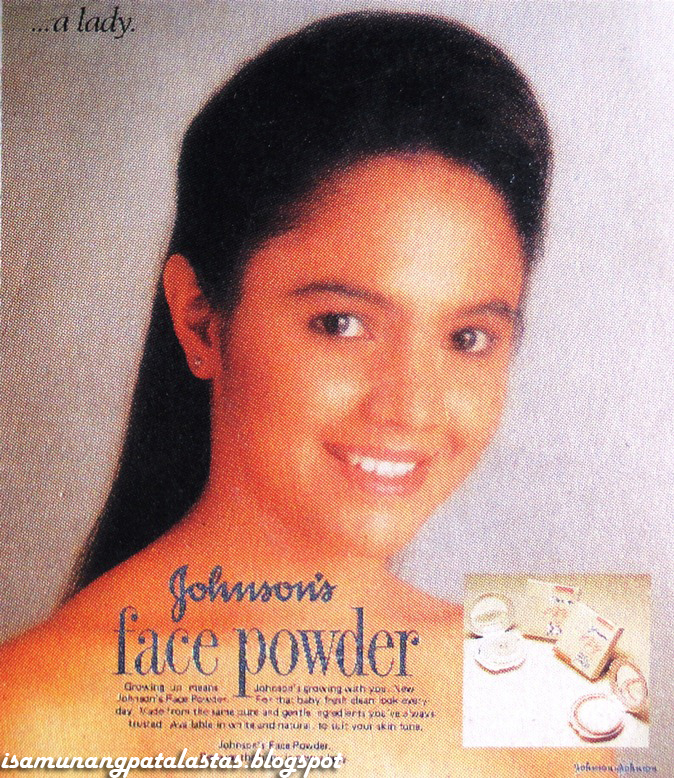
That year, J&J Philippines launched its JOHNSON’S FACE POWDER, which is
actually a pressed powder version of one of its flagship products, Johnson’s
Baby Powder. That became the take-off point to communicate the face powder’s
merits and benefits to a new market. After all, Johnson’s Baby Powder had been
in the Philippines for over 4 decades and had become a staple product for
Filipino babies.
But, since the baby had grown older, shouldn’t there be a
new product befitting her new stage in life? Thus—JOHNSON’S FACE POWDER.
The Saatchi creatives developed a campaign theme that
would provide product continuity for Johnson’s powder products. This was
articulated in the memorable campaign line—“because
the Baby is now a Lady”.
The TV and Press campaign idea seemed simple enough—it starts
with a close-up of a Baby being splashed
with Johnson’s Baby Powder , followed by
images of the baby growing older, in a series of smooth dissolves, literally
growing before the viewer’s eyes. The last fade-in reveals the refreshingly
beautiful face of a teen-age girl, with
the JOHNSON’S BABY POWDER product
shot appearing beside her. As we follow the girl’s growing up process, the
supers gently come in: “because the baby, is now a lady—JOHNSON’ FACE POWDER”.
It was a simple, no-frills commercial, but with a powerful
visual idea that relied on casting the right models. The search was on for 4
talents who would credibly portray different stages of growth—from a Baby, to a
Moppet, a pre-Teen, and finally, to a Teen beauty.
The exhaustive quest ended
with the casting of four different models who appeared in a series of prints
ads that ran on consecutive pages of a magazine. The same models also appeared
in the launch TV commercial that would proved to be so successful, that it paved
the way for the launch of a new, major teen line –JOHNSON’S TEEN ESSENTIALS.
But.. whatever happened to the 4 models in the commercial? We wonder!
CREDITS: ADVERTISER: Johnson & Johnson Phils. Inc. PRODUCT: Johnson's Face Powder AGENCY: Ace-Saatchi & Saatchi Advertising CREATIVE DIRECTOR: Jimmy F. Santiago COPYWRITER: Merlee Jayme ART DIRECTOR: Melvin M. Mangada CASTER: Flor Salanga
Mascots have been part of the advertising world for over
a century, like Mr. Peanut and Jolly Green Giant. They personify the character
of the brand—and they may come in many forms such as super humans, fantastic
creatures, animals—and in the case of JOLLIBEE—an
insect!
JOLLIBEE IN 1983
It was only in the 1980s that the use of “live” mascots was
fully exploited by Philippine advertisers, thanks to the JOLLIBEE MASCOTS.
Before
that, Philippine brand characters from the 50s -70s like Nars Cafi (of Cafiaspirina),
Shellane Girl (of Shellane LPG) and Pancho Pantera (of Pancho Pantera chocolate
drink) all were one-dimensional figures that saw print on posters and ads, and animated
on TV like cartoons.
The mascots of JOLLIBEE
not only fed the fantasy of children, but because they were so life-like, they
could interact with them in many fun moments.
In a special way, the JOLLIBEE mascot became role models too,
for each one was created with different characteristics to reflect the various product
qualities. But all were likeable and appealing.
JOLLIBEE in 1989
The lead mascot of JOLLIBEE
Foods Corporation was , of course, JOLLIBEE,
introduced in 1980. His name says it all—JOLLIBEE is a happy, loveable, active figure who flits from one place to another to
spread merriment on everyday occasions.
JFC
Founding Chairman, Tony Tan Cak Tiong, has often likened the mascot's character
to the Filipino working folk, noting that the bee "hops around and
produces sweet things for life, and is happy even though it is busy".
Ms. CHICKEE,
the brand mascot for Chickenjoy, was introduced in 1983.
That same year, the mini-skirted
bovine beauty, LADY MOO, was launched to represent the Milkshakes product.
She would
be joined in 1985 by MICO, a kid in
red short overalls wearing a milkshake cup for a cap. All three would later be
discontinued.
The fastfoods’premium burger, CHAMP, also had a mascot with the same name, introduced in 1984.
With a hamburger head, CHAMP was
dressed as a boxer, complete with gloves and a robe, but, like a boxer, the
mascot, has also been retired.
MR. YUM was
the original name of the Yumburger mascot, created in 1989. Dressed in a dark
suit, he wears a bowler hat in the shape of a Yumburger bun. In 2008, he was
updated and became simply YUM, a
younger, more funky boy in a raglan shirt and shades, but with the same, sesame
seed-topped burger cap.
TWIRLIE was
the name of the girl mascot who personified the very popular Twirly Sundaes
that were launched way back in 1988. In mall shows, she performs her own
special Twirly Dance.
An unusual mascot was seen in 1984, who sported his
stringy hair made from—spaghetti noodles. HETTY,
the resident spaghetti mascot, was nonetheless, a consistent crowd favorite.
But if HETTY seemed unusual with her
noodle ‘do, POPO looked awfully strange with his stringy hair made from—French Fries!
The potato boy has since transformed into a less weird-looking dude, with the cardboard
pocket holder taken off his head.
JOLLIBEE has successfully
employed mascots as promotional vehicles, and they are always in demand not
only for the Kiddie Parties, but also for corporate events. Christmas time is
when their mascots are at their busiest, where they not only attend partie but
also go on school tours, headline musical events, star in commercials, and make
special TV appearances. Children would crowd around to touch them, talk to
them, pinch them, pat them, adore them-to the point of hero worship.
WATCH THE JOLLIBEE MASCOTS HERE:
Jollibee (Apat na Dekada), posted by Glover Reselosa
They have been replicated as toys and dolls, featured on licensed merchandise from clocks to plates to pillows and lamps, clothing and school bags.
JOLLIBEE MASCOTS IN OPERETTAS THAT EDUCATE AND IMPART VALUES, 1987
As the characters are also used to promote various
advocacies—from propagating Pilipino as a language, imparting local values, to endorsing sanitation and cleanliness
programs—the mascots have to conduct themselves in certain way, guided by a
Jollibee Manual which has a mascot code of do’s and don’ts.
COLLECTBLE JOLLIBEE MASCOTS VINYL TOYS, credits to the owner of this photo
Today, the JOLLIBEE
MASCOTS have all become part of the Philippine pop culture, and there is
not a single kid who cannot, at once, identify him and his circle of friends.
JOLLIBEE MASCOTS AT A KIDDIE PARTY
After
all, they could always be counted on to spread fun,good times and great eats!
As one Jollibee fan astutely observed --“JOLLIBEE is not a bee..he is a
FRIEND!”.
CINDY'S TV commercial spawned one of the most memorable jingles in 1984.
CINDY’s—the
place to be—was founded in 1971 by a group of businessmen in Tarlac who simply
envisioned a restaurant that served “good food in a good place”. Thus was born
the first CINDY’s store in Tarlac in
1972, a bakeshop and restaurant place that served a standard fare of baked
breads, and merienda favorites.
The successful reception to the store prompted them to open more branches and to offer new
menu items like burgers, French fries and express meals. But it was the
bakeshop that gave CINDY’s a
competitive edge.
WATCH 'CINDY'S "The Place To Be" TVC Here:
At its peak, CINDY’s
was promoted through national advertising, a no mean feat for a homegrown
business. Its campaign "The Place To be", spawned a memorable jingle that is still remembered until now.
To focus on its uniqueness, CINDY’s re-conceptualized its product in
1996, by opening a store that was first a bakery, and secondarily a restaurant.
This gave it an edge above the rising number of fast food joints. Today, now on
its 46th year, CINDY’s
has over 62 branches nationwide.
Along with Susan Roces, Amalia Fuentes (b. 27 Aug. 1940) was
one of the first truesuperstars of the
Philippine silver screen of the 60s decade. Naga-born Fuentes was the daughter
of Alvaro Muhlach Sr., a Filipino of German-Spanish blood, and Concepcion
Amador. Her father had died during the war, so when she came of age, Fuentes
decided to find work to support the family.
MR. & MISS NO. 1: Juancho and Amalia
Adoptingher stepfather’s surname, she thus became
Amalia Fuentes,and atage 16, the teen
beauty entered the search for Sampaguita Pictures’ talent search for Mr. &
Miss Number One.
She topped the contest, along with male winner, Juancho
Gutierrez, and their careers were launched via their debut film, “Movie Fan”.
It was an instant success and she went on to make more blockbuster hits with
Juancho like “Sonata” (1957) and “Pakiusap” (1959). Eventually, she was paired
with Romeo Vasquez (“Pretty Boy”, “Ako ang May Sala”), who would become her
husband, and father of their daughter Liezl.
AMALIA FUENTES for Mantrade's Fairlane
But it was in the 1960s that her star shone the
brightest, beginning with the “Ako ang May Sala” (1960), and the 1963 romantic
comedy “Ang Senyorito at ang Atsay”. Her intense screen rivalry with Susan Roces
further heightened her fame. They had appeared together in “Amy, Susie, Tessie”
(1960). When Roces did the popular “Susanang Daldal”, Fuentes countered with “Amaliang
Mali-Mali”, and the competition was on.
SLIM, SLEEK AND BEAUTIFUL AS THE CAR, Mantrade Ad, 1965
As a an actress of superstar status, Fuentes was squired
by many companies to endorse their products. The largest Ford dealer in the
country, manila Trading & Supply Co. or MANTRADE, signed her up in 1965 to appear in print ads for their
latest car model—Fairlane 500.
FUENTES IN REVE D'OR Ads. 1965
She also became an endorser of REVE D’OR,a premium line of
cosmetics (Lotion, Face Powder, Perfume) distributed by Oceanic Commercial Inc. in
1965.
Fuentes became the face of LUX Beauty Soap in 1969, a casting coup for the brand which had
signed up Susan Roces earlier as one of their Lux ladies.She did a TV commercial that showed her at
her most beautiful.
She supported her daughter with Vasquez, Liezl Sumilang,
when she,too, became a child star and a commercial model, most notably for
SCOTT’S EMULSION in 1974.
The checkered career of Fuentes included not just acting,
but she also forayed into movie producing, screenplay writing and directing.
But no doubt, it was the pulling power of her beauty that she will be
remembered for, earning admiration from three generations of fans who have
dubbed her as the Philippine answer to Elizabeth Taylor.