THE YUMBURGER LAUNCH AD, showing an early Jollibee mascot.1978
Jollibee was just three years old when it began
advertising in 1978. From a small Magnolia Ice Cream parlor put up in 1975 in
Cubao, the visionary Tony Tan Cak Tiong, turned his dessert shop into a fast
food restaurant, and the rest is history.
By April of that year, Jollibee was operating 8 stores in
Manila: 4 in Cubao, 2 in Quiapo and 1 each in Greenhills and the University
Belt. The core offerings were burgers,
and the flagship product was the YUMBURGER.
Jollibee YUMBURGER
was a basic burger consisting of two buns that sandwiches a 100% beef
burger patty slathered with a special dressing. It was a no-fuss, no-frill
burger that nevertheless, delighted its market that had a taste nor just for
good food, but also value for money. Indeed, “the hamburger with a double yum”
was just priced at Ph.2.95!
The YUMBURGER
was introduced in colored print ads mostly in weekend and women’s magazines in
the first quarter of 1978. The print ad, whose maker or origin is unknown, was
noteworthy for a lot of reasons.
It marked the first appearance of the bee mascot as the
presenter of the YUMBURGER. It
looked more like an insect than the friendly, chubby Jollibee mascot that we
know now (Jollibeeconsultant Manuel
C. Lumba is credited with conceptualizing the vest-wearing bee with a chef hat.
Likewise, revising the restaurant’s name to”Jollibee”).
The origin story of YUMBURGER
was also romanticized to appeal to children—the ad claims that YUMBURGER was created in Yumburg, “a
place between here and nowhere”, pople by fairy-tale like characters. In any case, YUMBURGER offered “Pure beef. Pure pleasure.Pure goodness. No
cereals”.
To underscore the importance of YUMBURGER to the nusiness, the early Jollibee stores were even
branded “JOLLIBEE YUMBURGER”. As the
world knows, Jollibee dealt McDonald’s, an American brand, a big blow, and
today, continues to lord over the local market as the the country’s leading
fastfood chain. It has grown exponentially, expanding with branches the world
over—the U.S., Southeast Asia (HK, Taiwan) Middle East, Canada, Italy in Europe. All because of the burger that
started it all—the YUMBURGER!
One of the most sought-after models of the 1980s was
discovered in a most unusual way. Leoncel Rabago, a gangly youth in his early
20s, was out skating at the famous Skatetown of Ali Mall in Cubao, when a talent caster passed
by and saw something special in the slim and agile looker.
Archie Corteza was then one of the leading talent casters
of the Philippine advertising industry, and he knew a raw talent when he saw
one.
After all, he had been successful in discovering and launching the careers
of so many commercial talents—from Camay girls, Close-Up teen couples, Cinderella fashion
models to San Miguel Beer babes and hunks.
He handled the likes of young Eric
Quizon, Lito Gruet, Lloyd Sammartino, Miguel Rodriguez, Cris Coburn, who all
had their start in commercials.
Corteza took the young skater—an adopted child-- under
his wing. He enrolled him in a gym, trained him in fashion camps, introduced
him to couturiers for their runway shows, and helped transform him into a new commercial modelling
sensation—Leo Rabago.
He first started appearing in fashion print ads, as these
were simple enough. By 1984, his schedule was full, bagging plum assignments from Cinderella department
store, Walker, and his biggest break yet—as a resident model for SM, the
biggest department store chain in the country.
In 1986, Leo Rabago entered the first ever Bodyshots
Modelling Competition, organized by the Fashion Designers’ Association of the
Philippines (FDAP).
This contest was the launching pad for the showbiz careers of such winners as John Estrada, Alain Sia, Richard Cepeda, and Zanjoe Marudo. Not surprisingly Rabago emerged as the top model of the Male Division,
Professional Category.
The victory clearly established him as the country’s
leading male model, boosting his stock and career to an all-time high.
He continued to model in fashions shows, appeared in
MTVs., but TV commercial assignments—which were more lucrative—eluded him; it
seems he could not go past beyond the
high-fashion image that he projected.
As a result, he was often seen as a
dashing escort, a secret admirer, or as a boyfriend—but never the lead.
LEO RABAGO AS SM SHOEMART SIGNATURE MODEL, 1984
With limited projects as he turned 30, Rabago left
modeling, got a new talent manager and tried his hand in acting. He debuted in the
Gabby Concepcion-Maricel Laxa headliner “Ayoko Na SanangMagmahal” in 1993. His
next appearance was in the award-winning film “Wating”, a support to Richard
Gomez.
RABAGO, IN A WALKER BRIEFS Print Ad, 1984
He accepted whatever work was available, and even did sexy films with
such titles as “Hapdi ng Tag-init”
(1997), “Alipin ng Aliw”, “Campus Scandal”, “Bawal”, (1998) and “Alipin ng Tukso” (2000) and
“Lakas ng Pag-ibig” (2001). There would be no more film and TV assignments
beyond 2001.
LEO RABAGO, plays support to Suyen Chi in a LAGERLITE PRINT AD, 1986
Along the way, Rabago fathered several children; most were married and abroad. Misfortunes continued
to hound him; in 2000, he was jailed for assaulting the live-in partner of his
sister with a knife. In 2010, his adoptive mother, Froilanda Rabago, died of
aneurysm, a profound loss that deeply depressed and affected him. Not long
after, Rabago began developing what he thought was acute amoebiasis. It turned
out it was colon cancer.
LEO RABAGO, IN A MAGNOLIA YOGHOURT AD, 1987
Friends from the modeling industry took care of him in
his dying days. Leo Rabago, once the most in-demand model of the 1980s ,passed
away in the charity ward of the Eulogio "Amang" Rodriguez Medical
Center in Marikina City on 10 February 2011.
Before the ballpens took over, fountain pens were
standard writing instruments in the Philippines, used in schools, offices, and
for signing important documents. Fountain pens were filled up with ink—and one
dominant brand that would become a staple import from the 40s through the 60s was
Parker QUINK.
The brand name QUINK
is a coined term that combines “quick” and “ink”, and was first introduced in March
1931, by the Parker Pen Company. It was developed for the company by chemist Galen Sayler of Miner Laboratories, in
Chicago.
The general-purpose ink was an instant success, as it had
superior ink flow, water-resistant, and true to its name, it was quick-drying.
Its formula included an exclusive additive known as “Solv-X”, which eliminated clogging.
QUINK was supported by massive
advertising. And by the time it reached the Philippines in the 1950s, it had
become a household name.
QUINK was
imported from the U.S., and its Philippine representative, Carbonell & Co.
Inc, marketed and distributed the product in the 1950s. Other distributor-manufacturers
included Exclusive Distributors Corp .of Makati, and H. G. Henares & Sons, Inc. in 1961. It was
available in Blue, Black, Blue Black. Red, Green, and Turquoise Blue colors.
PARKER QUINK, Ad, 1957
Did a Filipino
Invent QUINK?
For many years, it was believed that a certain Francisco
Quisumbing, a U.S-educated Filipino botanist, was instrumental in inventing
QUINK, and that his name inspired the product brand name (QUIsumbing INK).Parker records, however, showed that no such
person worked with the company.
QUINK New Improved Formula PRINT AD, 1960
But there was indeed a Francisco A. Quisumbing, a 1914
U.P. chemical engineering graduate who also earned a Ph.D. from Columbia
Univeristy in 1921.This Quisumbing founded Quisumbing Inc. Products which
supplied Philippine government bureaus with ink.There is no concrete evidence
nor reliable documentation that he had
something to do withQUINK. When QUINK
was later manufactured in the Philippines under license from Parker, all the
bottled products were properly marked with the Parker name.
QUINK, 1965 AD.
The reign of the
fountain pen ends.
Fountain pen use waned in the 60s, as ballpens became
more convenient alternatives. Prized today for their collectible value and
status, they are still being manufactured in by Parker, including reproductions
of classic designs—like the Parker 51 which was thought to use only QUINK. After
87 years, QUINK continues to be produced today, an indelible part of the history
of written communications the world over.
SUNRISE COFFEE, in new Flavor-Rich Granules form, relaunch ad, 1988.
In 1987, Nestlè Philippines developed a local coffee
product that was totally separate and different from their premiere flagship
brand, Nescafè Coffee. It was envisioned to be a price brand, to make coffee
more accessible to more Filipinos. Named as Nestlè SUNRISE, the coffee blend
came in the form of flavor-rich granules—so one need only a small amount to make
a rich cup of coffee.
Nestlè assigned the product to Ace-Saatchi & Saatchi,
and the agency went to work right away in crafting the communication strategy.
The brand name inspired the way Nestlé SUNRISE would be positioned—it would be pushed
as your first cup of morning coffee, for morning people who need a quick
picker-upper to warm up the start of their day.
Though Nestlé SUNRISE was meant to be a popular price
brand, care was taken by the agency to create a campaign hinged on beautiful Filipino
traditions. Former DOT secretary Ramon Jimenez Jr., was the lead creative
director who crafted the launch campaign, together with his team.
WATCH "SUNRISE COFFEE" LAUNCH AD HERE:
Source: View on the 3rd Jojo Bailon
It was he who came up with the theme: “Magandang Umaga sa
Iyo”, which is charmingly Filipino. It shows an aspect of typical Filipino
habits such as the warmth and vibrance of exchanging morning greetings among
people from all levels of socio-economic strata.
This campaign came alive in 3 memorable TV 30s commercials:
that were all designed to be morning situations: “Bride”, “Spoon”, and “Delivery”.
The “Bride”begins with a slow music that introduces
viewer to a Father character, deep in reverie, while sipping a cup of Nestlé
SUNRISE. Slowly, he sees a figure walk down the stairs—it is her daughter,
dressed in a wedding gown, and the soon-to-be wed bridge greets his father
with“Hi, Papa”. Very quickly, the
misty-eyed Father sees his daughter as a young girl, then is jolted back to the
present time. The Father escorts her Daughter out, ready to give her away.
“Homecoming”, the second version shows a middle-aged
couple having coffee together. Their small talk turns to their Son—a PMA cadet
in Baguio-- whom the Mother misses. Little did they know that at that precise
moment, the Son arrives to surprise them with a short visit.
The third version, “Delivery”, shows a couple having an intimate
coffee moment together, shot at close range. The Woman drops a spoon, and as
the Man bends down to pick it up, he sees someone wearing white shoes entering
the room. It is then revealed, as the camera pulls out, that the Couple are a
Husband and Wife in a hospital room, and the white shoe-shod figure is actually
a Nurse bringing in their newly-delivered Baby Girl (as foretold by the dropping of a
spoon). All the the commercials end with the last strains of the jingle--“Maganda umaga sa inyong lahat!”, a
pleasant good morning to all.
WATCH SUNRISE New Flavor Rich Granules" 1988 TVC HERE
with Angelique Lazo
(Credits: The CompanY Singers, posted Sep. 10, 2017)
At the 1987 Philippine Advertising Congress in Baguio
City, all three Nestle SUNRISE commercials were recognized, winning Individual Golds at the
Araw Awards. The Radio ad—which actually was a full song entitle, “Magandang Umaga”, won a Bronze Award.
MAGANDANG UMAGA SA IYO
Gising
na, sa tulog na mahimbing
Lumiliwanag
ang dilim,
Pati
na ang paningin
Nababanaag
mo,
Sa
dakong silangan
Ang
araw ay sumisilip,
Bumabati,
dumudungaw
Magandang
umaga sa iyo..
Magandang
umaga sa iyo.
Magandang
umaga sa iyo..at sa iyo at sa iyo..
Magandang
umaga..magandang umaga..
...sa inyong lahat!
CREDITS
ADVERTISER: Nestle Phiilppines
CLIENTS: Levi
Castillo, Ed Trivino
AGENCY: Ace-Saatchi
& SaatchiAdvertising, Inc.
CREATIVE DIRECTOR: Ramon
Jimenez Jr.
ART DIRECTOR: Kits
Yamsuan / COPYWRITER: Alex R. Castro ACCOUNT MANAGEMENT: Sandra C. Puno ACCOUNT EXECUTIVE: Richelle Mendoza
TVC PRODUCER: Paul
Suarez
CASTER: Mario
Sarmiento
PRODUCTION HOUSE: Image Films
DIRECTOR: Neil MacDonald
COMPOSER: Charo
Unite, Ramon Jimenez Jr.,Alex R. Castro
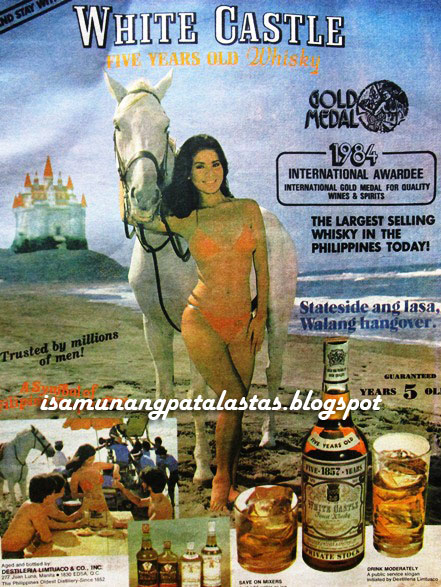
One of the most unforgettable brand ambassadors for a
product beginning in the 1970s was not your usual prim and proper college girl
type (like Miss Magnolia), or yourfashionable ladies from high society(like the Rustan’s VIP Council)—but rather a woman in a red bikini.
To make for a dramatic entrance, the WHITE CASTLE GIRL galloped into our TV living room astride a white
horse, hair blowing in the wind, as the image of a castle loomed in the
background. TV audience—especially male viewers—could not help but stayed glued
to the screen as the strains of the catchy jingle, “White Castle, White Castle
Whisky, White Castle Whisky ang bilhin”, followed her 30 sec. ride into the
hearts of the drinking class.
MR. JULIUS LIMPE CEO, Destiliria Limtuaco
WHITE CASTLE 5
Years Old Whisky had always been a national favorite for many years, the
product of Destileria Limtuaco, the country’s oldest distillery. The business
was founded by 36 year old Amoy immigrant Lim Tua Co, who put up the distillery
within 2 years of his arrival in the Chinese enclave of Binondo.One of his earliest successesis the medicinal wine, Sioktong.
Unfortunately, Lim Tua Co—who adopted the Christan name
Bonifacio—died in 1887. So too, did his only son, Carlos, his heir apparent. A
nephew, Lim Chay Seng took over the business in 1926, and shifted the
production from Chinese drinks to Western spirits. Thus--WHITE CASTLE WHISKY came to be. It would become one of the
company’s flagship brand, blended and aged to perfection in oak barrels, to
give the whisky smooth, full-bodied taste, aroma and golden color.
WHITE CASTLE GIRL, EVANGELINE PASCUAL (1974) Picture courtesy of: JOSE BENIGNO SALVADOR
The business flourished when his son, American-educated
James Limpe took over the helm in 1937, a position which was passed on in 1958
to son Julius Limpe, a business graduate the University of Indiana. Julius
became an expert blender of all sorts of liquor and spirit, which he patented
and produced,while steering Distileria
Limtuaco to its pre-eminent position in the industry.
To him also goes the credit for creating the imagery of
the WHITE CASTLE GIRL. After all,Mr. Julius Limpe was also an
artist, so he also put his creativity to work in WHITE CASTLE WHISKY marketing and advertising. He conceived of a
narrative that was fairy-tale like—a princess in a red bikini chanced upon a
group of men while on a bareback ride on the beach astride her white horse.
To distract the men who had taken fancy on her, she
brings out a bottle of WHITE CASTLE
and drops it on the sand, diverting the men’s attention to the drink. The ruse
worked and the princess in the red bikini rides safely back to her castle with
a red turret. Sylvia Licauco had the honor of being the first White Castle Girl
WHITE CASTLE GIRL, TETCHIE AGBAYANI (1982). SOURCE: www.limtuaco.com
Along the way, the “princess” element was dropped, which,
in a way was alright, as the first WHITE
CASTLE GIRL to appear in a promotional material—i.e. calendar-- was a
beauty royalty—Evangeline Pascual, Miss Republic of the Philippines 1974 and
Miss World runner-up. It would seem that Miss RP automatically became a WHITE CASTLE GIRL, as in the case of
Agnes Rustia and Peachy Veneracion.
WHITE CASTLE GIRL, LORNA TOLENTINO, 1982. SOURCE/ Photo Credit: Jose Benigno Salvador
Two years before her Playboy splash, Visitacion “Tetchie”
Agbayani reigned as the 1980 WHITE
CASTLE GIRL. Even former child star, actress Lorna Tolentino, rode the
bandwagon in 1982, at age 21.
WHITE CASTLE GIRL, CARMI MARTIN, 1984
The WHITE
CASTLE GIRL exuded a sexier air with the casting of voluptuous Carmi Martin
from 1984-86. From thereon, that bombshell mold was used in the selection
process.
WHITE CASTLE GIRL,LYKA UGARTE, 1986. SOURCE: www.limtuaco.com
The pouty beauty Lyka Ugarte, was a perfect follow-up to
Martinl she held the for 2 years. Star of ST (Sex Trip) movies Cristina
Gonzales snuggled with the white horse in the 1992 calendar. Glydel Mercado’s topless appearance in 1996. At
the turn of the new millennium, the WHITE
CASTLE GIRL started to look more provocative with her come-hither poses, as
seen from the calendars of Angela Velez, who did several versions from 1999 to
the first half of 2000s. The horse became an afterthought.
To drum up excitement, a nationwide search for a new WHITE CASTLE GIRL for 2007 was launched,
resulting in the victory of beauty queen Gemma Gatdula. Her reign went awry
when she was dethroned; she was replaced by former Wowwowee dancer, RR
Enriquez. Current WHITE CASTLE GIRL
is actress Meg Imperial.
WATCH WHITE CASTLE GIRL "LORNA TOLENTINO" TVC HERE:
(Source: Liquor Express, posted May 20, 2018)
"If it ain't broke, don't fix it".--this saying might
as well apply to WHITE CASTLE advertising.
Apparently, the campaign with the WHITE
CASTLE GIRL continues to work, and thus endures to this day, give or take a
few refreshments. After 4 decades, the girl in the red bikini continues to
charge on her white steed, past the white castle with a red turret—as fast as
the galloping sales of WHITE CASTLE
WHISKY!
MANY THANKS TO MR. JOSE BENIGNO SALVADOR FOR THE USE OF HIS WHITE CASTLE PICTURES (Evangeline Pascual,Lorna Tolentino, White Castle paper label), PEP.PH and MR. BORJ MENESES (for Gemma Gatdula's photo)
HOW I SURVIVED TEEN-AGE ACNE. A trio of medicated soap essentials popular in the 60s through the 80s.
Then, as now, the pubescent and teen years are a period
of great anxieties for young Filipinos. The age where his appearance becomes very
important as his social circle expands, is also the time when acnes can begin. In
the 60s and 70s, Filipino teens survived acnes and pimples by depending on affordable
medicated soaps from the boticas—not, mind you, on the expensive, imported anti-acne creams
that were often hard to find.
DR. KAUFFMAN'S SULPHUR SOAP, 1960
DR. KAUFFMAN’S
SULPHUR SOAP
For over a century, sulfur has been employed by western dermatologists to treat a
range of skin conditions including scabies,
warts, dermatitis, and of course, acne. Dr. Carl Ernst Kauffman was a Berlin
University graduate who first concocted sulphur bitters and other derivatives
in the 1830s.
DR. KAUFFMAN's MEDICINAL SULPHUR SOAP, 1979
His inventions were discovered by druggists Aaron P. and Frank L.
Ordway, who would use his formula to make Dr. Kauffman products. The Boston-based
company moved to New York in 1896. Today, A. P. Ordway & Co. still
manufactures DR. KAUFFMAN’S SULPHUR SOAP. Millions of teens have sworn by the
efficacy of this traditional soap in its old-fashioned wrapper, and the iconic
brand continues to be popular worldwide.
NEKO, very early Philippine ad, Graphic, 1929
NEKO SOAP
“The genuine germicidal soap” was available in the
Philippines as an imported brand in the late 1920s, and was advertised in the leading
publications of the day as an ant-deodorant. The NEKO brand is a trademark of
Parke, Davis & Co, once America's oldest and largest drug maker.
NEKO, HOSPITAL SOAP FOR THE HOME, 1986
It has
since been acquired by Warner–Lambert in 1970, then bought by Pfizer in 2000. NEKO’s
active ingredient is mercuric iodide, a disinfectant which helps stop rashes
and acne (course, mercury is now banned in cosmetics). Today, NEKO contains
Trichlorocarbanilide a powerful germicide, in combination with a high quality
soap.
WONDER SOAP, 1979
WONDER SOAP
WONDER SOAP was developed way back in 1953 by doctor and
medical researcher Jose Perez of Bulacan, who initially produced a whitening
soap. But he further improved on the formula; aside from bleaching or whitening
the skin, it now also could remove “ pimples, freckles, dandruff, scabies,
itching, head lice(s), rashes, falling of hair, and shallow wrinkles”.
WONDER SOAP, 1979
Thus,
WONDER SOAP was born, which met a measure of success in the 70s, notwithstanding
the petition of Crisanta Y. Gabriel to have the registration covering the trademark
revoked, which she claimed she owned (the Supreme Court ruled in Perez’ favor).
WONDER SOAP is distributed today by Philusa Corp. Its competitor is no less
than C.Y. Gabriel.
THE LAUNCH AD OF BREEZE 'Washes Doubly Clean". Magazine double-page spread. 1962
Philippine Refining Company (PRC), started as an oil
milling business in the country as early as 1916, but it was only in 1927 that
it was incorporated until it was acquired by Unilever Goup.
1966 box
By the start of the
1960s, PRC had become a worthy competitor to Philippine Manufacturing Co.
P&G, with a portfolio that included margarines, beauty soaps (Ever, Lux), shortening/cooking
oils (White Band, Camia) and detergent bars, specifically the very popular
Wheel. As one can see, all these products had competitive counterparts from
PMC.
But when PMC launched the highly successful powdered
detergent TIDE in 1957, PRC was caught
flat-footed and it took 5 years for the company to respond. But when it did,
the product touted as America’s newest washing discovery—BREEZE—also took off and became a major player in the powdered
laundry detergent segment.
BREEZE was
actually launched in the U.S. market by the Lever Bros. in 1947 as a soapless,
cleaning product. It was heavily supported with promotions and advertising, and
became an established brand by the mid 1950s, so it was the perfect product to
match to TIDE which had a hold on the powdered detergent market. The first ad appeared in 1962, which referred to the product as "America's newest washing discovery", in an age of colonial mentality. TIDE, of course, was touted as "a sensational new washing discovery.")
BREEZE SUSTAINING AD, 1963
BREEZE was
initially sold in pouches, and then in boxes. With its unique benefit—“BREEZE washes doubly clean—clean all
over, clean all through”—the detergent’s dual promise, with a value-for-money
undertone proved very appealing to Filipino housewives, and by 1963, it was
drawing converts and new users by the thousands.
BREEZE "BANDWAGON" SUSTAINING AD, 1963
It is accurate to
say that TIDE and BREEZE grew the
powdered detergent category in the Philippines, and both brands helped in
popularizing a new detergent form that was looked at as more modern, more
advanced, than detergent bars. It was one of the first brands to use music
marketing; on radio, local singer Ruben Tagalog was hired to sing kundiman paeans to the art of the wash.
DOUBLY CLEAN BREEZE AD, 1964
BREEZE
consistently stuck to its “double clean” benefit, and further fortified this
promise with the claim--“one soaping…one rinsing..no bleaching”.
THE ICONIC HOUSEWIFE SNUGGLING TO BREEZE-WASHED SHEETS, 1965
In 1965, BREEZE
ads began featuring an iconic outdoor shot of a woman with windblown hair, snuggled
close to a bundle of clean, white sheets in her arms. The shot was meant to visualize
“the fresh-air cleanness of clothes washed with BREEZE”.
NEW BREEZE, WITH INSTANT WASHING POWER, 1965
This picture would be used on the front panels of BREEZE boxes, as well as in its first relaunch
since 1962. In 1966, BREEZE with New
Instant Washing Power, was introduced. The new, improved BREEZE had quick-acting, power-packed suds that instantly work at
once on stubborn stains and dirt. The results are clothese “so clean, you can even
smell the freshness”.
FRESH-AIR CLEANNESS! 1966
This messaging would be used for the next two years,
1967-68. As a new decade dawned, PRC would go easy on BREEZE advertising, as by 1967, it was kept busy introducing its
second laundry powdered detergent brand, the short-lived “RINSO”.
SMELL THE FRESHNESS. 1967
BREEZE would
survive the rise of syndet (synthetic detergent) bars in the 1980s; today, BREEZE, (like its staunch competitor,
TIDE), remains available in the Philippines, in powder and in the new liquid
form, powered with ActiveBleach. The brand also continues to be advertised.