Friday, December 15, 2017

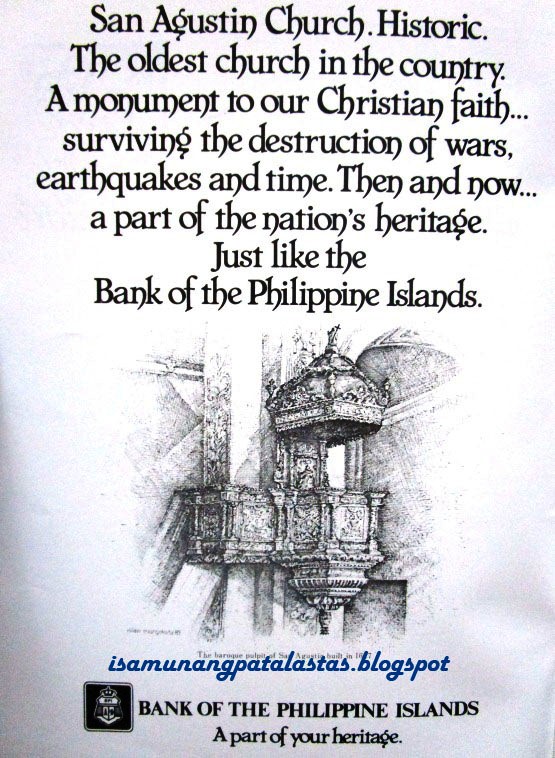
142. BANK OF THE PHILIPPINE ISLANDS, “Heritage”, 1983


In 1983, the corporate campaign of the Bank of the Philippine Islands (BPI) , which traced the bank’s rich, historic past that includes  the distinction as being the first bank in the Islands—was launched amidst much fanfare, glowing reviews and a sense of pride.

The centerpiece material was an incredible TV commercial, part of an ambitious “Heritage” campaign that brings to focus the impressive 123 year heritage of the country’s first and largest bank. SS&C Lintas Worldwide-Manila, led by creative head Richard Gerardini,  was tasked to do the campaign that took all of 6 months to plan--from Dec. 1981 to June 1982.
 
BPI GIRL NIKKI PRIETO, Now a Tarlac congressman, wife of former 
presidential candidate and former Sec, of Defense, Gilbert Teodoro.

As the commercial included many period scenes, locations were scouted all over the Philippines. The location crew went to Vigan for a look-see, but the old houses were all whitewashed and the roads asphalted, so the search shifted to the south—and thankfully, Nasugbu and Taal—old Batangas towns—were chosen. The streets were dressed up to look like Pasig and Binondo, during the 1900s American period. The featured actors, the supporting cast and the extras were all costumed by leading production designer and wardrobe expert, Laida Lim Perez.


Casting was another major challenge.  Most of the talents were recruited by Mad Gallaga (wife of film director Peque Gallaga) who assembled name stars like Joel Torre (fresh from “Oro, Plata, Mata”) and Ronnie Lazaro, to take part in the ad, along with local townsfolk who portrayed farmers, fishermen and vendors.


The casting of the BPI Girl was another matter—the agency team wanted someone who has not appeared in any magazine cover or commercial, and the client wanted an embodiment of class, chic and timeless mystique. Monica Louise “Nikki” Prieto (now Teodoro, a  Tarlac congressman and wife of Gilbert Teodoro), then an international marketing student from a Swiss university, was the final choice.  But her school schedule allowed her only 10 days of leave—so the shooting of the 60 sec. commercial couldn’t go beyond 2 weeks. Prieto was promptly sent her round-trip tickets so she could come home for the Philippine shooting.
 
ACTORS JOEL TORRE & RONNIE LAZARO, gamely joined the
TV commercial cast.
The multi-awarded Image Films, Inc., one of the most experienced and prestigious production houses in the country was given the blue chip BPI assignment. Gen. Manager Amar Gambol contacted Pio de Castro III for the directorial job.  De Castro, who had been shooting films for10 years, was mentored by National Artist Gerry de Leon. 

DIRECTOR PIO DE CASTRO III (+) . He would be honored by the
Creative Guild of the Ph. with a posthulous Lifetime Achievement Award.
His credentials not only include internationally-awarded ads (PBM Steel “A Nation is Growing”, Kodak “Times of Your Life”) but also mainstream films like “Soltero”, and “Ina, Kasusuklaman Ba Kita?”. Commissioned to compose the jingle music was no less than Jose Mari Chan.

LISTEN TO BPI  HERITAGE TVC 
"Cherished Part of Me" Jingle Here:

The filming took up to 12 days of hard work, and every single day had its own challenge. Billboards and electric wirings had to be taken down or camouflaged with tree branches and cadena de amor vines, and whole rowhouses in Taal had to be whitewashed in Taal to reflect the look of the era. 

WATCH THE BPI 'HERITAGE' TVC HERE:

A town Marian procession with lit carrozas  had to be staged. And even Nikki Prieto’s modern girl gait had to be toned down to reflect the demureness of an early 20th century Filipina. Where an average 60 sec. ad cost about Php 200,000 to produce in the 1980s, the bill for the BPI ad cost up to several times more.


But everything was worth the wait, and the laborious hours that went into the final crafting the TV ad. When BPI president Xavier Loinaz previewed the film, he instantly fell in love with it. When the “Heritage” TVC aired in early 1983, it was hailed for its epic proportions, Filipino theme, technical and production design excellence,  and a memorable tuneful score. These significant impressions were not lost in the next Philippine Advertising Congress Awards as “Heritage” won a slew of technical and craftsmanship awards.

CREDITS:
AD AGENCY: SSC Lintas: Manila
EXECUTIVE CREATIVE DIRECTOR: Richard Genardini
CREATIVE DIRECTOR: Bing Baloy
ART DIRECTOR: Olive Mestidio
PRODUCTION: Image Films, Inc.
DIRECTOR: Pio de Castro III
CASTING: Mady Gallaga
PRODUCTION DESIGN: Laida Lim Perez
JINGLE COMPOSER: Jose Mari Chan

SOURCES:ISLANDS, a publication of the Bank of the Philippine Islands, vol. 1 no. 2, “Heritage: The Making of a Commercial, by Ma. Socorro Naguit, pp. 25-28.  July 1983.

Monday, December 4, 2017

140. JOHNSON’S BABY POWDER. Early Ads, 1953-1971


JOHNSON'S BABY POWDER Print Ad. ca. 1972.

 It was only in 1956 that the American pharmaceutical giant, Johnson & Johnson, set up its Philippine office, but years before that, its flagship product, JOHNSON’S BABY POWDER was already enjoying the good patronage of Filipino mother and their babies.

It was this product that shifted the reputation of Johnson & Johnson from a medical company to a “baby company”.

Invented in 1893, JOHNSON’S BABY POWDER was made from Italian talc that had a more soothing effect than the plasters J&J manufactured earlier. Talc also provided effective relief from diaper rash. The product was a success and was launched in the market the following year.

JOHNSON’S BABY POWDER , in the familiar tin packaging, was initially imported and sold by JOHNSON’s BABY POWDER was known locally as “Talco Johnson”.

Early Johnson's Baby Powder Ad, 1953

Availability of the product improved when the local J&J office on Dasmariñas St. took over the distribution of the U.S.-made Johnson’s product. Demand was so great that J&J contracted a local trading firm, Shiro, to manufacture JOHNSON’S BABY POWDER locally, in limited supply (J&J would soon set up its manufacturing plant in Pasig).
 
JOHNSON'S BABY POWDER Ad, 1958.

Marketing efforts were also stepped up, and J&J turned to professional advertising to support the lead brand. In the next couple of years, JOHNSON’S BABY POWDER was promoted solely for baby’s use—for the effective protection of his delicate skin against rashes and chafing. 

JOHNSON'S BABY POWDER Ad, 1959.

Though the slogan “Best for Baby. Best for You” appeared in 1959 ads, the message continue to focus on babies’ complexion.

JOHNSON'S BABY POWDER Ad, 1961.

For adults, Johnson’s also launched a medicated powder that was advertised in the early 1960s, but this did not catch on.


A PAIR OF JOHNSON'S BABY POWDER 'Mom & Das" ads. 1964.

It was not until 1964 that an attempt to expand its usage to adults was made in subsequent campaigns with reference to JOHNSON’ S BABY POWDER’s gentleness as “best for baby, for you”.
 
JOHNSON'S BABY POWDER Ad, 1968.

It would only be later, in the 70s and 80s, that ads targetting specific audiences i.e. other than babies-- like adults and youths—were produced to create broader appeal, by taking out the “baby-ness” from JOHNSON’S  BABY POWDER.

"Ikaw Lamang, Wala ng Iba" was one such campaign that was created by agency McCann-Erickson in the 1980s, which featured the product being used by teens.

WATCH JOHNSON'S BABY POWDER 1980s AD HERE:

SOURCES:
youtube, Johnson's Baby Powder TVC 'Wala nang Iba" TVC 1980s, uploaded by Jackie Arjona, published 6 Nov. 2010.https://www.youtube.com/watch?v=FyNLWgQ9HGs
Johnson & Johnson Philippines website

141. Creative Guild Print Ad of the Year 1987: VISINE EYEDROPS, “Visibly Refreshing”

UNMISTAKABLY OPTICAL. VISINE EYEDROPS, "Visibly Refreshing" 1987
Ace Compton, now officially known as Ace/Saatchi & Saatchi, scored its third Print Ad of the Year victory in 1987 with “Visibly Refreshing,” an ad for a mini-pack version of VISINE, Pfizer Philippines’ popular eye drops. “Visibly refreshing” had been running as a campaign for some time, and long-time client Pfizer, had wanted to use the brand name to sell the new 6 ml.  budget version. Client originally planned to use a predictable parade of progressive bottle sizes, but CD Jimmy Santiago and his concept team had other ideas.

The search for an “unmistakably optical device,: was conceived by art director, Ariel Dalisay.  Copywriter Robert Labayen lent his copy expertise, which Dalisay laid out over an entire page--jumbling and arranging the letters like those of an eye chart, commonly displayed in doctors’ offices.

Starting with a huge “A” at the top of the “chart” , Dalisay punctuated it with a shot of the product being peered at from under a small magnifier. Additional info copy—“Get a pack from this store”. “In tamper-resistant packs, too.”, and the battlecry “VISINE—Gets the red out in 60 seconds”—all fit satisfactorily into the full page, full color ad-cum-outlet poster without distracting from the intently recognizable visual device.

“That was the big idea”, Santiago recalls. “The eye chart for an eye product—the connection was almost seamless.”

VISINE stayed with Saatchi for several years after the ad was run.

CREDITS:
AGENCY: Ace/ Saatchi & Saatchi
ADVERTISER: Pfizer, Inc.
PRODUCT: Visine Eyedrops
CREATIVE DIRECTOR: Jimmy F. Santiago
COPYWRITER: Robert Labayen
ART DIRECTOR: Ariel Dalisay

SOURCE:
Perfect 10: A Decade of Creativity in Philippine Advertising, written by Butch Uy. Published by the Executive Committee of the Creative Guild of the Philippines. 1995.p. 24.

Thursday, November 23, 2017

139. Where Are They Now? THE UYTENGSU CHILDREN of Alaska Milk Products

THE 3 MODEL COO's (Children of Owner) Michael, Candice, Wilfred Jr. Uytengsu

Fred Sr. & Bonnie Uytengsu
The ALASKA MILK empire was begun by a Wilfred “Fred” Uytengsu Sr, who had grown up separated from his family for part of World War II. As a teen, he did forced labor for the Japanese under grueling conditions, such that he contracted malaria, and was sent home. After the war, his godfather, Robert Williams, sponsored his  studies in the U.S. and at 16, Uytengsu began an industrial engineering course in Stanford.

 After graduation, the young engineer began a career in the food industry, and in the late 1950s, he established the General Milling Corp., a flour mill business that became so successful that he ventured into other businesses—including livestock, feeds, and dairy. Thus in the 1970s, ALASKA MILK was born.

ALASKA MILK became the a leading name in the Philippine milk industry, moreso when it began  rolling out its advertising campaign in the mid 70s. What made the ads more memorable was the presence of the three Uytengsu children in the ads produced by ALASKA’s ad agency, Reach  Inc. The three children—Wilfred Steven, Candace and youngest Michael were the children of Wilfred Sr. with Bonnie Brooks, an embassy official assigned at the U.S. Embassy in Manila.


Youngest Michael Uytengsu is best remembered as the young boy in the 1974 ALASKA MILK TV commercial, in a basketball duel against Cisco Oliver. (Read the article here: Michael Uytengsu, Alaska Boy) He also was featured in the packaging of the short-lived ALASKA Quick Cooking Oats.


Candice or Cindy  Uytengsu, was the featured model in the Daisy Reconstituted Long Life Milk line, punctuating the commercial with her saying “Pick a daisy. It’s healthy..naturally!”. Her mother, Bonnie, made a cameo role in the launch commercial.


The eldest, Wilfred or simply Fred Uytengsu, appeared in a corporate Christmas Ad of ALASKA MILK, in 1975, along with his siblings.  He was just 14 at that time.

Over the years, Fred Sr. traveled between the Philippines and California, as the three kids grew up in Atherton, California, close to the Stanford University Campus. Fred Sr. would live to see ALASKA MILK CORP. flourish and become an icon brand in the Philippines, He would turn over the reins of the business to his son Fred Jr, in 1998, He died in 2010, at age 82. The three children are all American citizens.

SOURCES:
Picture of Wilfred and Bonnie Uytengsu: “Honoring an Engineer’s Journey”, http://giving.stanford.edu/stanford-benefactor/stories/uytengsu-teaching-center
Picture of Wilfred Steven Uytengsu Jr.
Picture of Michael Uytengsu: www.tuskestates.com

Thursday, November 16, 2017

138. THE MAKING OF CLOSE-UP TOOTHPASTE “Close To You” MTV AD, 1987-1988


The Philippines caught the Music Television (MTV) fever in the 1980s, which used music videos presented by by video jockeys or VJs. The creatively-produced videos used early computer techniques, quick, out-of-synch editing, spliced with mood footages and unrelated visuals—a fresh look that appealed to the young generation of that time.

"You'll never look at music the same way again"—the 24 hour MTV channel proclaimed—and it delivered that promise, building a world-wide fanbase while exerting significant influence on its audience.

Ad agencies took note of this—and Lintas: Manila—sold the bold idea of using MTV style ads for Philippine Refining Co.’s CLOSE-UP TOOTHPASTE, which is positioned as the toothpaste for  young Filipinos. Maria Lourdes “Diame” Alba, the woman behind this concept, relvealed that the use of an MTV-style commercial to relaunch the gel toothpaste that has been in the market since the early 70s, was an experiment in breaking out from the mold of youth advertising.


Since it was difficult to present the MTV imageries using a traditional storyboard, the Lintas creative opted to make a rough video using past CLOSE-UP footages edited with computer effects, using Gwen Guthrie’s reworked “Close to You” song.The ideas was met with the PRC marketing team’s approval, then headed by Peter Dart and Angie Lacson.

Lintas: Manila then assembled a creative production team headed by Director Jun Reyes to produced the longest commercial in history: 2 minutes and 17 secs.—a fanciful, a little irreverent, a bit amusing and a romantic music piece—that was promoted a a TV event. When the CLOSE-UP “Close to You” ad unfolded on Philippine TV in early 1987, the MTV was met with amazement  and acclaim, with many thinking it was a slick, foreign material.  Teeenrs went agog over the commercial, and college-age students lapped it up, and the ad became a marketing case study in schools.

WATCH THE CLOSE-UP “Close to You” MTV Ad here:
Published by ALGLecaroz, 18 Sep. 2011

 Since then, Lintas:Manila have produced 3 more MTV style commercial versions—“Closer to your Love”, by Al Jarreau and “When I Fall in Love” (1988)  by Natalie Cole. 

WATCH CLOSE-UP "When I Fall in Love" TVC  1988 Here:

A local recording company packed a CD selection of love songs entitled CLOSE-UP Love Songs”,  inspired by the campaign. The CLOSE-UP ad also won a slew of Gold trophies at the 1987 Philippine Advertising Congress,winning for Best TV, Personal Products; Best in P.O.P. and Collaterals; Best in  Production Design; Best Multi-Media Campaign.

CREDITS:
ADVERTISER: Philippine Refining Co. (PRC)
PRODUCT: Close-Up Toothpaste
AGENCY: Lintas: Manila
CREATIVE DIRECTOR: Diame Alba
ART DIRECTOR:  Jo Chua/ Nap Jamir
PRODUCER: Bong Malsi
PRODUCTION HOUSE: Unitel
DIRECTOR: Jun Reyes
DOP: Boy Yñiguez
PRODUCTION SUPERVISOR: Art Dumaup
ANIMATOR: Pete Jimenez

SOURCE:

De la Torre, Visitacion: Advertising in the Philippines, Tower Book House, 1989.
youtube: "When I Fall in Lovewith Closeup", https://www.youtube.com/watch?v=r8POi1N5P8w, Uploaded by Closeup Philippines, 2011 Nov. 20
youtube, #1 Closeup,  https://www.youtube.com/watch?v=r8POi1N5P8w&t=30s, Uploaded by ALGLecaroz, 2011 Sep. 18

Wednesday, November 8, 2017

137. FRANK H. HALE: THE MAN BEHIND ESCO SHOES, The Shoe of Quality, 1929

Reprinted from the Frank H. Hale Permanent Collection Brochure, presented by the American Historical Collection.


FRANK H. HALE Old timer, industrialist, and friend 
of the Filipino people
At the time of his death in Manila in 1952, pioneer shoe manufacturer of the Philippines, Frank H. Hale (b. Aug. 30, 1872) was called “Friend of the Filipino People.” He was also known as “Mang Isko” by millions of Filipinos, who gave him this nickname in appreciation of his contribution to Filipino life. His vision was that every Filipino replaced his or her chinelas with a pair of sturdy, stylish, and affordable shoes.

The brand ESCO became a household word, and its shoes were soon being worn even in remote areas of the Philippines. Mr. Hale became the largest exporter of shoes to the U. S. and Europe. At the outbreak of WWII, Esco was the largest manufacturer of shoes in the Philippines and, according to some economists, possibly in the whole of Asia.

1929 ESCO PRINT AD, from Graphic Magazine.

From humble beginnings as a volunteer cobbler with the U. S. Army aboard one of the American ships sailing to the Philippines in 1898, followed by his setting up shop in Fort McKinley under the auspices of General Pershing, Hale built what became Esco.

1929 ESCO PRINT AD, from Graphic Magazine.

Having grown up on a wheat farm in California that suffered from a wheat market disaster in the U. S., he was determined to create something needed in the Philippines to last for generations to come and to be a stable organization staffed by Filipinos for Filipinos.

1929 ESCO PRINT AD, from Graphic Magazine.

Reinvesting all profits made, he turned the cobbler shop into a modern industry. He arranged for machinery, backed by royalties, to be brought from United Shoe Manufacturing in Boston, Massachusetts, and imported the finest leathers from the U. S., Italy. Argentina and Australia, to manufacture fine shoes capable of competing worldwide in terms of style and strength.

1929 ESCO PRINT AD, from Graphic Magazine.

ESCO became the manufacturer for leading brands in the U. S. and Europe, as well as the contractor for military and industrial shoes in the Philippines. Manpowered by 100% Filipino skilled workers, ESCO became a model corporation where employees were given housing, medical, social and sports facilities. Employees’ families thrived, and some opened up their own businesses backed by ESCO resources.


1929 ESCO PRINT AD, from Graphic Magazine.

Hale then experimented with Philippine materials, opening Tropicraft Corporation, which experimented steel and plastics to increase the strength and life rattan furniture. His admiration of the Philippines led him to call it the “Land of Promise, Opportunity.” He was included in Who’s Who with other leaders of agriculture and industry in the Philippines.He also opened Lyric Music House, bringing in the finest musical instruments from abroad for the tastes of talented musicians of the Philippines.

1929 ESCO PRINT AD, from Graphic Magazine.

During WWII, the Japanese military government confiscated the factories and turned them to their own uses. Mr. Hale was interned in Santo Thomas where he helped sew up older co-interns’ shoes. Reconstruction after the war meant adjusting to new conditions within the new Philippine Republic. He was weak by then but nevertheless
returned to success but on a smaller scale.

The exhibit features Mr. Hale’s personal belongings, generously donated by his granddaughter Ruth Hale Cobb Hill to the American Historical Collection.

SOURCE:
American Historical Collection: http://rizal.lib.admu.edu.ph/ahc/pg_exhibits.htm
Various Graphic Magazines from 1929

Friday, November 3, 2017

136. Brand Icon: TITA FRITA of Tita Frita Banana Catsup 1989


1989 TITA FRITA CATSUP AD, with the wholesome Rita Avila.

As Nestle’s Tita Maggi was winding down her reign, another “tita” appeared on the ad scene as the brand name for a condiments line by Zest-O Corporation. TITA FRITA included bottled tomato and banana catsup, and hot sauce.

To launch the new products, the company created a brand character in the mold of Tita Maggi—wearing a chef’s hat, an apron over a colored shirt.

They found the image of TITA FRITA in Rita Avila, then a 24 year old actress with 2 years of showbiz experience under her belt. She had dabbled in commercial modeling in her teen years, and no one knew at that time that her career was about to soar with her appearance in so-called "ST" films, with soft core content.

Surprisingly, the wholesome TITA FRITA character took off when the ads aired, and so did Avila’s rise to stardom as a sexy, and later as a dramatic actress.

Today, TITA FRITA is  no longer as extensively advertised (now sold as institutional products). However, Rita Avila, aka TITA FRITA, continues to enjoy her showbiz career to this day, on both the TV and film screens.
.

SOURCES:
Tita Frita Photo Source: Mr. & Ms. Magazine, 1989.