Saturday, January 28, 2023

410. Brand Stories: DR. WEST’S TOOTHBRUSH, Philippine Ads 1929-1961

AN EARLY 1929 DR. WEST'S TOOTHBRUSH Print Ad, Graphic Magazine

DR. WEST’S –a name that originated from West Products Company--became a byword in dental hygiene when, in 1938, the company introduced the world’s first nylon toothbrush—the DR. WEST’S Miracle Tuft Tootbrush. But the globally popular brand was already in existence since 1921,  when the Chicago-based company, launched its DR. WEST’S Toothbrush with the health curve, that follows the curved angles of the mouth for better cleaning. These toothbrushes and their subsequent variants were known and sold  as WESCO Products.

1924 DR. WEST'S with Health Curve

Less than a decade after its introduction, DR. WEST’S Toothbrush brands were being sold in the Philippines, available at local druggists. These early toothbrushes were still being made with ”choice, carefully-selected bristles” from animal hair, like boars and pigs.

1929 DR. WEST'S TOOTHBRUSH Philippine Ad

The West Products Company changed all that in 1938, when it launched the orange coloured, medium size, Dr. WEST’S Miracle Tuft Toothbrush. Originally released in February 1938, this toothbrush was the first successful commercial application of nylon, marketed as the DuPont 'Exton' bristle.

DR. WEST'S GERM-FIGHTER AD, 1959

In October 1938, the West Products Company, Chicago rolled out  an intensive national advertising campaign for its new toothbrush with the Dupont-made synthetic bristles. The ads communicated 4 benefits:  ‘No bristle shedding, 100 percent waterproofed, longer life, greater cleaning power.’ The value of oral hygiene was underscored when DR. WEST’S Toothbrushes were included in the personal kits of soliders  who served during World War II.

DR. WEST'S Color Ad, 1961

When WECO's exclusive franchise with Dupont  on the use of the bristles expired in 1940, other manufacturers began to make nylon bristled toothbrushes. By the 1950s, almost 80% of all toothbrushes had synthetic bristles. DR. WEST’s Tootbrushes were advertised until the 1960s in Philippine magazines.  The 1961 colored ad played up on the different color handles available to make brushing with the germ-fighting DR. WEST’S Toothbrush more fun and appealing.

There is no information available about the closure of the West Products Co. business,  Today, there are Dr. West (not West’s) toothbrushes being made in China and Oman, but these are not in any way, connected with the original DR. WEST’S Toothbrush of West Products Co.

SOURCES:

1924 Dr. West’s print Ad, ebay.com

Dr. West’s ad,  Life Magazine ,Nov. 21, 1938 issue.

History of the Modern Toothbrush, by White Dental Studio | Oct 12, 2015 |, https://mywhitedental.com/toothbrush-history/

Friday, January 13, 2023

409. CALUMET: The Double-Acting, Better Baking Powder, 1956-1960

1950s CALUMET PRINT ADS, with endorsers Gloria Romero and Lolita Rodriguez

One of the most popular baking products in the world with the most recognizable packaging is CALUMET Baking Powder. Chicagoan William Monroe Wright, with partner chemist George Campbell Rew, formulated a revolutionary, double-acting baking powder in 1899 that replaced cream of tartar with aluminum phosphate and also included dried egg whites.

The product was christened CALUMET, after a French-derived word for a Native American ceremonial pipe. It was also the name given to the land that would give rise to Calumet City, Illinois. The red, black and white CALUMET tin canisters featured the stylized profile of an Indian wearing a feathered war bonnet. To this day, this iconic packaging remains unchanged.

1956 CALUMET AD, Baked Desserts

1956 CALUMET AD,Baked Desserts

The success of CALUMET prompted Wright to put up his CALUMET Baking Powder Company  until it was acquired by General Foods in 1929..

CALUMET RECIPE ADS, 1957

CALUMET Baking Powder became available in the Philippines in the 1950s, when Filipino women discovered the joys of baking in modern ovens. It was heavily advertised in 2-color ads in leading magazines, using movie celebrities like Gloria Romero and Lolita Rodriguez as endorsers. Ot was promoted along with Swans Down Cake Flour, another General Foods product.

FILM STAR GLORIA ROMERO FOR CALUMET, 1958

LOLITA RODRIGUEZ CALUMET AD,1959

GLORIA ROMERO FOR CALUMET, 1958

In 1990, General Foods merged with Kraft Foods. The company grew even bigger when, 2015, Kraft Foods  merged with H.J. Heinz Co. It continues to produce and market CALUMET Baking Powder today

1960 VINTAGE CALUMET ADS

SOURCES:

The Kraft Heinz Co., https://www.kraftheinzcompany.com/

Calumet, on Wikipedia: https://en.wikipedia.org/wiki/Calumet_Baking_Powder_Company


Saturday, January 7, 2023

408. Before Mineral Water Became Commonplace, there was AGUA DE CARABAÑA, 1978, 1990 Ads

AGUA DE CARABAÑA Ad, 1978

There was a time that bottled mineral water was a rare sight in the Philippines. Imported brands like Evian were looked at as status symbols of high society people, who carried the small, green bottles to outdoor and sports events like they were flaunting their Rolexes and Vuittons

But long before we were introduced to mineral water in PET bottles, Filipinos in the peacetime era were discovering the many health benefits of AGUA DE CARABAÑA, mineral water in clear glass or aqua bottles, from the Carabaña Springs of Spain. The water was believed to have curative and medicinal properties that it was soon being commercially bottled in the early 20th c. to America and Europe. AGUA DE CARABAÑA then was available only in boticas and farmacias in the Philippines and was used to cure all sorts of ailments--from kidney problems, stomach ills and even as an abortifacient!

AGUA DE CARABAÑA Ad, 1990

In the 70s, AGUA DE CARABAÑA was distributed by PhilUSA Corp., an importer based in Pasig. The water came in colored and clear  bottles with the familiar Agua brand name in relief. The brand was marketed professionally, supported by print advertising. However, it continued to be sold as medicinal water that “works wonders for you, inside and out”, with laxative and antiseptic properties to clear skin and maintain digestive health.

OLD AGUA DE CARABAÑA COLLECTIBLE BOTTLES

Today, mineral water is so commonplace in the Philippines—there are scoresof brands with fancy names to choose from,  readily available from supermarkets, convenience, and neighborhood sari-sari stores.  AGUA DE CARABAÑA has since become obsolete after the ‘90s, its name and history forgotten--but that’s water under the bridge.

SOURCE:

Castro, Alex. flyandflea.blogspot

Tuesday, January 3, 2023

407. ZENCO FOOTSTEP: We Shoe The Philippines, 1983

ZENCO FOOTSTEP CORPORATE AD, 1983

The shoe store that boomed in the 80s and 90s selling such brands as Mighty Kid, Islander and Kaypee, started back in 1957 as Zenco Commercial (ZENCO) , a distributor of footwear founded by Yao Khapu. From a tiny store in Binondo, and later in Caloocan, Khapu moved to Divisoria to open his  first ZENCO FOOTSTEP on 26 May 1961. A strong marketing network propelled ZENCO FOOTSTEP’s business, pushing its diverse footwear and shoemaking products in major markets  nationwide.

 WATCH A 1991 ZENCO TVC HERE:
Courtesy: RoofDev Studios

When ZENCO partnered with Rubberworld Philippines in 1981, business grew even more, and soon ZENCO FOOTSTEP became the place to go for Rubberworld products that became hugely popular with the young and sport set, including Grosby, Adidas, Spartan sandals, Kaypee, Dockmaster, Mighty Kid shoes and fashions.

The closure of Rubberworld due to the financial crisis, the pull-out of Addias, and the renewed effort of SM stores to regain its foothold of the footwear business by building its giant malls  in 1990s, put a halt to ZENCO’s amazing run. Through all these, ZENCO FOOTSTEP remains in business today—more modest, but still viable-- in a few, but choice locations nationwide.

 SOURCES:

Zenco Footstep weebly: http://zfootsteps.weebly.com/about-us.html

 A short history of Zenco Footstep, https://www.esquiremag.ph/long-reads/features/zenco-footstep-history-a00289-20220615

 Zenco Footstep TVC (1991) (Effects and footages), https://www.youtube.com/watch?v=QNjf5jvpIrg, Uploaded by RoofDev Studios


Thursday, December 29, 2022

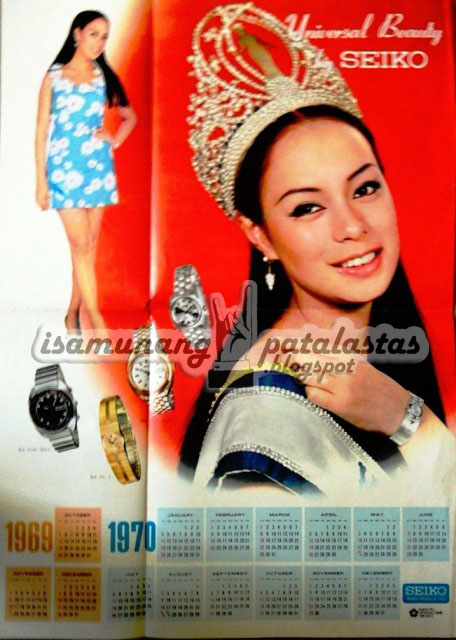
406. Miss Universe 1969 GLORIA DIAZ: Universal Beauty Calendar Insert, from SEIKO, 1970

GLORIA DIAZ , IN A SEIKO CALENDAR GIVEAWAY, 1970

One of the favorite giveaways of companies during Christmas and the New Year are calendars—chosen for their practical use, and for decorative purpose. Indeed, SEIKO WATCHES made sure their premium calendar—given free as an insert in magazines---will be most appreciated, as the company tapped the year’s reigning Miss Universe 1969, 18 year old  Gloria Aspillera Diaz, to grace the one-sheet calendar. Diaz was hailed as the very first Filipina Miss Universe, and went on to become a successful actress and showbiz personality.

SEIKO, the Japanese company that made quality  watches, clocks, and timepieces, was founded in 1881 by Kintarō Hattori in Tokyo.  SEIKO  has distinguished itself as the most dependable, innovative (the company was one of those that launched the first quartz watches in the world)  and durable brand of timepieces in the market.

 SEIKO WATCHES were already available in the Philippines in the late 1960s, with many service centers nationwide. Today, they are sold by Seiko Philippines is a Filipino-owned corporation designated as the  authorized seller and service center of Seiko Watch Corporation in the country.

Friday, December 23, 2022

405. HAVE A SANYO CHRISTMAS! Corporate Ad, 1975

SANYO CHRISTMAS PRINT AD, 1975

SANYO Electric Co., Ltd., is a Japanese electronics company founded in 1949 by Toshio Iue, who grew it to become a Fortune 500 Japanese Electronics Company. SANYO means “three oceans”- referring to the Pacific, Atlantic and Indian oceans, as it was Iue’s ambition to make his business global.

In 1971, SANYO established international operations in the Philippines , thus SANYO Philippines Inc. came to be. It manufactured home appliances and consumer electronics—from air conditioners, refrigerators, radios, televisions, gas ranges, electric fans, and washing machines, that were marketed worldwide.

SANYO LOGO, 1976. Source: wikimediacommons

SANYO became a very popular brand in the Philippines in the mid 70s thru the 80s, as it was considered more affordable than the established Japanese brands like Toshiba, Panasonic and Mitsubishi, that is until Sharp Phils.came along.

With a booming business in 1975, SANYO greeted its growing legion of customers by putting out ots Christmas corporate ad, wishing them a happier life, that could only happen if one start buying their products now.

In 2011, the Haier Group acquired SANYO Electric Co.’s white goods business (refrigerator, washing machine, and consumer electric appliances) in select Asian markets like  Indonesia, Malaysia, Vietnam, and the Philippines. These are what SANYO Philippines Inc. continue to market, promote and advertise  today, online and in-store.

SOURCES:

Sanyo logo: wikimediacommons.

Sanyo website: https://www.sanyo-av.com/us/

Haier  completes acquisition of Sanyo brands in Southeast Asia:  https://www.haier.com/ph/about-haier/news/20190912_105720.shtml


Friday, December 16, 2022

404. Is That Who I Think She Is? LULETTE MORAN for BON-AMI Polishing Cleaner, 1974

LULETTE MORAN FOR BON AMI CLEANSER, 1974 Print Ad

Not all eyes were on Maria Margarita Moran when she reigned as 1973 Miss Universe; TV viewers were also transfixed with the sight of the pert and pretty model of a new HALO Shampoo TV commercial, a Colgate-Palmolive product that aired just later in the year.

THE MORAN SISTERS, MARGIE & LULETTE

The model was LULETTE MORAN, the equally beautiful younger sister of Margie, who charmed us when she playfully transformed her hair—and her character-- using shampoo suds. “I’m a wabbit!” Lulette purred in the shower, with rabbit ears made from HALO foam, sticking out from her head. That shot of her would give her wide recognition, paving the way for more commercial projects and career opportunities. Unfortunately, no print of this TV ad exists.

MORAN, model of  HALO SHAMPOO

In this rare 1974 print ad, MORAN is the lovely endorser for BON AMI Polishing Cleaner,  an iconic cleaning brand manufactured back in the 1880s in Connecticut. In 1971, Bon Ami was purchased by the Faultless Starch Company, and found its way to the Philippines. BON AMI, was recommended for appliances, and kitchen cookware because it cleans without scratching.

Despite MORAN’s endorsement, BON AMI floundered because Ajax and Dutch Cleanser were unshakeable in their dominance.  With all her advertising exposure, it is the HALO Shampoo commercial that remains identified with her.

MORAN put her U.P. education to good use by joining Bancom, and later Jardine Davis. It was in one company social in Hong Kong that she met French-English Philip Monbiot, an Oxford graduate. She wed Monbiot and settled in Singapore, where her husband ran a cocoa trading business. They have 3 children Natalie, Charles and Edward, and are settled in  Kensington, London.

 SOURCES:

Bon Ami: https://en.wikipedia.org/wiki/Bon_Ami / Halo Shampoo photo: ebay.com

Woman’s Home Companion Magazine

Butch Francisco, Lulette Moran after her halo days. https://www.philstar.com/entertainment/2002/09/05/174755/lulette-moran-after-her-145halo-days146