When couple
Dr. Ernesto and Alegria Sibal started selling American books from a one-table
store in 1945, little did they know that their business would grow into “the biggest and most modern bookstore in the
Far East” in the 50s and 60s. Their
bookshop—ALEMAR’S was derived from Mrs.
Sibal’s name—ALEgria, and the first given name of the Sibal daughters, MARia.
VISIT ALEMAR'S, 1975 AD
ALEMAR'S, in its heyday, had its main store on Rizal Avenue and branches in Ermita,
Recto, Quezon City and Makati. It ventured into printing and publishing
in 1950, through its Phoenix Press and Phoenix Publishing House.
DOVER & SUNSET BOOKS, 1978 AD
BY 1975, ALEMAR'S WAS EVEN SELLING KIDDIE CLOTHES!
ALEMAR’S carried more than just books—local, imported,
textbooks, used books-- it also sold school
and office supplies, toys, men’s, ladies’ and children’s wear, home
accessories, magazines and more. Central Book Supply, a division specializing
in law books, was also put up. With more aggressive competition from National
Bookstore and with heirs leaving for the U.S., ALEMAR'S started closing its
shops in the 1980s.
SOURCE: “The
Alemar’s Story”, 1961 Philippine Business Progress Report, pp. 24-25.
AVENUE beverageswere manufactured in the 1950s by
Avenue Aerated Water Co.,in Grace
Park, Caloocan. This 1956 print ad lists 6 tasty Avenue flavors: Red Berry,
Orange, Sarsaparilla, Cream Soda and Pineapple. Avenue sold for 10 centavos per
bottle and remained available all through the 60s.
SOURCES:
Avenue Beverages & Soda Bottle, courtesy of Siglo Antiques & Collectible
The story of El Porvenir Rubber Products Inc., more
popularly known as ELPO (diminutive
of El Porvenir St., “the future”, in Spanish, and the company address) is the story of Don Tomas Geronimo, father of
the rubber shoe manufacturing industry n the Philippines, who established the
industrial enterprise in 1933.
ELPO FOOTWEAR CHRISTMAS AD, 1933
Don Tomas engaged in the importation and exportation of flour
and sugar in the 1920s, and from this humble beginnings in Herran, he grew the
business by leaps and bounds,
Upon his death in 1940, his son Carlos took over, until the
company suffered great financial losses when the war came and destroyed the
factory and machines.
ELPO AD, 1956
In 1946, Carlos Geronimo rebuilt the business, producing
2,000 pairs of rubber shoes a day. By the start of the 1960s, ELPO shoes were being produced at the
rate of 4,000 pairs daily. When it
opened its 13,000 sq.m. Caloocan compound, Elpo was regarded as the biggest and
most modern rubber shoe factory in the Philippines with over 500
employees. Its company compound stood on
a 14,000 sq. m. lot in Grace Park.
ELPO AD, 1956
ELPO Shoes became
very popular nationwide by the 50s and all through the 60s. The company was
awarded the “Rubber Show Manufacturer of the Year 1950”.
SOURCES:
Article previously appeared in short form in FilipiKnow and spot.ph (used with permission)
“Porvenir Rubber Products, Inc.”1961 Philippine Business
Progress Report, p. 66
GOLDILOCKS, the old and the new, 1986 and current brand visual identity
In the mid 60s, anyone wishing to enjoy an
honest-to-goodness slice of cake for a meatime dessert or a mid-afternoon treat
had to wait for mother’s free time to bake one.
EARLY GOLDILOCKS MASCOTS, Source: Goldilocks website
In the Leelin clan, three young housewives’ favorite pastime
was baing cakes and pastries. Encouraged by the mounting orders from relatives
and friends, their hobby evolved into a small enterprise. On May 15, 1966, a
modest store was opened by sisters
Milagros Leelin Yee and Clarita Leelin Go, with sister-in-law Doris, in a small
space in an unpretentious apartment row on Pasong Tamo, Makati.
1985 GOLDILOCKS 20TH ANNIVERSARY PRINT AD
A third sister, Maria Flor, suggested that they name the
enterprise "GOLDILOCKS”,after the fairy tale character. The intention
was to make it easier for children and their mothers to remember the bakeshop's
name, and also because it suggested luck and prosperity. The store was manned
by a staff of 5, who took turns in shaping dough, filling in shopping bags and
loading goodies for deliveries. In time, the name GOLDILOCKS was associated with “home-baked” confections and
pastries , and when one wanted cakes, one thought of GOLDILOCKS.
1990s GOLDILOCKS BRAND CHARACTER
A GOLDILOCKS
image was created in the mid-1980s with the help of the store’s ad agency—a
standing figure of a girl with golden locks. In the mid-1990s, an industrial
design agency streamlined the character, using just GOLDILOCKS' face and a unique font specially created for the GOLDILOCKS brand name.
The character was
altogether dropped, and now, the GOLDILOCKS
shop is represented by its monogram G in script, encased in a circle of
turquoise shade.
SOURCES:
Adapted from Goldilocks 20th Year advertorial, “Your Good
Taste Made It Happen”, Sunday Times Magazine, 11 May 1986.p. 23.
One of the more popular brands of electric fans in the 1980s
were made by 3D Industries Inc., the
manufacturing arm of Northern islands Co. Inc. (NICI)which started as a pioneer
home appliance marketer and distributor in the Philippines, back in 1957. Founder
Mr. Francisco Guy, grew it from a modest
business selling buttons for the local market.
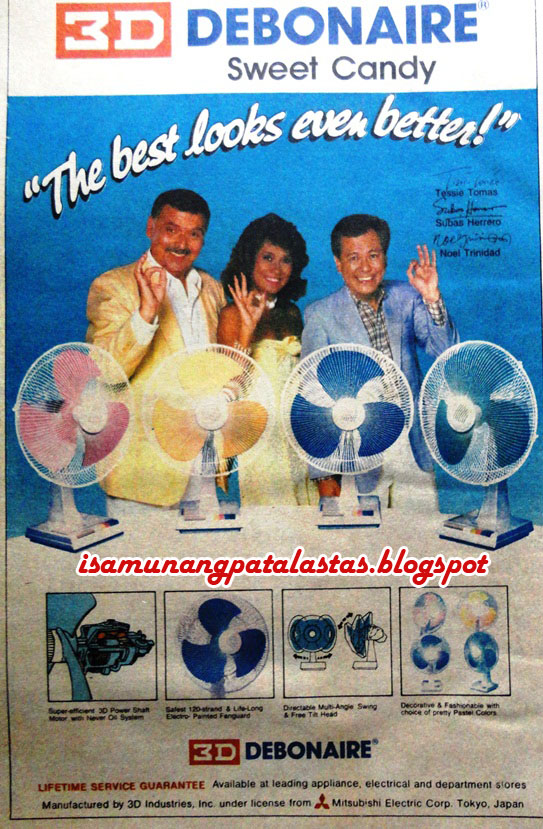
3D DESK FAN AD, 1990, featuring Subas Herrero & Noel Trinidad
His small enterprise really took off when he received an
exclusive contract with Mitsubishi Electric Company Ltd., which signalled the
beginning of his electric fan product
line. The "3D" brand of
electric fans, made under license from Mitsubishi of Toyo, Japan was sold across
the nation for more than 30 years.
WATCH THE 3D ELECTRIC FAN TVC, 1987, Champoy Duo
3D was heavily
supported with tri-media advertising, featuring popular local TV and movie
stars like the Champoy gang (Subas Hererra, Noel Trinidad, comediennes Tessie
Tomas, Nanette Inventor, Dely Atay-atayan and actress Nida Blanca. Some of the
jingles that accompanied the ads are still recalled today, reworked from traditional Pinoy folk songs.
3D DEBONAIR AD, 1987 featuring Subas Hererra, Noel Trinidad & Tessie Tomas
When the contract with Mitsubishi expired, Mr. Guy continued
to manufacture and market quality home appliances under the brand - "3D". The 3D line of appliances include Desk
Fans, Oval Oscillating Fans, Stand Fans. Industrial Fans, Box Fans,Tower Fans,
Wall Fans, Air Coolers, Ceiling Fans, Air Circulators, Ventilating Fans, Mini
Fans. It also carries Kitchen Mates—assorted home and kitchen appliance—from
coffee makers, deep fryers, gas stoves, electric ovens, slow cookers, electric
grills, flat irons, and many more. No wonder, 3D is known through generations
for “the quality you can trust”.
Miss RP 1973, Miss World '73 1st Runner up, EVANGELINE PASCUAL for RIVLENE
Orani-born Evangeline Louise A. Pascual was just 18 when she
was crowned Miss Republic of the
Philippines 1973. She went to the Miss World pageant in Londonand placed 2nd after a tie with
Miss U.S.A.. Marjorie Wallace was broken by American actor and judge, Gregory
Peck. However, after a few months, Wallace was stripped off her title for
failing to meet her contractual obligations.
Miss RP Vangie Pascual with Miss World 1973 (dethroned) Marjorie Wallace, U.S.
The Miss World crown was then offered to Pascual, being the
1st runner-up, which she refused as she had already began a more
lucrative showbiz career by then. She had previously appeared in corporate
sponsor ads like RIVLENE Fabrics, 100% polyester double-knit materials, manufactured by Riverside Mills Corp. in
Pasig. The company was plagued with labor problems in the 1980s, until it
ceased it sold its assets and ceased its operations.
RIVLENE was a major contest sponsor of Miss RP 1973.
Pascual also appeared in a n obligatory print ad for another
major sponsore, KOKURYU Cosmetics, manufactured by Cherry Laboratories Inc.,
under license from Kokuryu-do Co. Ltd of Tokyo, Japan, established on February
1965. Kokuryu attained a measure of popularity in the Philippines and actively
advertised on Philippine television, and continues to operate in the
Philippines today.
VANGIE PASCUAL for KOKURYU COSMETICS, 1974
From ads, Pascual progressed to movies, playing lead roles
alongside Fernando Poe Jr., Joseph Estrada, and Ramon Zamora. She was married
to J. Anthony B. Lapid of Guagua, with whom she had a son, Niño Antonio, a
U.S.-based artist. Evangeline Pascual continues to remain active in media and
the arts as a radio host, presenter, and is a Distinguished Toastmaster (DTM)
at Toastmasters International.
The 7-UP“Where There’s Action” campaign was launched in 1965, by J. Walter Thompson, bannering the message that the drink has a “taste
that’s fresh and frisky….with a quick-quenching action to make thirst quit!”
The print ads featured young, active groups engaged in all kinds of fun, sporty
and leisurely activities.
LISTEN TO 7-UP'S 1965
'WHERE THERE'S ACTION' JINGLE:
In 1966, the U.S. campaign was adapted in the Philippines
using local talents , but keeping the global design template including the
typeface, copy, and visual vignettes. The Philippine version however, emphasize
more on the bright, exhilarating feeling that comes with the refreshment that 7-UP brings in these action-packed
social events.
7-UP PHILIPPINES, 'SKATING', PRINT, 1966
7-UP PHILIPPINES, 'JERKING', PRINT, 1966
7-UP PHILIPPINES, 'DRUMMING', PRINT, 1966
7-UP PHILIPPINES, 'TUG-OF-WAR', PRINT, 1966
“Where There’s Action” campaign was used until 1967, and the
last few ads made use of American models possibly also provided for by the U.S.
mother agency. The 7-UP campaign was
later replaced by the world-fampus “UnCOLA” campaign that became a blockbuster
success for many years.